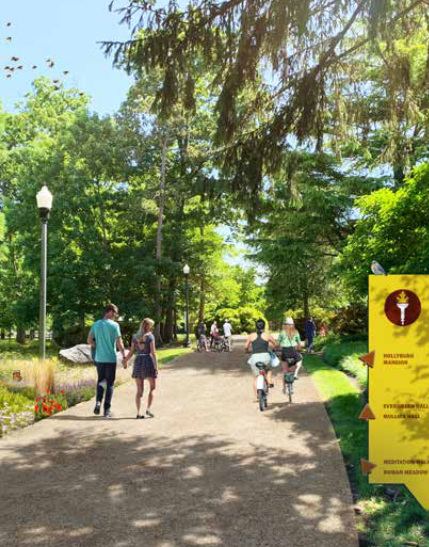
Rowan University’s impact on it’s surrounding area can’t be understated. Whether it’s gentrification fundamentally changing the way businesses and residents live their lives, or the influx of new students skyrocketing population growth, Glassboro wouldn’t be what it is today without it.
However, Rowan’s impact extends far beyond Glassboro’s economic growth. Rowan’s recent growth comes with a greater environmental footprint.
“This is the classic question of environmental debates,” said Garret Broad, Provost’s Fellow for Sustainability here at Rowan. “Can there be a sustainable economic growth? Can there be green growth?”
Rowan’s campus isn’t completely environmentally destructive. Sarah Wright, an Associate Teaching Professor in the Department of Biological & Biomedical Sciences, outlined Rowan’s arboretum and gardens: a biologically diverse collection of thousands of woody plants across Rowan’s campus.
“The arboretum and gardens is our plant collection on the Glassboro campus, and it’s supported by students and faculty from all over the university,” said Wright.
It’s currently expanding, encroaching on lawns Wright describes as “biological deserts.”
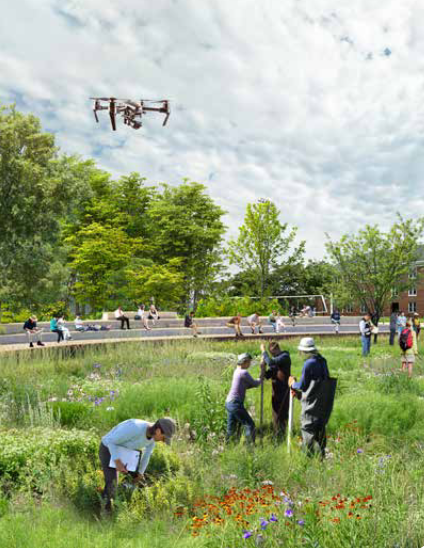
“Think about what a lawn actually is,” said Wright. “It’s kind of like a biological desert. I never want to say we shouldn’t have any lawns because humans use lawns. Like, we use them as gathering spaces on campus. But this particular lawn I’ve never seen anyone use. I’ve been here for seven years, no one goes out in it. No one plays in it. It’s just a big empty space, basically. And so we’re trying to convert it into something that’s a little more functional from an ecological perspective.”
That includes conversion from a lawn to a meadow filled with plants native to South Jersey located behind the Science Hall. Wright not only hopes to create a nice meadow, but to pull the university away from pesticides and herbicides—highly toxic chemicals to humans, animals, and plants.
“If we put in a big meadow, we’re going to be doing a few different things,” said Wright. “We’re going to be irrigating less, and we’re going to be using fewer pesticides and fewer herbicides, and those sorts of things. If you really want to maintain a big nice show lawn, you have to use pesticides and herbicides, and we do that on campus to keep things looking a certain way. But the fewer areas on campus that do that, the lesser are impact and the more healthy the whole system can be.”
Rowan recently released a sustainability master plan. This includes a detailed outline of Rowan’s environmental goals.
“There are huge developments on the west campus and also eventually on the south side of 322,” said Broad. “We’re going to see a lot of development in the coming years. All of these are going to be built with a from a much more energy efficient sustainable perspective.”
The West Campus Development Project features a forested preserve on its south end. The planned Wellness Village is designed to shrink car dependency. Stormwater management aims to manage runoff, preventing flooding in the surrounding area.
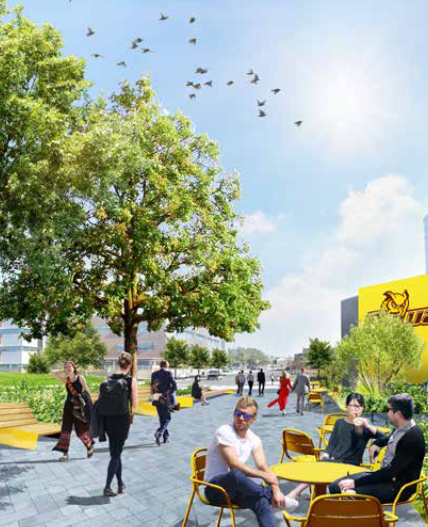
Rowan hopes to replace brutalist, utilitarian infrastructure with infrastructure favoring environmental cleanliness and compatibility. Concrete is to be replaced with materials allowing water to seep into soil directly. And plants native to South Jersey—not invasive species—are mandated.
Increasing green spaces and tree canopies helps lower local temperatures and energy loads, and pedestrian centric infrastructure improves walkability and limits congestion.
“If you read that document [the sustainability master plan], there are a lot of considerations of sustainability that are built into everything,” said Broad. “That’s just part and parcel of doing any sort of development or design in 2026 as opposed to, say, 1970 when a lot of this place was being built. That includes a lot of considerations around, not just buildings and energy efficiency, but also campus mobility.”
Much of Rowan’s focus is on growth, but Broad hopes growth means greater efficiency. To him, greater efficiency implies greater environmental friendliness.
“I think the sweet spot is when development is sustainable, it tends to also be efficient,” said Broad. “Efficiency saves money and is also good for environmental quality. And so that’s really the lens that advocates for these issues push.”
Environmental health isn’t just an issue pushed by biologists or those empathetic for animals. It has serious impacts on public health, whether it relates to air quality, toxic waste, food quality, wildfire smoke, and so on. According to the Urban Institute, environmental health can even benefit upward economic mobility.
“You need to be appealing to people’s heads, to people’s hearts,” said Broad. “We also need to be designing environments so they don’t have to think or feel at all. It just makes it easier for you to, you know, bike around campus. As opposed to having all these barriers because there’s no place to park or you’re dodging traffic because there’s no bike lanes. Even if I really want to bike to campus or take public transit, these barriers might get in the way. If these barriers are strong enough, I’m not going to do it. That’s the real challenge.”


Leave a Reply