• How American hegemony hijacks semiotics

    Aidan Vanhoof

    8 min read

    Jun 29, 2025

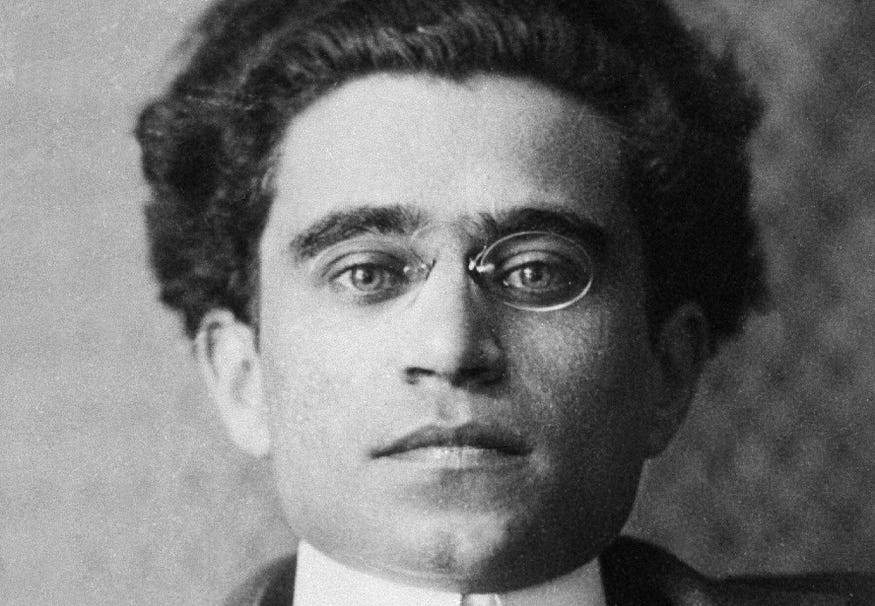
    Italian philosopher Antonio Gramsci; source: Jacobin

    Tribalism is an old, seemingly inevitable fact of American life. Everyone has opinions, none appear compatible, and the American political system remains a wreck; one which the rest of the world gawks at like a crowd watching a public execution. But this ideological division does not occur as per the centrist viewpoint: that Americans simply want radically different things, leading to an ideological conflict. To many, making the two sides collaborate would be like fitting a square peg into a round hole — it’s simply impossible.

    The object of this article is to focus most of all on how the centrist narrative isn’t sufficient to explain why we are divided as a country. This leads to my thesis: Division in modern America is a problem of signification, not of belief.

    Before I go any farther, I think it’s necessary that I diagnose the main source for this division. I believe the answers are found in Slovenian philosopher Slavoj Zizek, who applied the Lacanian point de capiton (a theory from French psychoanalyst Jacques Lacan) to ideology in his book The Sublime Object of Ideology,

    … the multitude of ‘floating signifiers’, of proto-ideological elements, is structured into a unified field through the intervention of a certain ‘nodal point’ (the Lacanian point de capiton) which ‘quilts’ them, stops their sliding and fixes their meaning.

    Ideological space is made of non-bound, non-tied elements, ‘floating signifiers’, whose very identity is ‘open’, overdetermined by their articulation in a chain with other elements — that is, their ‘literal’ signification depends on their metaphorical surplus-signification.¹

    A floating signifier is an unsignified element in a signifying chain. This is a massive part of Zizekian ideology critique, being the means by which the subject is able to embrace contradictions.

    Let’s take communism: communist states in the past have been brutal and tyrannical. Yet, communists to this day believe that such systems are integral for human flourishing and freedom. How is restricting freedom necessary for freedom? Because the floating signifier (freedom) is ‘quilted’ into the authoritarian (communist) ideology. Thus, ‘freedom’ is signified as ‘communism’, and vice versa. Other ideologies are not signified as free, but communism is, so the communist state is ‘free’ because all that isn’t communism is innately ‘unfree’. Therefore, communism is synonymous with freedom, both by process of elimination and direct association.

    During this process, the ideology retroactively changes any past experiences, memories, and beliefs, and alters them to fit within the ideological framework. The communist sees their comfortable upbringing as a product of bourgeois privilege in the face of widespread struggle; the fascist sees their diverse schooling as the death of authentic culture and heritage, and so on.

    By applying the aforementioned theory, I believe division is thus not just a problem of conflicting signifiers, but a problem of competing signification.

    Donald Trump ran on a working class and populist basis. This is nothing new. What he did remarkably well was take working class concerns, like the price of eggs and milk, or housing costs and job security, and signify them into a right-wing quilt (rising housing costs are not an inevitable product of an unregulated free-market, but a product of immigrants, minorities, environmental regulation, and so on).

    Such economic logic operates like this: The working class is only struggling because the wealthy are, too. They’re overregulated and tax dollars for social programs are in fact corrupt, as those are used and abused to exploit the victimized wealthy, who demand tax cuts and deregulation. The demanded upward transfer wealth manifests in the greater economy, which manifests in the working class’ collective wallet. In other words, the wealthy are suffering because of leftist regulation, and the economy is bad, therefore, to help the working class, the wealthy must be deregulated.

    Let’s take this quote from the US Department of Labor,

    The days of waste, fraud, and abuse are over. The Trump administration is bulldozing through red tape and big bureaucracy, returning freedom and purchasing power back to hardworking men and women.²

    And,

    Workers feel heard, respected, and empowered by this president.³

    In what sense does bulldozing government programs give power back to workers? Do they vote for their CEOs, managers, wages, and so on? Do they vote for the oligarchs that control what they see and hear? The oligarchs who placed them in debt and increased the costs they’re so concerned with in the first place?

    While we can choose what to buy, what we buy is to a degree determined by our income status, the advertisements we see, the retailers we have access to, and so on. We don’t have absolute freedom of choice in this case, thus we do not have a ‘free’ economic ‘vote’. In other words, purchasing power, which, in the above passage, is equated with ‘freedom’.

    We have a range of choice, but that range is decided by factors either out of our control, or within our control but in which our control is limited. If I am poor, it is decided by demographic, region, lineage, and so on, as much as it is decided by personal choice (with exceptions, of course; e.g., addiction); if I am rich, it is the same way, and my purchasing power is determined solely by the value of the given currency.

    So unless one runs society, they are the exploited — not the exploiter. The only true power they have is over the ‘democratic’ state, thus the only power they have is through regulation of that which they have little power over.

    But even in my case, I operate under certain assumptions, such as the idea that ‘democracy’ implies universal power, as opposed to the opportunity for power; that a state in the midst of a democratic backsliding is better than an already undemocratic market; that a politician is better than a CEO, and so on.

    But Trump understands — or at least functions as if he does — this signification process, alongside the contradictions baked into his thought. Let’s take this quote from his 2019 State of the Union address,

    America was founded on liberty and independence — not government coercion, domination, and control… Tonight, we renew our resolve that America will never be a socialist country.⁴

    Trump signifies past Marxist-Leninist communist regimes as the blanket term ‘socialism’, thus ‘oppression’ with ‘state-economic-power’, even if that state power is fundamentally different from the authoritarian hellscape his supporters fear. He signified normally socialist signifiers (working class liberation) as per a fascist ideological field. He took working class concerns and didn’t justify the right wing, but attacked the solutions to his voters’ problems and propped up himself and his economic class in the process. This also allows him to act as an authoritarian, doing precisely the “government coercion, domination, and control” he is quoted as opposing, as authoritarianism is reframed as a socialist symptom — one which is impossible under a non-socialist system such as his own.

    This indicates something even more important: the working class has the same concerns practically universally. Bernie Sanders ran a tremendously successful presidential campaign in 2020, and proves himself still to be the most popular member of congress, meaning he is crossing the party line. He and Trump said they’d solve similar problems with different solutions, but, in the end, the American people simply wanted something consistent: some kind of change and a solution to their problems.

    Division is even more deep-seated than before. Each side hates the other because they truly, in the most honest of ways, feel the other is destroying the country, as they fundamentally disagree, not on principle, but on definition. To one side, freedom means freedom from taxes and corporate regulation, to the other it means economic justice. Yet even economic justice means two different things. Economic justice could mean justice to imperialists and freedom from exploitation, to others it means the freedom to hold property. And what is property? Some may say it’s a path to theft, the other may declare their opposition to be the thieves.

    This division won’t disappear with respectful discussion or unity of any kind. It’ll always exist, because in the end, it isn’t just ideological.

    From the Human Rights Campaign,

    Polling indicates that 64% of all likely voters, including 72% of Democrats, 65% of Independents, and 55% of Republicans think that there is “too much legislation” aimed at “limiting the rights of transgender and gay people in America.”⁵

    The majority of conservatives take little to no issue with gay and transgender people, yet Donald Trump is known to be devoutly opposed to them, believing that they are a terrible problem leading to the corruption of moral society, pushing the need for book bans and restrictions on childhood expression of queer identity. Trump and the GOP as a whole, given hundreds of anti-transgender bills have come out in the past few years, would make such people out to be extreme threats and those who respect their right to live to be radicals and extremists. If congress mirrored the will of its voters and the news media honestly portrayed public opinion, transgender people would face little oppression. Yet, they face such oppression, indecating that this problem is not one of ideology, but one only pervasive within the ruling class.

    ‘Freedom’ is thus signified as freedom from the expression of minority identity, ‘immorality’ is signified as ‘queerness’, ‘extremism’ is signified as ‘social liberalism’, and basic queer expression is retroactively made into an ideological imposition. Those who support such ‘impositions’ are turned into scapegoats — alongside the queer community — for ideological oppression and social degradation, among other things.

    This is arguably the most important thing to consider in understanding ideological dogmatism. To return to the previous example of communism, Zizek writes,

    ‘Communism’ means (in the perspective of the Communist, of course) progress in democracy and freedom, even if — on the factual, descriptive level — the political regime legitimized as ‘Communist’ produces extremely repressive and tyrannical phenomena. ‘Communism’ designates in all possible worlds, in all counterfactual situations, ‘democracy-and-freedom’, and that is why this connection cannot be refuted empirically, through reference to a factual state of things.⁶

    To use this passage in our context, rational argumentation becomes impossible, as (1) opposing sides operate with different definitions; and (2) contradictions are inherent to the quilting process, yet this process still goes on, so contradictions to a given ideology are by default meaningless.

    This signification is not the product of a working-class spontaneously animated toward general purpose bigotry, nor is it necessarily religious. Protestantism has little consistent stance on queer issues (many churches and theologians — and I am inclined strongly to agree with them⁷ — are highly supportive of the queer community), and the Catholic Church has roughly the same inconsistency, but the simultaneous stance that such people should be respected and loved regardless. Neither the church nor the Bible advocates for religious state intervention, and historical situations to the contrary have often been pandering by the church to the state to accumulate wealth and power — a class based distortion of scripture.

    Thus, such an animation is a product of those who seem to care — those who establish transphobic and bigoted policies. This is the central problem: it is not the powerless, but the powerful, who are causing this division. It is not ideology on its own, but, as Gramsci put it, cultural hegemony. The working class is exploited, not just materially, but ideologically, by the property holding and political classes.

    ¹Slavoj Zizek, The Sublime Object of Ideology, 1989

    ²Lori Chavez-DeRemer, 100 days in, Trump’s Golden Age puts American workers first, 2025

    ³Ibid

    ⁴Library of Congress, President Donald J. Trump’s State of the Union Address, 2019

    ⁵Cullen Peele, Reality Check: Public Opinion on LGBTQ+ Issues Ahead of Second GOP Debate Highlights the Failure of Extremist Attacks, 2023

    ⁶Slavoj Zizek, The Sublime Object of Ideology, 1989

    ⁷I’m tempted to write an essay on this problem in the future, if only for myself in order to organize my thoughts.


  • Why achievement is existentially disturbing even for those who have achieved: a psychoanalytic perspective on the division of labor

    Aidan Vanhoof

    8 min read

    Jun 21, 2025

    Source: StockVault

    I’m young, naive, a little bit optimistic. The world, as my older friends and coworkers have told me, hasn’t crushed me into a pulp. I’m glad, and I hope I won’t lose this slightly stupid optimism, because, in the end, bathing in hopelessness will bring me and this species nowhere.

    But, in time, as I have expressed in past articles, I believe this optimism will become increasingly hard to hold on to. The world will fight me and berate me until I harden into a rock and lose all personality. Debt, in particular, frightens me. I hate even thinking about this, but the notion of affording a house is a distant and idealistic dream and the student debt I’m already saddled with ensures that.

    But there’s more to the story than debt. Debt can be paid off. Debt can go away. But labor doesn’t. Humans love, and need, to work — and it doesn’t have to be ‘work’ in the traditional sense. It can be a family, friends, anything really. Anything that gives us a purpose, because as social beings, we are fundamentally subservient, thus laboring, to the social world.

    But labor in modern life lacks what makes such work so enjoyable and meaningful. It lacks soul. It’s shallow and drab. And for lack of a better way to articulate it, it makes me rather depressed.

    I dream of being a journalist, and quite a good one, too. But what happens if the costs of living exceed what I’m paid? I’ll be trapped in a position in which I’m forced to proceed, not according to what fulfills me, but what fulfills a dying economy which lacks any concern for the people whom it serves. And where will the fruits of my labor go? Not to myself or those I care about, but an abstract representation of an abstract monetary system which represents abstract value systems, all so an oligarch can take a flight to space or pay off the politician I probably voted for. Labor, because of where and when I live, is less and less meaningful. And, will achieving my goals make me happy to begin with?

    This isn’t a new problem. None of it is. The problem of what philosophers call the ‘alienation of labor’ has been a key theme across leftist theory for nearly two centuries now. But political theory has existed for thousands of years and philosophy concerning labor nearly equally long. So what gives? Why are philosophers now so concerned with ‘alienation’?

    I’m beginning to suspect a consistent through line, especially since reading the most radical of them all: Karl Marx.

    Karl Marx theorized that a principle issue in capitalist labor is its adversarial nature. From The German Ideology,

    For as soon as the distribution of labour comes into being, each man has a particular, exclusive sphere of activity, which is forced upon him and from which he cannot escape.

    And,

    In a real community the individuals obtain their freedom in and through their association.

    He built off German philosopher G.W.F. Hegel, who argued that, in order to be authentically self-conscious, we must also realize that we are observed, that we are something other than a ‘floating consciousness’ and an actual being. And, other humans do that observing. Thus, humans aren’t their fullest selves without other humans, which means humans need other humans to exist meaningfully, rendering us collectivist by nature.

    Therefore, the individualistic and deeply competitive nature of the labor market leads a person to anguish; all because, instead of collaborating, they’re obligated to fight and compete and win or lose. We are thus alienated from society at large and delegated to our individual, subjective worlds. This is the problem inherent to the ‘meritocratic’ division of labor: it takes from people what makes life enjoyable. It ensures that each and every person beneath or ascending, and even those who have already done so, are isolated and alienated, divided from their fellow people and forced into a prison of meaningless, spiteful, and gamified work. The individualist work-ethic fails for this reason: it hurts the individual and it kills the collective — none win.

    But, if we were to take the meritocracy seriously, decide the working-class deserves poverty and debt and focus only on the most successful of us all — declaring wholeheartedly that the successful deserve what they have — how does this affect them? It may hurt the ‘greater good’, if there is such a thing, but perhaps it’s necessary; perhaps it delegates the best to the best, the worst to the worst, and the average to the average.

    Let’s assume this is true. What now?

    I’d like, as I so often do, to reference psychoanalyst Jacques Lacan. Through his framework, we gain a better understanding of desire. From Lacan’s Seminar II,

    Desire, a function central to all human experience, is the desire for nothing nameable. And at the same time this desire lies at the origin of every variety of animation. If being were only what it is, there wouldn’t even be room to talk about it. Being comes into existence as an exact function of this lack.”

    If we were to apply this quote to ‘achievement’, the career-person, whose life revolves around their job and the identity they’ve built for themselves surrounding this career, is driven by a desire for further recognition. In that, they are driven to success because (1) they want to be seen as successful and (2) they want to have their identity which is defined by their career validated to the greatest extent it can be. 1 and 2 are effectively the same: the subject wants to be seen as the ‘epitome’ of their respective occupation. Their identity is their occupation, thus to feel ‘whole’ they must embody their occupation. The ‘best’ lawyer, the ‘best’ doctor, the ‘best’ CEO or investor: in each of these cases, the ‘best’ of a given occupation is a role only assigned to a person by other people. If they want to achieve success and feel successful — not merely make more money — they need to be seen as successful.

    Who sees a person as successful? Who cares for the success of a lawyer, doctor, CEO or investor whom we have no relation to? Those who care most are the subordinates of the aforementioned, the people pushed as far down as possible, the people whose livelihood and recognition is valid only insofar as they recognize their own inferiority. As, to compete, one must first identify their adversary. This is the key reason why success is so appealing: it is, in essence, a ‘recognition pump’ — a constant and unending stream of identity-validation and confirmation.

    Competition becomes the most powerful drug. But, with this, we land at yet another problem: the inferior may be unequal materially, but they often, though not always, live more meaningful lives. They strive, they fight, they struggle, all for a better salary and access to the coveted recognition pump.

    Struggle is the greatest source for purpose in life, since desire is the driving force for human behavior, as to fulfill our desires could be considered among the worst things to happen to a person. After all, what now, having managed great success, does one have left to look for? What reason does one have to live if all that once made life appealing has been eaten away? One gets bored with success and they begin desiring once again.

    Recognition is what we desire, but desire itself is what makes recognition appealing — because to feel whole we seek recognition, yet to be recognized only means the creation of new aspirations: we never truly feel whole. As to fulfill our desires is hell and to be recognized is heaven. They are each treated the same yet they are fundamentally incompatible.

    The joys of hierarchy are nothing beyond a condemnation. Capitalism is made for the career-person; the man, woman, or in-between who dedicates their whole existence to the production of profit. In other words, the hardworking, rugged individualist: the exploiter being exploited, the servant to the servant, the weakest among the strong.

    This is why so many successful musicians, actors, and other celebrities, who seemingly achieved all that they set out to do — whom we assume should be happy — end up depressed. They have nowhere else to go. Their life has plateaued. It has reached its end because there is nothing left to do or desire except what will soon grow boring and meaningless.

    While the working-class wallows in debt imposed by the white-collar, the white-collar debtor wallows in nihilism. Each are equally alienated.

    I may be idealistic in saying so, and I believe I am, but perhaps this is where we can find an important form of resistance: in living a life actually worth living; not in pursuing success, but in living for other people — the people who make success appealing, but remain crushed by it. For by doing so — by actually living — we are taking from capitalism what makes it so potent: its power to, not only exploit our labor, but to exploit our happiness. By living a life despite it, we are materially taking from the capitalist market its most necessary asset: the alienated laborer.

    To answer the question of ‘why now’ I asked before: life is only getting worse and alienation is a more profound problem than ever. Industrial labor and white-collar labor alike are frustratingly arbitrary and absurd, guided increasingly by AI and information technologies; new technologies which turn the modern educated laborer into just another processor crunching numbers and ‘knowledge’ to translate their value as a human into profit. Existence becomes defined by social media, turning recognition universal, opening the door to premature recognition of success through curation and editing, stealing from recognition the very desire it exists to satisfy.

    Our lives are more devoid of meaning than ever before, as the very foundation thereof has been destroyed. Your exploiter feels the same as you do, so don’t just blame them: blame what incentivizes them to exploit.

    Labor alienation is how capitalism keeps the individual subservient: their labor means nothing, thus they find meaning elsewhere, growing complacent by the hour as they assume the fruitlessness of labor is a default state. Therefore, one’s misery is associated with the economy or politics — changeable conditions — yet they feel this misery is normal, they won’t fight it. After all, life’s life. Thus, what they feel is controllable — family, friends; i.e., collective, social activities — are left to the individual to control, while both greater society and themselves care little for the damage done to them. The individual in individualist society remains wounded — they’re merely more alone than before.

    Capitalism forces repentance: it mirrors the self-sabotaging, self-punishing zealots of the Middle Ages, who beat and whipped themselves for mistakes they identified within. The modern laborer punishes themselves for deviating, for wanting something better, for working a healthy amount and longing for rewarding work. Because to rebel against labor means to cease one’s labor. If one doesn’t labor, they’re ostracized as lazy, unemployed, stupid, and so on; and they lose a source of income, thus they risk even death. Thus, they repent for their laziness before the oligarchical gods of capitalism, losing both self-esteem and the means to live.

    So, not to beat a dead horse, but I must ask, how the hell am I free?

  • Aidan Vanhoof

    7 min read

    Jun 13, 2025

    Mountains in Washington State; Source: Shutterstock

    Recently, I’ve been spending some time thinking about my future, as any 19-year-old may. Not only college or my future career in journalism: what’s fascinated me has been my retirement. That point in life when working becomes undesirable, when to labor would bring me little meaning, and all I want is to settle down with a partner, perhaps a dog, and relax.

    What fascinates me is how that retirement would go. I live in Southern New Jersey — known for its farmlands and seemingly endless suburbs and retirement communities, both of which have a habit of trapping me in a maze-like loop, with sparse landmarks and cloned houses and trees gifting me the now frequent opportunity to get lost. This endowed me with a deep and fundamental hatred for such communities, and I’ve decided that to live in one would be my personal hell.

    Thus, in thinking about that, I’ve found that to live in its negation — an isolated, natural, beautiful environment that features actual life on earth — is far more desirable. One of my favorite TV shows is Twin Peaks. If you haven’t seen it, I’ll insert a picture below. That is the life that hypnotizes me — among the mountains, away from the world, in nature.

    Twin Peaks; Source: Nevertwhere

    This has become a daunting task. Retiring and living a simple, content, quiet life — that’s seemingly an irrational want. This is my thesis to this essay: Being content is impossible in a world of wants. The modern world has ironically devolved with its simultaneous evolution: life is steeped in and utterly dysfunctional without consumption, without being bombarded with systems designed specially to play on human desire. To be content with little has become impossible; yet, to be content with lots remains impossible.

    I’d like to preface my main argument with a statement on what leads a person to be content. In this case, I’d like to apply the theories of French psychoanalyst Jacques Lacan.

    It is human nature to chase, but never to attain. To attain our desires would mean the creation of new desires for us to chase. What modern America is so good at doing is riding on our backs, holding the stick before our faces, letting us chase it in loops until we take the carrot (buy the product), then replacing it with another carrot — perhaps it’s bigger (advertisements, iPhones, and so on) — keeping planted on the saddle until we keel over and die. We only stop desiring once we die.

    It is what mediates this desire that holds the most power over humanity: the state, the corporate world, our heroes, our villains, and so on. Desire is controlled by the world around us, by our culture, by language, by what we are taught and not taught. Desire, thus, is the desires of the Other — not our own. We desire what we want others to think we desire; i.e., we want to be seen a certain way, and we attempt to embody that ideal — the Ideal-I — and project it. This becomes our self-identity. As Lacan wrote,

    The I is always in the field of the Other.

    This is where I hope to elaborate on contentedness: the world of desire is not necessarily our own, as it is controlled by the world of symbolic systems — what Lacan called the symbolic order. It is with this that I come to my first conclusion: Authenticity is not primacy of the self, but primacy in the choice of selves.

    The subject is incapable of the traditional, ‘existentialist’, libertarian type of authenticity: To use an example from Jean-Paul Sartre, the self one has when they think the mannequin is a real person, and the self they become when they realize it is fake, are one and the same; they are equal parts of the whole identity. One’s identity is formed by how they want to be perceived, and they become either happy if they are merely chasing it; or they become anxious if they feel they have already achieved it, but are not being recognized by the Other as such. Who a person is when they are watched is a version of their self, and who a person is when they are not is just as much a version of their self. But neither one is their ‘only’ self: they are each simply different selves. One projects internally in the pursuit and self-deception of the Ideal-I, and one projects externally in the projection of the Ideal-I.

    Therefore, to become ‘authentic’, one must first acknowledge that such a thing is impossible. Authenticity is a myth, but a myth that remains important to human happiness. So, it is a myth that must be critiqued, but one that must also be supplanted with a non-myth: the idea that, instead of pursuing absolute ‘self-recognition’, one should achieve absolute ‘choice-recognition’. What this means is, I must choose how I am to be recognized, take steps to achieve that recognition, but avoid groups that recognize me differently to how I want to be recognized: in other words, authenticity manifests in choosing the groups you belong to, not necessarily in rejecting group identity. It comes in picking those who recognize you for who you are — who you want to be seen as — and not altering your sense of self to fit in with others, instead altering the others to fit your sense of self.

    It is with this that I conclude that humans are fundamentally collectivist. Anti-social behavior thus often comes with a crisis of recognition: it comes when the Other fails to recognize the subject, alienating them from recognition as a basic precondition for happiness. Then, they reject recognition altogether, losing this communal edge to human nature. This would also be why altruism and ethical behavior is often important for individual happiness.

    This is what capitalism does so well: it provides artificial means for recognition — watches, clothes, shoes, music, and other consumable products. Products that are sold to us as means to another identity, as pathways to a different self, as ways to fit in to the groups we choose. To build on a past metaphor, commodities are the carrot, corporations are the person holding the stick.

    Contentedness comes in recognition without artificiality: e.g., a Buddhist monk may spend their time living a minimalist, basic existence, but they are purely content, as they are recognized within their group, and, whatever suffering they may endure pales in comparison to what they desire — true enlightenment. Desire overcomes pain, and with the meaning provided by recognition comes a warped happiness. This desire paired with pain emits a paradoxical attachment to the source for pain: the source for pain becomes a catalyst for the power of desire, as desire is amplified as the guiding light through times of suffering. Pain strengthens desire by bringing one closer to it emotionally.

    Contentedness in the sense of the Buddhist monk is different from happiness as it is sold to us: the recipe for happiness has hardly changed for thousands of years, despite drastic changes in material conditions: it is predominantly social. Happiness is the satisfaction of recognition. Contentedness is the satisfaction of recognition wholly independent of material conditions. It is thus pure happiness.

    Modern happiness is different: it is happiness mediated by commodification: it is the commodification of all that is social, happiness originates in the social, thus that which is commodified is also that which is social, therefore that which is happiness is also that which is commodified. Thus, in the modern schema, commodities equal happiness. This demands one desires what exists on the short term: what dies alongside the Buddhist monk, dies with the purchase of each new product for the American consumer. The Buddhist monk can be content through the whole of their life, despite enduring downright primitive material conditions. The commodified person is happy only as long as they are consuming. They cannot be content, they can only have false-joy and short-term pleasures. In other words, hedonism.

    This is the source of my fear: I feel that I will not be content in retirement, for even to function in society requires I navigate the internet, own a cell phone, understand the media, and so on. While I hope I don’t end up a hermit, capitalist desire — consumerism — is utterly unavoidable. To be content in America, no matter how hard one may try, is becoming increasingly difficult, and it is a task that, while possible, is appearing more and more like a sheer, unclimbable cliff face towering before us. I fear for my retirement. I hope I won’t need to for much longer.

    This is my desire.

    I understand it must be ironic that I’m writing this and posting it on Medium and the internet at large. I must confess I enjoy these things — the commodities and infinite access to information. Capitalism is enjoyable on the short term. It is on the long term — contentedness — where the pains of American life as a commodity are discovered, yet it is also on the long term where desire is truly meaningful. Thus, the modern world is a factory for existential meaninglessness and shallow happiness; it is a world without character beyond the briefest of illusions and a life without true authenticity. For that authenticity, as much as it is touted by our individualist culture, is a commodity in-itself.

  • Aidan Vanhoof, Staff Writer

    October 22, 2025

    "People aren’t persuaded by fear and discomfort; they lash out against it." (Alexander Cruz / Graphics Editor)

    “People aren’t persuaded by fear and discomfort; they lash out against it.” (Alexander Cruz / Graphics Editor)

    I don’t think many of us like hecklers. It doesn’t matter who —  be it a salesman, a political organization, or a preacher. Having a person shout at me to manipulate me in their own favor is a genuinely dreadful experience. 

    So, it shouldn’t be a surprise that I’ve grown to dislike the preachers. It’s nothing personal. I’ve spoken to them, and they seem like lovely people. But their message, supposedly the good news, is nothing except an attempt to scare what they call sinners, i.e., college students deviating from a set mold, into submission. 

    Daily, I see LGBTQ+ kids rushing past them. Sometimes, someone gets daring and steals something or kicks a sign over. One even ripped a sign in half a few weeks ago. While I certainly don’t advocate for vandalism or violence, I get it. Truly. 

    Watching as two men rave about the end times, the cleansing of sinners, and eternity, isn’t in itself a miserable experience. But when you’re the one cleansed during the end times and given an eternity of suffering because you like the same sex, identify a certain way, or hold alternate beliefs, it becomes miserable. 

    Not too long ago, I wrote an article about them and a few other preachers. In speaking to students, the reviews weren’t positive. Non-Christian students mentioned preachers calling them out, shouting at them to remove religious garb and repent. LGBTQ+ students consistently despise them and their presence. Students outside both communities regularly found them disruptive and annoying. Even some Christians had real issues with them and their aggressive approach. 

    Obviously, this attitude isn’t universal. But it’s a problem for many students, not only me. These preachers are here five days a week, all semester long. They’re inescapable. 

    It might be reasonable just to ignore them. Walk by, maybe even run by, and tune them out. However, that’s easier said than done, especially when each word spoken is directed at you. 

    Words are potent. We can’t act like they mean nothing, like they can be ignored. But words are just symbols. So, all you have to do to change a word’s meaning is change what it represents. 

    In this case, sinners, as a term, carries weight, even if the aforementioned sinner isn’t religious. It signifies the sinner as a member of an out-group; someone to be attacked. In this way, it’s not just a religious term, it’s a scarlet letter marking rejection. 

    So when preachers condemn an oppressed and vulnerable group, they’re doing more than insulting them. They’re actively alienating students from the environment they’re in. 

    As a result, power walking by or avoiding the area may not be enough. Imagine having a random man harass you, attack your lifestyle, and literally declare you a cosmic failure, then print it all on a sign in big bold letters. Obviously, that’s not easy to ignore. 

    Of course, two preachers bothering students doesn’t justify violating the First Amendment. It’s not like they can be removed. Rowan University is a public institution, so they’re preaching on public property. They have a right, just as we have a right not to listen. 

    But even if they’re allowed to be here, it’s obnoxious and exhausting. I’m tired of spotting those signs and the ensuing urge to pick a different route to class.

    It doesn’t help that it’s a bad approach. People aren’t persuaded by fear and discomfort; they lash out against it. Salesmen flatter and swoon for that reason. LGBTQ+ students aren’t drawn to this God because they’re told he’ll send them to be tortured; Muslims rarely turn to Christianity because they’re harassed by two random men on a street corner. 

    Regardless, they’re a problem. I appreciate their right to express themselves and spread their spiritual beliefs to anyone who will listen. But, given the clear backlash and the preexistence of campus Christian organizations, it should be clear to them that they’re unnecessary and unpopular. 

    If the administration can’t do anything, students need to. Cruelty and vandalism won’t get us anywhere, but confronting them may. Protesting, respectful arguments, calling them out, complaining to the administration, etc., aren’t unhelpful. Even if zeal ensures they don’t budge, anything that protests their presence or tells them they’re unwelcome is a step in the right direction. 

    For comments/questions about this story, DM us on Instagram @thewhitatrowan or email opinion@gmail.com

  • Aidan Vanhoof, Staff Writer

    October 22, 2025

    "On her way to class at Rowan College of Burlington County, Louwinda Soy’s car broke down, hurting her grades and social life. As unpleasant as this was, it inspired something important: Baron Rides." (Contributor / Lauwinda Soy)

    “On her way to class at Rowan College of Burlington County, Louwinda Soy’s car broke down, hurting her grades and social life. As unpleasant as this was, it inspired something important: Baron Rides.” (Contributor / Lauwinda Soy)

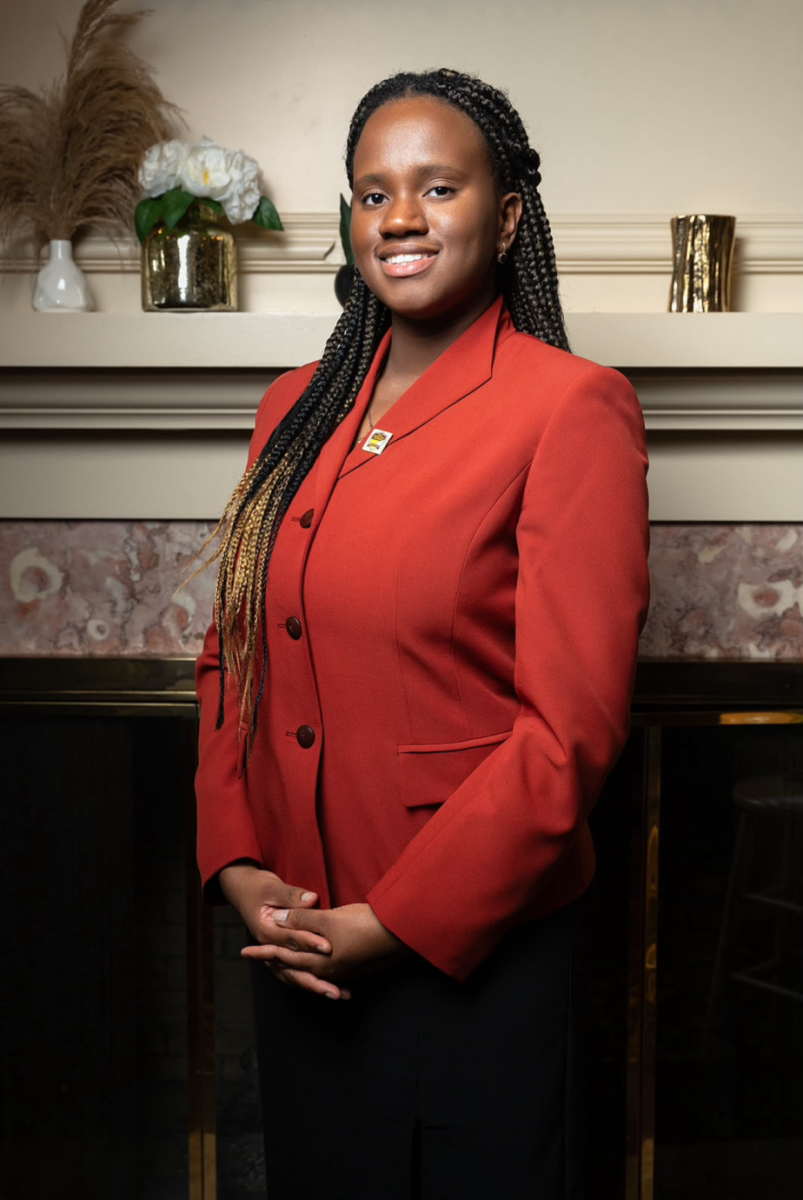
    On her way to class at Rowan College of Burlington County, Louwinda Soy’s car broke down, hurting her grades and social life. As unpleasant as this was, it inspired something important: Baron Rides. 

    Soy, who will graduate next May with a Master’s in Business Administration, depicts Baron Rides as a place where students can pay for transportation, not from random strangers, but from fellow students. 

    “Think of it as a matching app. Instead of you finding your soulmate or partner for life, you find your fellow students, your potential friends. For example, not too long ago, my car broke down. So let’s say you’re a student and this happened to you, it would match you to other students already living nearby who you can carpool with,” said Soy.

    In part, Baron Rides exists to help international students, who often have a particularly challenging time finding affordable transportation and student community spaces. 

    “Born and raised in Haiti, I know how it is to learn English and live in another country,” said Soy.

    To her, ride-share apps like Uber and Lyft can be overly expensive, and public transportation proves sporadic or unreliable. 

    “I found out that so many students were struggling with transportation issues … Since we are students, and we know we don’t make money like that, it’s a consistent price compared to what’s out there. You can actually budget for it,” said Soy.

    Each of these plays into her community-centric ambitions, involving the creation of community spaces linked specifically to Baron Rides. To her, our world is devoid of solid connection. She aims to be the solution. 

    “In terms of buses and everything, I was really struggling … I want to move beyond Rowan. I want to move beyond having it just be an application. As life gets more complicated, it’s hard to make connections. So I want to make a community out of Baron Rides,” said Soy.

    She met her cofounder, Pietra Oliverira, at RCBC, whose computer science background was indispensable. Oliverira returned to her home country of Brazil, but she remains Soy’s coding adviser. 

    “The short answer: she is still part of the story of Baron Rides,” said Soy. 

    The app’s name stems from RCBC’s mascot, Barry the Baron. At first, Soy tried changing it. But since Oliverira left, Soy liked it as a reminder of their close friendship. 

    “Initially, we considered changing the name; we didn’t want the ties to a specific college. But after Pietra moved back to Brazil, I decided to keep it,” said Soy. 

    Soy aims to create more apps in the future, all with her stated goal: bringing people together. 

    “At this very moment, my passion is literally bringing people together. I don’t know if it’s because I was born in a different country, but it’s a passion of mine to connect people. Eventually, it may be something bigger,” said Soy.

    Her ambitions extend beyond ride-sharing, into non-profit work and further entrepreneurship. 

    “If I could put together students willing to learn to be social media managers, like for small companies … Having some sort of a media company run by students willing to help non-profits and stuff like that,” said Soy. 

    At the moment, Baron Rides isn’t complete. She hopes to release it by September 2026 — the beginning of the Fall semester. 

    “We will launch across universities in N.J. to really get feedback,” said Soy. 

    For comments/questions about this story, DM us on Instagram @thewhitatrowan or email features@thewhitonline.com

  • Aidan Vanhoof, Staff Writer

    October 8, 2025

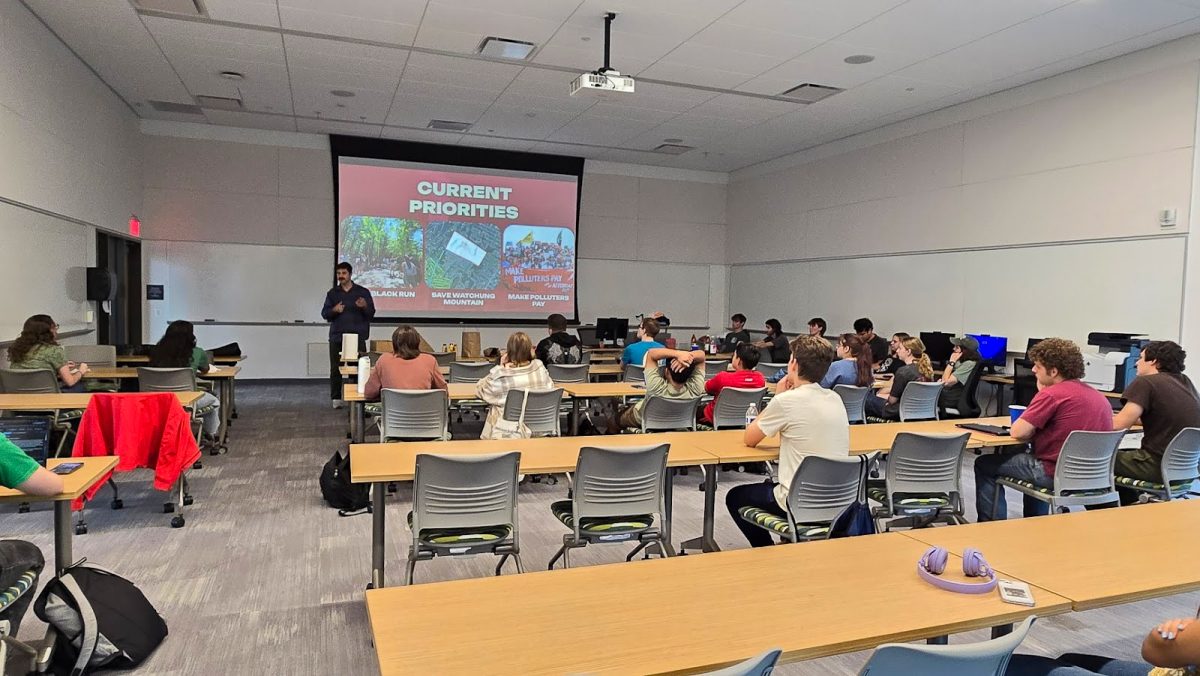
    Activist Ben Dziobek, 25, gives a presentation to the Rowan Environmental Action League. Tuesday, Oct. 7, 2025. Glassboro, N.J. (Aidan Vanhoof / Staff Writer)

    Activist Ben Dziobek, 25, gives a presentation to the Rowan Environmental Action League. Tuesday, Oct. 7, 2025. Glassboro, N.J. (Aidan Vanhoof / Staff Writer)

    The Rowan Environmental Action League (REAL) welcomed guest speaker Ben Dziobek, a 25-year-old political and environmental organizer who works as the executive director for the Climate Revolution Action Network (CRAN), a community-based organization that focuses on addressing environmental issues and fighting for climate justice.

    During the workshop, which was hosted in Discovery Hall this past Tuesday night and saw about 25 people attend, Dziobek discussed New Jersey’s environmental policy and the ongoing fight against climate change. 

    “There’s no youth voices around the state, and when we’re talking about legislation and policy and whatnot, none of our opinions are included. So our whole thing is to uplift you all into these spaces, whether it be local town councils, accomplishing resolutions, or working on the ground with preserving land or something like that, coordinating,” Dziobek said. 

    This event was organized as part of a broader effort to bring more organizations, especially colleges, to CRAN. The group hopes to build a coalition of New Jersey organizations and college clubs to combat climate change, according to Dziobek. 

    According to Kyle Mains, the president of REAL and a senior computer science major, the workshop aimed to educate people in a more experiential or engaging way.

    “A workshop was a catch-all term. As opposed to a lecture, it’s more of a teaching experience,” Mains said. 

    The workshop began with a recap of future events, including a kayaking trip to Scotland Run Park on Oct. 16. Soon after, Dziobek started his presentation. 

    Dziobek singled out three ongoing priorities during his presentation: “Save Black Run Preserve,” an effort to save a nature reserve from a property developer; “Save Watchung Mountain,” an effort to keep property developers from blowing up the top of Watchung Mountain; and finally, “Make Polluters Pay,” an effort to force major polluters to pay significant fines for environmental damages. 

    Most of the presentation revolved around “Make Polluters Pay,” which refers to the New Jersey Climate Superfund Act, an act requiring polluters to fund climate change mitigation. Ideally, it will hold contributors directly accountable instead of the taxpayer, and by regulating companies, it will slow climate change. Dziobek claims it can save taxpayers up to $50 billion. 

    “We have new legislation that maybe we’ll get past next year, but the superfund’s the really important piece. And the super fund is a national issue. If we do this here, it, quite literally, triggers the rest of the states to be like, ‘These three states got it at this point, this makes sense, right?’” Dziobek said. 

    Dziobek continued, discussing ongoing organizing efforts and the hurdles faced by both activists and environmental protection as a whole under the Trump administration. 

    “We can do this. Young people can make this happen,” Dziobek said. 

    The club proceeded outside to the Discovery Hall lawn, where a picture was taken, and Dziobek answered any further questions attendees had. 

    “I think it was really informative and entertaining at the same time,” said Conor Flaherty, a junior geographic information sciences major.

    For comments/questions about this story, DM us on Instagram @thewhitatrowan or email news@thewhitonline.com

  • Aidan Vanhoof, Staff Writer

    October 8, 2025

    “I don't actually believe him, but I choose to believe him…the mothman." (Graphics Editor Alexander Cruz)

    “I don’t actually believe him, but I choose to believe him…the mothman.” (Graphics Editor Alexander Cruz)

    With the rise of the internet, conspiracy theories pervade everything from everyday conversation to whole political movements. In 2020 and 2024, conspiracy theories like Q-Anon spread like wildfire on the American right wing. 20% of Americans believe COVID-19 vaccines microchip Americans, and another 54% of Americans believe that JFK’s assassin, Lee Harvey Oswald, did not act alone. 

    Despite this, overall, college students believe in conspiracy theories less than the average American, mostly due to a stronger education. Is Rowan University any different? 

    On average, not really. Among Rowan students, such theories don’t appear too common, though they’re not nonexistent. 

    Gracie Tomeipar, a junior majoring in liberal sciences, is skeptical but finds them fun, citing a belief in the “mothman,” a winged creature from West Virginian folklore thought to be a bad omen. 

    “I don’t actually believe him, but I choose to believe him…the mothman,” Tomeipar said.

    To Tomeipar, logic is more important, citing limited evidence in most cases.

    “I think the world is weird enough that we don’t really need conspiracy theories … some of them have way too many statistical problems … I’m somebody who likes to have empirical evidence,” Tomeipar said. 

    Another student, Daniel Eang, a junior majoring in computer sciences, like Tomeipar, considers most of them unreasonable, but still finds one convincing: aliens. 

    “My mom did say that she saw some video about UFOs online. I mean, it does exist, space outside of the Solar System … So I do believe in those kinds of alien conspiracies,” Eang said.

    Jaedon Angelus, a junior majoring in biology, says he enjoys reading about them, but doesn’t believe in any. He simply remains open-minded.

    “I wouldn’t say I necessarily believe any of them, but I enjoy reading about them. I’m talking, getting my own perspective on conspiracy theories instead of just believing what I read,” Angelus said.

    To him, conspiracy theories aren’t very reliable, since many begin in internet echo chambers and change as they’re repeated without sufficient pushback.

    “I just try not to trust other people … A lot of information just gets put out there, it’s really reverberated in echo chambers and everything,” Angelus said.

    Travis Reese, a sophomore majoring in psychology, doesn’t believe in any, although he didn’t specify any reason why not.

    “I don’t think I have a particular reason. I just don’t,” Reese said. 

    Like Reese, Hani Patel, a junior majoring in computer science, doesn’t feel they can be substantiated. To her, this means they likely aren’t true. 

    “I just don’t believe them. If you can’t see it, it’s not real. That’s what I think,” Patel said. 

    Among those interviewed, some of whom refused to be quoted, few appeared to believe in any popular conspiracy theories, like Roswell or the aforementioned JFK plot. 

    As to why, on average, students in higher education have greater analytical tools, exposure to different viewpoints, and tend not to attribute intentionality to otherwise random events. 

    A lack of critical thinking skills and echo chambers reinforce conspiratorial ideas, all of which higher education combats, according to a research paper in the National Library of Medicine. 

    Despite this, many students, like Tomeipar and Eang, remain open-minded and engage with such theories, mostly for fun or out of personal interest. 

    For comments/questions about this story, DM us on Instagram @thewhitatrowan or email features@thewhitonline.com

  • Aidan Vanhoof, Staff Writer

    October 8, 2025

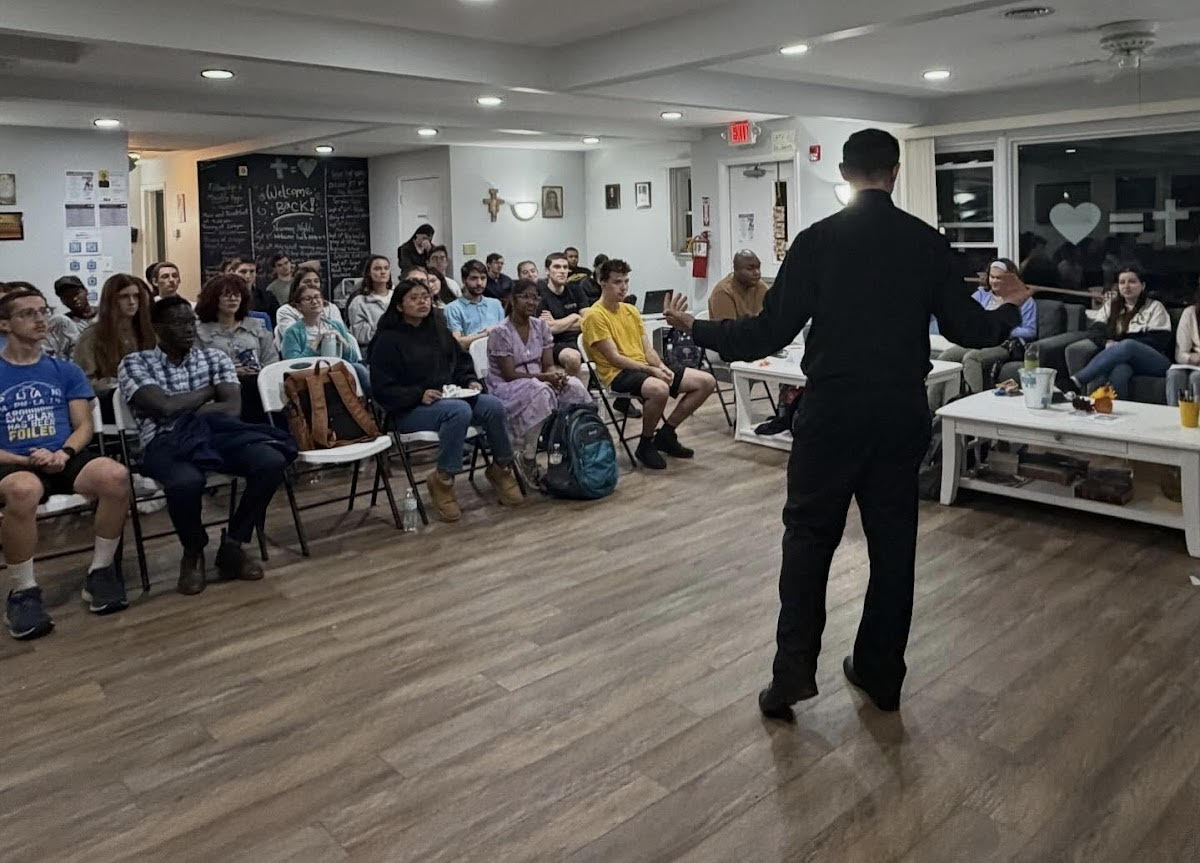
    Students watch Father Thomas Piro give a presentation on his life and vocation. (Catholic Campus Ministry via Instagram)

    Students watch Father Thomas Piro give a presentation on his life and vocation. (Catholic Campus Ministry via Instagram)

    At the Newman House in downtown Glassboro, dozens of Catholic students and alumni gathered to hear Father Thomas Piro give a presentation on his life and work. 

    Initially, students flowed in at 6 p.m. on Oct. 1, settling at tables and eating free food.

    “We always start with a free dinner at 6 o’clock on Wednesdays and then have our meeting after,” Campus Minister Kari Janisse said. 

    The meeting started properly an hour later, with Janisse recapping the Catholic Campus Ministry’s schedule for the week. After about ten minutes, Father Thomas Piro started his presentation, where he discussed, in great detail, his early life, upbringing, and journey through religion and priesthood. 

    “Hopefully we’ll have some questions, but before we’ll get to hearing about who I am and my vocation,” Piro said. 

    A question and answer session was held afterward, wherein eleven students asked a mixture of deeply personal and broader, theological questions. Some students asked about Piro’s life and time in the church; others asked for advice. 

    “I have students asking these very deep questions and really seeking to know why … It’s been a great blessing,” Piro said. 

    Piro is Rowan’s Parish Parochial Vicar, a Catholic priest assisting the main pastor. He started at Rowan in July, and this is his first assignment since graduating from seminary. He’s popular for his youth, energy, and relatability. 

    “You don’t see a lot of young priests; we’re used to seeing older men…[he’s] very relatable in that sense … Students can understand [him] because it’s part of their generation as well. Working with him since July … has been super joyful,” Janisse said.

    Events like this one happen weekly, often featuring presentations from relevant speakers with a focus on faith and vocation. Last week, they had a couple discuss the adoption process, another Catholic vocation. 

    “There is usually a speaker every Wednesday … Like last week, we had a married couple from the parish come and give us their story,” Janisse said.

    Students enjoyed the presentation, finding it insightful and helpful for their own spiritual or religious lives. 

    “A lot of us have anxiety about something, like other people … I think [presentations like this] do a lot of good,” said James Scalice, a sophomore history major.

    Students from the surrounding area attended, as well, like Dae Miller, a sophomore liberal arts major from Rowan College of South Jersey. Like Scalice, he considers this to be a sort of “home away from home,” though he’d appreciate more student presentations. 

    “I think we’re very lucky to have a Catholic community right here on a public university campus … [but] I think they could incorporate some more speeches from students … I don’t get to hear from Rowan University students as much; it’s usually a lot of older people,” Miller said. 

    While the event ended around 8:15 p.m., students lingered for hours afterward, as the Newman House remained open until 11 p.m. the same night. The Catholic Campus Ministry’s next meeting will be on Wednesday, Oct. 15.

    For comments/questions about this story, DM us on Instagram @thewhitatrowan or email features@thewhitonline.com

  • Aidan Vanhoof, Staff Writer

    October 1, 2025

    "Lockheed Martin benefits from Rowan. By working with them, Rowan supports Lockheed Martin, implicitly condoning their actions and business model." (Lockheed Martin- Partner Page)

    “Lockheed Martin benefits from Rowan. By working with them, Rowan supports Lockheed Martin, implicitly condoning their actions and business model.” (Lockheed Martin- Partner Page)

    Twice a week, on my way to class in Robinson Hall, I pass a poster listing major companies Rowan University graduates have gone on to work for. Among them are companies like Bloomberg, NJM, Inspira, and BetMGM. 

    However, one stood out: Lockheed Martin.

    Rowan University offers unique programs, both for students here at Rowan and for employees at Lockheed Martin. This includes a Rowan-exclusive graduate program, designed especially by and for Lockheed Martin called the Certificate of Graduate Studies in Combat Systems Engineering, and benefits for employees enrolled in Rowan’s Rohrer College of Business. 

    They write on their partner page, “Rowan’s Rohrer College of Business (RCB) is proud to partner with Lockheed Martin in the educational pursuits that complement their strategic goals and bolster their employees’ careers.”

    By offering these programs, Rowan connects itself to something much larger than just one company. Our taxes, when they go to the military, aren’t just dedicated to training soldiers or dropping bombs. In part, they’re funneled from the government to a massive corporate machine dedicated to perfecting the art of war: the military-industrial complex.

    It’s a strictly systemic construct born of lobbying, corporate influence over the government, and an already expansive private defense industry.  

    Lockheed Martin is one of those corporations. In fact, 73% of Lockheed Martin’s profit comes from defense contracting, 19.5% comes from international contracting, and only 1% comes from regular commercial sales. 

    They create weapons of war, designed specifically to destroy while spending as few resources as possible. It makes sense; competition breeds innovation, and maintaining a military like ours demands innovation. 

    But at what point is it concerning that American companies are profiting from war? 

    These companies don’t just need defense to survive. In fact, they’re often on the offense. 

    For example, the United States sends money and weapons to Israel, who, according to the United Nations, continue to perpetrate a genocide against the Palestinian people. 15 out of every 16 Palestinians killed by the Israeli military are civilians, and their onslaught has only inflated, thanks in large part to the United States, whose supplies, according to The Guardian, are designed and manufactured by companies like Lockheed Martin.

    In addition, they have billions in contracts with Immigration & Customs Enforcement, or ICE, which they use to develop systems made to monitor and capture immigrants, according to Lockheed Martin’s own website.

    That’s not to mention the influence they hold over our government via lobbying and campaign donations. Over the last 20 years, the defense industry has contributed nearly $160 million in campaign donations and about $150 million in congressional lobbying, according to the Center for Responsive Politics.

    And Rowan decided this would make a great partnership. 

    By bringing in large corporate collaborators, Rowan appears more attractive to prospective students seeking jobs in defense.

    Many engineering and business students will enter the defense industry either way. Engineering students deserve good jobs, and they’re paying Rowan thousands to help them. It makes sense for a university to support its students throughout their journey. 

    Still, Rowan’s alignment with such a thing as Lockheed Martin can’t be neutral. It’s a deeply ethical and absolutely political statement.

    Lockheed Martin benefits from Rowan. By working with them, Rowan supports Lockheed Martin, implicitly condoning their actions and business model.

    If they were neutral, they’d keep away; if they were against it, they’d oppose it. But they’re not. By acting to Lockheed Martin’s benefit, Rowan is only bolstering their influence, effectively endorsing it. 

    This doesn’t mean much in itself. But it mirrors a less-than-ethical attitude Rowan has towards investment and partnership that, given Rowan’s ethics encompass the whole institution, extends to all of us as students—not just to their industry allies.

    It’s not totally about the partnership itself. It’s about what it means: If it’s beneficial to them as an institution, regardless of how genuinely awful, they don’t mind it.

    Public institutions like Rowan have an ethical obligation to serve the public; Lockheed Martin’s only responsibility is to deliver profit to its shareholders. These interests are antithetical, with Lockheed Martin and companies like it failing over and over again to act in society’s best interest. 

    At the very least, this mandates a neutral position. Yet this partnership only widens Lockheed Martin’s influence, gifting them discounts, careers, and innovation, meaning Rowan’s indifference actively wounds the public. 

    So this partnership isn’t just unethical on an ideological basis—it’s a failure to fulfill a public institution’s most basic ethical function. 

    Rowan and Lockheed Martin’s partnership is a stain on an otherwise great institution, and it needs to end.

    For comments/questions about this story, DM us on Instagram @thewhitatrowan or email opinion@gmail.com

  • Unionized Deptford metalworkers are striking for higher wages amid contract negotiations

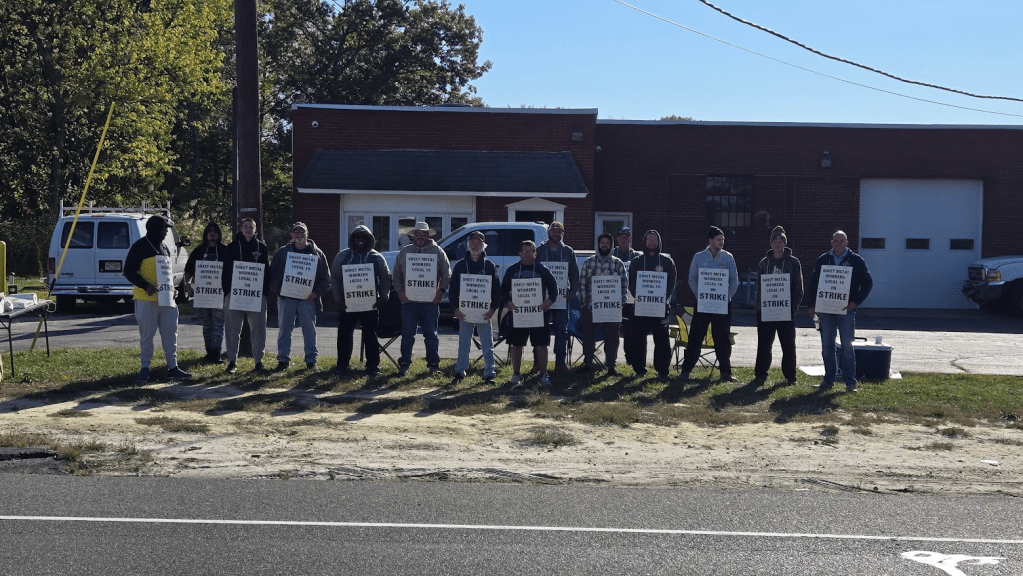
    Striking metalworkers hold up signs on Thursday, Oct. 2, 2025, reading, “Sheet Metal Workers Local 19 on Strike.” (Aidan Vanhoof)

    By Aidan Vanhoof

    Oct. 2, 2025

    DEPTFORD, N.J.Metalworkers waved signs and chanted slogans outside South Jersey Metal, or SJM, in Deptford on Thursday, protesting diminishing wages amidst higher costs of living

    Workers’ employment contracts expired on Sept. 30 after three years, leading to now stalled negotiations for higher wages and better working conditions, union officials said.

    Sheet Metal Workers Local 19, a tri-state area labor union, organized this strike.

    “We’re out here demonstrating for workers rights and higher wages,” said Bryan Blum, Union Business Agent for Sheet Metal Workers Local 19 and a striking SJM metalworker.

    According to some workers, current wages hardly afford food and basic utilities. They’re seeking a $3 wage increase each year over the next three years, meaning a $9 total by 2028.

    “[We want to be paid] to where the guys can keep a loaf of bread on the table… and have dignity in life and be able to retire,” said Blum.

    Larry Meekins, a striking metal polisher at SJM, works for $20 an hour—$5 above New Jersey’s minimum wage. 

    “I don’t know what they offered, but it wasn’t high enough for our union leaders to want to even present it to us,” said Meekins. 

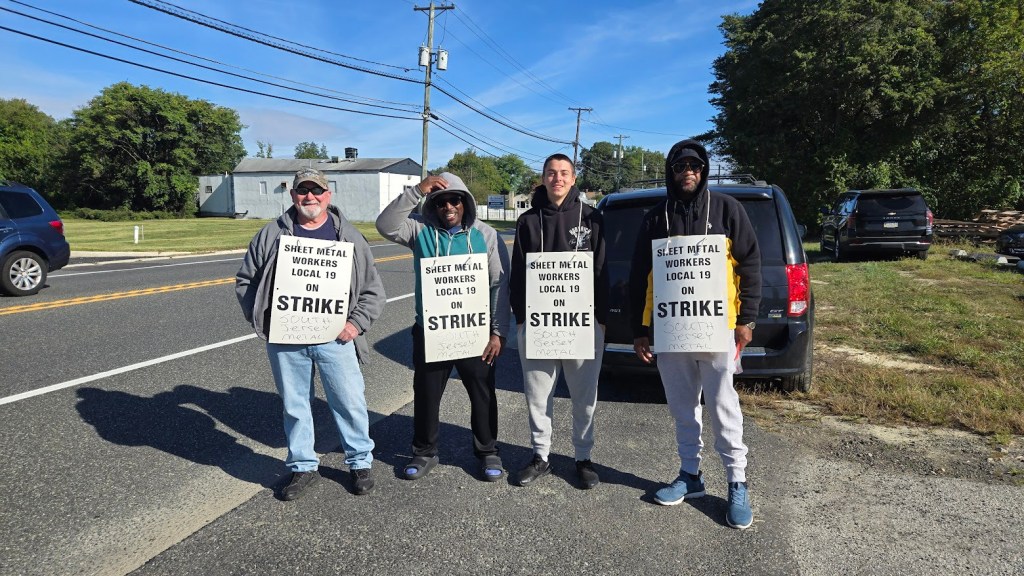
    Craig Tucker (far left), Larry Meekins (far right), as well as two other metalworkers who declined to be named, hold up signs on Thursday, Oct. 2, 2025, reading, “Sheet Metal Workers Local 19 on Strike.” (Aidan Vanhoof)

    They’ve been striking since Wednesday, Oct. 1; they mean to strike until a deal is made.

    “That’s the thing about strikes. You never know how long it’s going to go on… we could be here for another week, a couple of weeks, months… God only knows,” said Craig Tucker, a striking sheet metal worker at SJM. 

    Despite protesting, Blum made one thing clear: the relationship between workers and management is positive and respectful; only, they’ve reached an impasse. 

    “We’re at an impasse right now in negotiations, and we’ll get past it… It’s just a disagreement on a few things… and we try to meet somewhere in the middle,” said Blum.

    According to Blum, some workers have been at South Jersey Steel for upwards of 40 years. In that time, they’ve only been on strike a few times, having been treated well by SJM management. 

    According to Meekins, it’s been 19 years since their most recent strike in 2006. At the time, they were aligned with a different union, Local 194. 

    Union representatives will meet with SJM management at 11:00 a.m. on October 2nd to negotiate further.

    Deptford sheet metal company, South Jersey Metal, photographed Thursday, Oct. 2, 2025. (Aidan Vanhoof)

    The mayor, as well as retirees from Local 107 Teamsters, met the strikers to provide them food and coffee, according to a post on Sheet Metal Workers Local 19’s Facebook page

    Despite its localization, comments on the Facebook post announcing the strike tout it, among others like the labor protests at Valley Forge Casino, as one link in a greater regional workers’ rights movement. 

    SJM’s management was contacted but did not respond.