I’m not the first to say social media divides us, makes us less social, and by and large alters the way people interact in strange ways. It’s not hard to see in everyday life: even some of my classes integrate social media and modern communications technology into lectures and assignments.
To explain how social media affects the social bits of our lives would make this essay at the very least unoriginal, at worst, exceedingly boring. So I’m not going to do that. The problem extends farther, deeper, to the economic base of our society, and will continue to do so as long as we allow and rely on the corporate world to mediate our social lives.
Social media has democratized the political process in ways never before imagined. Those previously silent or voiceless can shout and hear their voice echo back to them. Ideas once too radical for the mainstream media now have a home. On the surface, it’s an absolute positive for greater society and the individual alike. I wouldn’t be where I am, and I doubt you would be too, without it. However, what was previously rational, informed discourse (or at least as close as our society can get to it) is made diluted and confusing. In a massive shift from older forms of media, like a grenade, fragments of information come at us from all angles, helping some, hurting others. Those who previously had no interest in politics now have a platform, ideas spread (good or bad), extremism emerges, and with it, figureheads representing each group in what becomes a sort of ‘dialectic’.
From Social Media Effects: Hijacking Democracy and Civility in Civic Engagement by Bolane Olaniran and Indi Williams,
More specifically, the coherent discussion of ideas has been substituted with the spread of fragmented ideas, resulting in the spread of populism (Wirth et al., 2016). To this end, social media in political discourse are rife with a pathological form of democracy (Betz, 1994; Engesser, Ernst, Esser, & Büchel, 2017).
Through the internet, democracy loses its rational edge. Irrationality conquers, then by appealing to the internet’s radical democracy, the people grant populist leaders power. I’ve explored how populist ideology has changed since the 20th century, here. New communication technologies alter ideology and the ways it’s distributed. If we are to understand this, then it’s necessary to consider those who control said communication technologies, as those are ultimately, given they’re overseeing and facilitating the distribution and regulation of that information, the arbiters of contemporary ideology.
The media, more specifically social media, is wholly privatized, unleashing the hand of profit to guide what we see and how we see it. Social media is made profitable by the selling of advertising spots, so the higher the engagement, the more attractive the platform. Then, advertisers purchase user data to further curate and target ads to individual markets and consumers. Thus, engagement is a necessary component of social media profit.
To make engagement more efficient, each user’s data is harvested. Their feed is decided by algorithms watching over their shoulder, looking at what they linger on and avoid, what they like, comment on, click, tap, and so on. In other words, one’s social media experience is shaped by profit and specifically tailored, not so much to what one may want or need, but what farms the most attention, the most engagement, thus profit.
If information and media is turned into engagement data, and if that engagement data creates profit, then that information and media is turned into profit. It’s now a magnet for engagement, not a product of a person’s creative labor and a member of a social ecosystem. Thus, it’s abstracted into its exchange value. This data is then translated into profit and sold on a marketplace for other platforms to exploit. Both the creator and the consumer are fetishized: the creator has their information turned into data, thus their role in that platform is one of data; the consumer, by interacting with that platform, is also turned into data. To the platform and to the corporation running it, users are data and nothing more.
In this process, the average person is stripped of their status as a human being. They’re no longer a person with a mother and a father, who aspires and celebrates and mourns; who kisses their partner and feels love’s euphoria. To the modern capitalist, they’re no longer someone. Now, they’re an abstract collage of data and monetary values. We are seen as the industrial farmer sees livestock.
This is what Karl Marx called, in his seminal work Capital: Volume One, commodity fetishism.
When something’s prepared for sale, it’s translated from a product of labor, a thing with an identity, properties, and a use, to an impersonal batch of values, a vessel for profit. This abandonment of reality in favor of an illusion, a sort of supernatural veneration of value, of data, is a fetish: an elevation of an otherwise normal thing or property into something transcendent, the material object acting as a shell for some hidden world.
If fetishism wasn’t a fact of capitalism, capitalism would die. The producer needs it, as profit is necessarily fetishistic. And the worker needs it, as they’re paid by fetishizing labor and changing it into an exchange value, their role as a worker being one of a commodity obligated to compete for higher wages, higher productive value, and for jobs in a job market. This, of course, isn’t a nice experience for the laborer.
In this process, the worker is alienated from their labor — a separate concept from fetishism, but a direct evolution of it. In that, they are disconnected from both the process and the ends. Their labor feels foreign, like it’s not for anything except subsistence and profit for someone whom they’ll never see, meet, and who cares nothing for them. It’s repetitive, the product of their labor is beyond them. And because of the division of labor, the community and collaboration inherent to work disappears. The property owner benefits, the mass of laborers suffers.
Marx, of course, concerned himself with industrial labor. But we Americans progressed beyond industry, nowadays exporting such labor to poorer and developing countries. But the features inherent to capitalism haven’t gone away. They’ve only morphed, retreated to more subtle areas. Beneath the content we consume and create, the messages and moments we share; beneath the words plastered across each and every screen, inside each letter, print or pixel.
By rendering the user data, the creation thereof becomes data. In that, because the profit motive structures how media is shared, if that media is to be successful, it too needs to conform to profit. Thus, media, not just on the corporate side, but on the artist’s side, is fetishized. We can see this easily in influencer culture. Across social media, users called influencers project an image made specially for their platform. Their lives, their words, the products they use and the house they live in, is perfectly shaped for social media consumption. On YouTube, creators like Mr. Beast post content edited, scripted, and overall, conceptualized, around profit, growth, and absorbing the most possible views. These creators happen to be the most popular, thus influential, on their platforms. Because these platforms are hubs for culture, they’re deeply influential to culture. So, the corporate fetishism inherent to capitalism spreads like a disease to the whole population.
This contributes to a culture alienated in much the same way industrial workers were and still are. Art and media alike are made vapid. Commodification strips it of its human character. The division inherent to the internet, as described above, divides the population and renders a community otherwise united, divided — emulating the alienation of one from the collective caused by an exploitative division of labor. This leads to a population with capitalist fetishism flowing through their veins, enabling exploitative ideologies and systems, such as right-wing populism, to take power.
Why? Capitalism.
Marx’s, or more accurately, Lenin’s proposed solution was by no means perfect. To say otherwise is to reject history. But social control over both the means of production and communication isn’t impossible, and doesn’t demand a viciously totalitarian regime to maintain it. What perpetuates capitalism isn’t the will of the working class at large, as Trump exhibits. His populist message appealed to a sort of ‘liberation’, only he diverted the working class’ gaze to the wrong places, the wrong things, and the wrong people. What perpetuates capitalism is the will of the wealthy projected onto the poor — hegemony. And modern social media is the most powerful form ideological hegemony takes, it’s totalitarian yet free at the same time. It’s beautifully contradictory in the most fundamental way.
The old world is dying, and the new world struggles to be born: now is the time of monsters.
-Antonio Gramsci
Trump played us, but we shouldn’t be surprised. Trump is a product of an unregulated market, a desperate people, and a crumbling system holding on to whatever power it can before it dies — another link in a lengthy chain of populist pseudo-fascists across the globe. He’s no isolated incident, but he’s worthy of analysis on his own, especially given his election should tell us something quite concerning:
The American system is slowly and quietly collapsing.
He’s nothing new historically, nor is he anything new ideologically, but he’s unique in how severe an example he is. He’s an inevitable and brazen mutation of American late-stage capitalism, and a sign of oligarchic control emerging all across the world. He’s a new kind of authoritarian — softer, less overt, and perfect for the 21st century.
But, strangely, this should give us a vague feeling of hope: Trump is no Hitler, and he’s far too old to continue on through a third term. What he mirrors is a working class longing for any amount of power, representation, or recognition — in other words, class consciousness.
By analyzing him and his ideology, we can understand how authoritarianism has adapted to the modern world — if it even needed to do so. I’d like to explain in three parts how Trump manipulated us ideologically, is a symptom of a diseased system, and why he’s symbolic of something much deeper. In two parts, with a more so journalistic structure; in the third part, on a theoretical basis, using Marx and Hegel specifically.
Part I: MAGA Ideology
America’s “Golden Age”
Trump ran promising a fresh golden age, an American Pax Romana. A time of flourishing and newfound comfort in which America would once again be a bastion of freedom and power.
It’s clear no such thing has happened.
Economists, even before he was elected, knew his economics would fail;¹ and he stated he would be “a dictator on day 1.”²
As of August 2025, the economy is wretchedly volatile, much more so than before. GDP, job, export and import growth has either stagnated or stayed the same.³ Yet, Trump’s inauguration was populated with among the richest men on Earth, who were given the keys to the government, able to purge those charged with regulating them to their hearts content.⁴ Plus, extensive tax cuts to the most wealthy classes.
His 2024 campaign, even some of his behavior now, displays an affinity for authoritarianism. He recently deployed the national guard to combat crime in Washington, D.C. despite declining crime rates.⁵ He sent 2000 national guard troops and 700 marines to L.A. to combat protesters⁶ — a move that likely only contributed to further rioting among otherwise peaceful protests.⁷
Despite this, it wasn’t just the electoral college that won him the election — he won the popular vote.Meaning that, despite his projected policy failures and the historical detriments of policies like protectionism and excessive tariffs, people still voted for them.
This should tell us that, during Trump’s rise to power, policy was far from the main focus — it was Trump himself.
Trump’s Cult
Trump maintains his cult of true believers. While his approval rating continues to tank, it rests at a consistent 37%.⁸ 37% of Americans, despite his extensive policy failures and a nonexistent “Golden Age,” still support him. But this isn’t surprising: objections to Trump’s critics are baked into his ideology. Faux populism, anti-intellectualism, “fake news,” and so on, each churned to become a vicious cocktail of willful and extremely active ignorance. He has a fan base within which ignorance is considered a virtue, not a failing.
So, even if the world seems against him, it’s not because Trump’s policies are poorly thought through, historically illiterate, and deeply authoritarian. It’s because the world is out to get him as he strives to challenge existing power structures.
This attitude comes from the fact that Trump, during both terms, identified himself as an outsider against the elites, dedicated to purging the world of its most corrupt people. We were asked to disregard who he actually was — a felon and a member of the wealthy elite known for his deeply corrupt business practices. Through this, he created a sort of ‘honest corruption’: he was obvious, but to his supporters such corruption was the defiance necessary to bring about meaningful change.
Paired with a vulgar charisma quite unique to him, he cultivated a downright religious following. According to the European Consortium for Political Research,⁹
…self-professed ‘forgotten men and women’ are willing to subordinate themselves to an authoritarian leader who defies social rules and legal orders. Trump promises to ‘make America great again’ (mission), attacks internal and external enemies (Manichean demonisation), exhibits a strong personal presence, and uses derogatory language against opponents (makes supporters feel part of the in-group).
Trump doesn’t come across as a politician. He looks like a fool, but in that same sense, he doesn’t hide much, at least as far as we can see. He doesn’t sugarcoat or speak in neutral, egalitarian terms as many politicians do; he doesn’t talk down to people or use words none can understand; and he’s as far from pretentious as it gets.
However, this ideological satire isn’t always directed at the political elite, which would be nothing unsurprising on its own, given he’s a populist. What turns his persona from charisma into something far more dangerous is his use of minorities as the satirized. Through this, Trump can both direct blame from the institutions he’s protecting, e.g., corporate interests, and towards those who genuinely need protecting, i.e., minorities and oppressed groups. Then, by calling his administration an American “Golden Age,” he cultivates an ideal, an illusion, which all of his followers hope for, long for, and will do anything for. This permits even the most atrocious of crimes, given they contribute to the cause.
With all of these, Trump becomes a cult figure. Loyalty to him and his ideology is paramount, given he is the only mechanism by which his utopia can be realized.
Part II: Trump is a Corporate Tool
Politics is Money, Althusser’s Ideological State Apparatus
Trump isn’t the cause, as some liberals may make him out to be. He’s a symptom. As in, his election tells us of a disease hidden beneath the surface. In this case, widespread systemic failure.
America is the wealthiest it’s ever been, but that wealth seldom makes its way down to the middle and lower classes. It’s stuck on top, with inequality widening, and with it a drastic shift in the distribution of power.¹⁰ Through lobbying agencies, campaign funding, and so on, the wealthy can control who is elected and the policies they enact. Corporations control the news and the media, alongside the machinery by which information is spread.
In essence, because the democratic process is infested with financial interest and legalized bribery, and because the economy controls the distribution of resources and information, the interests of the market often help determine the dominant ideology. And, while we are free agents who can decide on our own who to vote for, we are free only insofar as we interpret: If the information itself is tainted ideologically, one can only exercise their agency by understanding and interpreting already biased information. Thus, one’s ideology, or at least the information leading to ideology, can be predetermined by the market.
For example, if I am raised in the Cold War United States, and all I’ve been told about the Soviet Union is that they’re a horrific, evil, totalitarian regime, and I’m allowed no access to alternative information, I would be irrational to think they’re anything but terrible. The only rational conclusion based on the information given to me is that they’re evil. So, whatever group is dominant, because they control what we see, can control what we believe. It’s why indoctrination often entails the careful control of information alongside active efforts to persuade.
When applied to America, we can see how capitalist ideology flows through each crack and crevice of American society; and, how the worst products of that ideology inflate, absorbing everything.
For example, viewership of right-wing news network, Fox News, directly correlates to Republican Party popularity and election success, by about a 0.5% increase in votes with every 0.05% increase in Fox News viewership.¹¹ Rupert Murdoch, who founded Fox Corporation, is among the world’s richest media figures and a deep-seated free market libertarian. He has a net worth of $24.6 billion, having founded Fox News to be an exclusively right-wing media outlet.¹² In other words, to disseminate ideologically biased news — i.e., propaganda.
Or, the rise of Christian conservatism in America — a demographic instrumental in Trump’s election. According to Politico,¹³
Soon after his arrival in Los Angeles, Fifield founded Spiritual Mobilization, an organization whose mission was “to arouse the ministers of all denominations in America to check the trends toward pagan stateism, which would destroy our basic freedom and spiritual ideals.” The organization’s credo reflected the common politics of the millionaires in his congregation: Men were creatures of God imbued with “inalienable rights and responsibilities,” specifically enumerated as “the liberty and dignity of the individual, in which freedom of choice, of enterprise and of property is inherent.” Churches, it asserted, had a solemn duty to defend those rights against the encroachments of the state.
Soon after, the aforementioned organization became a national political force, encroaching on a religious-political territory once dominated by socialists,
Many wrote the Los Angeles office to request advertised copies of Friedrich Hayek’s libertarian treatise The Road to Serfdom and anti–New Deal tracts by Herbert Hoover and libertarian author Garet Garrett. Armed with such materials, the minister-representatives transformed secular arguments into spiritual ones and spread them widely.
While the movement died out in the 1960s, they flooded the American government with religious imagery justified using elitism, anti-communism, and libertarian deregulation, associating the American state and economic system with Christian ideals. This would give rise to American Christian nationalism and conservatism, then Trump.
And that’s just two examples that in-themselves justify essays. Let’s not consider the 52 billionaires who poured hundreds of millions into Trump’s campaign¹⁴ for whom he’s performing political favors right now.¹⁵ However, I won’t disregard the campaign funding given to Harris: she received more than Trump.¹⁶ This should be a sign — perhaps the two party system is failing to represent anyone except the most wealthy among us.
This tells us that Trump’s ideology, alongside his policies, are made to pander to an elite class of billionaires; that the elections are meddled in hugely by the billionaire class; and that American liberal democratic institutions are losing their democratic edge and descending into oligarchy, implying what is called “systemic decay”: defined by The Climate Sustainability Directory as:¹⁷
…the gradual weakening of an institution’s core functions and its capacity to deliver on its stated mission or societal role.
If the stated mission or societal role of the American state is to “form a more perfect Union, establish Justice, insure domestic Tranquility, provide for the common defence, promote the general Welfare, and secure the Blessings of Liberty to ourselves and our Posterity,” then on all fronts the American system is decaying.
Part III: The Working Class Remains Alienated
Marxist Alienation and Hegelian Dialectics
The working class is alienated and has been for quite a while.
On an economic level, the federal minimum wage hasn’t changed since 2009, yet inflation in sectors like housing, education, healthcare, and food, continues to increase, raising costs of living to unlivable levels.¹⁸ As I’ve stated, inequality is expanding at alarming rates, while increased economic activity benefits none except the wealthiest few.
On a more theoretical level, Karl Marx, whose body of work originated over a century and a half ago, had insights into human labor, capital, and oligarchical society that still resonate today. In particular, his concept of alienation, as described throughout his work:
Because the individual is understood as a laborer only in terms of their productive potential (because under wage labor, an individual is only rewarded as per their productive potential); and because the rewards for that labor are extracted from their wages as profit; and because they are laboring only as operators of instruments of production, as opposed to directly interacting with the end product of their labor, labor and life under capitalism becomes unrewarding, miserable, and repetitive.
For example, an office worker, whose labor involves crunching numbers or making periodic calls to clients, doesn’t see the fruits of their labor. Those fruits only mean more profit for their boss or financial security for people they’ll never meet. All they get is a monotonous job and a periodic paycheck.
Then, because of increasing inequality and higher costs of living, they spend their life worrying — about whether they’ll have somewhere to live in the next few months, if they can feed their kids, if they can afford to have their car fixed, and so on.
But Trump can’t just be explained by a sense of material anguish. He needs to be understood according to his mass ideological appeal. We also need to apply the theories of philosopher G.W.F. Hegel. In particular, his theory of recognition — the master/slave dialectic.
To have any sense of identity, it’s important that we surround ourselves with other people. Other people, when they see us, confirm to us that we are something other than a ‘floating consciousness’. That we are, in fact, really what we think we are. But to be recognized there has to be another entity recognizing. And if that entity recognizes me, then it is an entity like me: it is another human, another consciousness. Therefore, it also wants to be recognized, so it likewise labors for recognition. Eventually, a ‘dialectic’ begins: two parties fight to be the one recognized (the master), and not to be the one recognizing (the slave).
When applied to politics, a pattern emerges: Populism is appealing during times of systemic decay because during such times the working class is at its most alienated. Conditions are the worst for them, therefore they are the entity slaving away, recognizing the ruling class while the ruling class doesn’t reciprocate.
When a populist leader emerges, riding in as a savior for the masses and claiming to use immense authority to rebuild a broken nation, they’re of course highly appealing. They’re a magnet for recognition. At the same time, they’re an entity recognizing an unrecognized group. Therefore, they seem to even things out: the working class feels recognized, and the person ruling them seems to labor for them.
Despite this, the working class remains a class of slaves.
Right-wing populist policies rarely benefit the working class. However, because the figurehead is the source for recognition and policy isn’t, policy no longer matters — all that matters is the figurehead.
Through this a sort of idolization occurs, and with it, fetishism: a cult of personality.
In this case, the figurehead is the master. They direct the gaze of the slave (the working class), thus they continue to dominate and misrecognize those beneath them. They see them, not as a class, but as tools for recognition; the working class sees itself as a class, the figurehead as a tool. The dialectic stalls because neither side correctly recognizes the relationship they’re engaged in.
Trump, for a time, was that leader, that master, that figurehead.
Trump and most totalitarian leaders share a major similarity — they direct the gaze to them, then to an out-group (Mexicans, Jews, Kulaks), and to an elusive external enemy (immigrants and liberal social policy, the Treaty of Versailles, the bourgeoisie). By doing this, the figurehead can make the population feel like masters themselves. Not simply equals, but like they’re the recognized group others are laboring for. And the figurehead takes the position of the savior (Trump as the only path to the Golden Age). The working class submits to a master to feel like masters themselves.
Because of this fetishism, and because of the vapid pleasure brought by this feeling of superiority, ideology becomes enjoyable. Trump represents a new world that hasn’t yet come. Trump’s ideological power comes from this, thus, as long as the ideology has power over a given group, that new world hasn’t come. Therefore, they keep pushing and pushing, and if that new world is greater than any immediate issues — such as mass deportations or authoritarianism — then anything is justified if it contributes to the cause. This includes suffering: if one suffers or if conditions are bad now, all of it will pay off at some point.
Religion has a similar effect: even while a person suffers, because someday they’ll be somewhere better and because God truly cares for them, they’ll prevail. They’re able to endure immense hardship. In that same sense, a German during WW2 may have suffered massively because of bombings, personal losses, and so on, but the ideal Hitler gave them motivated them beyond horrendous material conditions.
The feeling that one is fighting for a new world and belongs to the right group is a satisfying one. It satisfies desire, while the ultimate goal — say, a communist utopia, racial purity, or a Golden Age — gives an elusive, unquenchable desire. Thus, an unparalleled sense of meaning and purpose in life.
MAGA ideology isn’t just something people believe in — it’s something people live for.
Yet, this doesn’t make Trump a totalitarian. Maybe he wants to be one, maybe he doesn’t — I can’t read his mind. But there are immense similarities between MAGA ideology and totalitarian ideology, and the ways people are enamored and hailed into each system are nearly identical.
He’s a spectacle: Trump’s power comes from his persona, his behavior — not the invisible hand of policy and economics. He’s someone to be watched, just like the fascists and communists of the 20th century. With his vulgar sensibilities and overwhelming irony, alongside the primal simplicity of his rhetoric and style, he brings a new type of oligarchical authoritarianism fit for the digital age. Unlike past totalitarians, he doesn’t use grandiosity to create such a spectacle: he uses blunt simplicity. But, in the end he’s an oligarchic tool, thus a symptom, whose most obvious properties all branch from this one point.
We shouldn’t focus anymore on Trump, only on what he symbolizes: a desperate move from a desperate system, a ruling class dedicated to maintaining power, and a dying country ready for something new. When a given system begins failing, it can’t be justified by its own merits — it has to convince people of them. At this point, we get populists like Trump, who create paradoxical ideologies to justify continuing a broken system.
To address the quote located above, our culture, as divided as it is, has outpaced our state and economic structures. But the old world still clings to life. It is at this confrontation with the absurd, the clash between our need for something new and the world’s refusal to progress, that we get people like Trump; and, with it, a new world, good or bad.
It seems like ‘freedom’, maybe the most abused term in politics, is practically undefinable.
Each ideology has its own definition of the word. Two of the top 10 most powerful conservative organizations are named after it. Even those that don’t do so still use ‘freedom’ as an ideological mainstay: The conservative organization Club for Growth describes itself on its home page as “limited government Americans who share in the belief that prosperity and opportunity come through economic freedom.”
On the opposite end of the political spectrum, even communist organizations like the RCA write on their website, “In the words of Engels, it will be the ascent of humanity from the kingdom of necessity to the kingdom of freedom…”
One defines freedom as intrinsic to a free market; the other, as exclusive to communism. This tells me two things: What freedom means is a semantic game, and each values freedom in some way.
To the conservative, freedom is a technical, legalistic freedom, one brought by limited government and a respect for human rights. Freedom comes at a cost — often monetary. To leftists, freedom is something slightly more abstract: from the same sentence as above, the RCA continues:
…from a world in which the vast majority of humanity is relegated to the mere struggle for survival to a world in which each individual can realize their full intellectual and creative potential as we collectively chart the course for the future of our species.
Vladimir Lenin distinguishes between two types of freedom: formal (bourgeois) and actual (proletarian). Formal freedoms appeal to the capitalist. They’re legalistic, technical. Actual freedoms are the more abstract, existential, left-wing freedoms — freedoms that promote human flourishing above all, as opposed to providing the opportunity thereof. Both are interdependent: a society can’t abandon either, or else it risks falling into capitalist inequality and communist authoritarianism.
Both types are the basis for most modern ideologies: even the most authoritarian of leaders tried looking free. Stalin wrote,
Real liberty can exist only where exploitation has been abolished…
Hitler himself said in a 1922 speech,
We recognized that freedom can eternally be only a consequence of power…
Each center themselves around an abstract concept of ‘freedom’, with the end goal of redefining freedom along ideological lines. And, each wants the elusive actual freedom while failing wholly to fulfill. However, while these dictators stripped their people of formal freedoms, even those may be pointless if they lack sufficient systemic support.
Let’s take the modern day United States: while we might technically have a free press, 90% of the American media is run by just 6 major corporations, meaning each one distorts information and manipulates us on a regular basis in their favor. And, such policies are meaningless to the over 700,000 homeless people starving on the streets, living off of scraps gifted to them by those passing by; to the 45,000 people who die each year because they can’t afford basic healthcare; to the over 149 million people in the United States struggling to meet basic needs, like food, housing, and transportation.
Freedom means nothing if it exists in a broken system. The conservative organizations listed above who exploit the term, through economic deregulation, caused most of the problems we’re stuck with now. While the masses starve and the rich grow richer, society supposedly grows freer.
I must ask you, does this really look like a free society?
Thus, while formal freedom is important, it’s not everything. Actual autonomy must be realized existentially, not just technically. Philosopher Jean-Paul Sartre realized this, arguing that people remain obsessed with income and the burdens of life, which keeps them held back as individuals and prohibits them from living their fullest, most meaningful lives.
We may have a limited state, as in we lack a monarchy or dictatorship, but we remain enslaved to an exploitative division of labor, to the whims of the market and the dictates and ideologies of oligarchs. The market still rules with an iron fist. Sartre wrote in Materialism & Revolution,
History has shown that no individual liberation is possible while men remain enslaved by an economic system which exploits them. Freedom demands a collective transformation of society.
Lenin recognized this, inspiring the two types of freedom defined above. He and Sartre were alike in believing that a collective liberation only came with the death of competitive, oppressive bourgeois society and its false notions of liberty. To both, the end of capitalism would realize an entirely new form of freedom.
They were wrong. Sartre migrated away from Marxism later in life, Lenin died before hopes of his communist utopia collapsed beneath Stalin’s brutality. Formal freedom is a necessary prerequisite for actual freedom. But the end goal of bringing about a sort of ‘freedom of the soul’ is nothing except noble, honest, and authentic. As every person’s desire to live, their driving force, comes from a different point. We are all unique in that way, so we need the freedom to navigate to that point, guaranteeing each person can live the best possible life.
We may have faced the Soviet Union, but paired with our ruthless Cold War corporate imperialism, whether it be Guatemala, Chile, Vietnam, Iran, Argentina, and so on, we were no protagonists. We were the villains. Yet we claimed to be ‘spreading freedom’. For liberty to be ‘righteous’ like Americans think it is, we need actual freedom because it ensures freedoms only exist insofar as they contribute to basic human flourishing — an objective that should be the only goal for any given state structure. As what other purpose does the state serve except to ensure the wellbeing of its people? Any other purpose turns a state structure into unnecessary over-regulation — in other words, oppression.
But freedom still needs to be defined. This essay may not make waves, but perhaps only for personal reasons, it’s important that ‘freedom’ be given a definition, because what freedom is colors the rest of a given ideology.
Humans are social beings to an extreme extent, as we are dependent on each other. Not only dependent on each other to accomplish a goal, like cleaning a yard or getting a ride somewhere. Without community, some people may even lose their will to live.
Meaning and purpose in life, which give us a reason to live beyond biological impulse, are healthily married to the social world. Ideology and religion give us a will to live so strong we paradoxically offer ourselves to die for it. We dedicate our lives to causes, thus those causes become our lives: the cause supersedes our existence.
The communist revolutionary dies for the cause in the hopes that the revolution will live on after him, the religious zealot sacrifices themselves and lives after death, and so on. This drive to live on after death via our impact on the world is called the “death drive.”
Both psychology and philosophy help explain why and how this death drive is social. In particular, Lacanian psychoanalysis and Hegelian philosophy.
To Lacan, identity comes from our relationship with the Other (another entity, whether social, constructed, imagined, or anything else) and an obsessive impulse to please them. We project an identity and personality shaped by how we think the Other wants to see us. In other words, we want to satisfy the Other, and we go to extreme lengths to do so. It’s a perpetual people-pleasing inauthenticity. Even ideological systems, like Marxism or Christianity, can be understood through Lacan, as God gives a gaze from which we can gain approval, or the revolution gives one a system through which they can feel recognized within the revolutionary framework — every action they do is by default validated, given it contributes to the cause.
In Hegelian philosophy, humans are driven by a desire to control how they’re seen and how the Other sees them. This compulsive need to control our social environment forms the foundation for Hegel’s philosophy, which he called the Master/Slave Dialectic. One subject, the slave, recognizes another; the master is the recognized. But in the process of recognizing, the slave labors, refining their identity and actively subverting the master, at some point becoming the master themselves. It’s a human urge to control. To have a hand in whatever affairs are consequential to them, and the way it often aggravates the other party, ensuring a constant and unending battle for control. Our lives are dictated by our relationships with other people. While his philosophy is best applied to politics, it’s fundamentally a psychological concept, one echoed and made far more sophisticated in psychoanalysis.
Anthropologically, humans can’t survive without this impulse to please and control, which also explains their origins. Before agriculture, humans lived in nomadic communist groups kept together by mutual aid. If I needed food or clothes, I’d receive them under the assumption that I’d someday return the favor. Normally, the favor was returned. Humans are born with ethical intuitions like empathy and pity. Some ethical theories like non-cognitivism base ethics as a whole on emotion and impulse. Without this, which allowed us to hunt and survive despite lacking basic natural defenses, we’d have gone extinct long ago.
In some philosophical traditions, particularly Nietzschean philosophy, each person is seen as selfish. For example, we only act collaboratively for self-preservation, only do charity to feel good about ourselves, self-sacrifice to live on after we die. But in the end, we still find ourselves dependent on other people, even if that dependence is a deep-rooted selfishness. We are selfish, but by being selfish we become altruistic. While this calls into question the idea that selfishness is intrinsically bad, it fails to dissuade human nature — a nature psychologically dependent on other people.
Human psychology is thus predisposed to unfreedom. We live subservient to the Other and to be dominated, ironically so we can dominate — over death and over identity. But this doesn’t mean freedom is impossible. Only that the libertarian, individualistic version of freedom is. We must redefine freedom as a collective pursuit and one originating from a fundamentally unfree spot.
At first glance, the Leninist route would make sense. After all, the main idea of Leninist collectivism is freedom through collaboration. But Lenin rejected formal freedom outright in favor of a temporarily authoritarian revolutionary government in transition to communism. To him, such freedoms, because they failed in serving the working class, apparently weren’t necessary.
But, psychologically, we still need formal freedom. We are a deeply tribalistic species; in that, we choose over and over again the group that makes us feel recognized and cling to that group as tight as possible, shaping our identity according to our in-group and against the out-group. Leninist communism hopes to achieve freedom through community. But in the process of creating a mono-culture — the single community, the collective — communism dismantles the freedom to choose what group one belongs to, and forcibly immerses them into a single group. Without a choice in groups, those who may not fit in properly remain alienated, losing a sense of meaning and purpose because they haven’t discovered a community that fits them. In the end, the communist mono-culture fractures. People have different desires, different needs and hopes in life. This leads to different but weakened tribes and a shallow, tense, totalitarian society.
Proletarian, actual, existential, freedom first requires bourgeois, formal, legalistic freedom. To be free, a society must give its people the ability to join whatever groups and organizations they may wish, that means refraining from ideological oppression of any kind. All of this, in the end, is to achieve the ultimate possible existence: to allow the people to live their best lives.
Therefore, I will define freedom as follows: Unconstrained thought, expression, movement, and choice in group and identity; i.e., the ability to live an ideal life according to one’s most authentic nature without external constraints.
This definition aims to synthesize the formal and the actual. Neither can exist without the other. This is where the state structure and economic system — in other words, ideology — is important. I’ve already dismissed capitalism, I’ve already dismissed communism. But capitalism manifests across both the right and left wing. Social democracy, while it’s certainly a milder form of capitalism, doesn’t do much to stop economic imperialism and intensive exploitation; and both problems are natural symptoms of a free market. This should tell us that a free society shouldn’t have a free market. Instead, a democratic, planned economy — one in which those previously exploited now control their state, their economy, and access to their needs; i.e., what communism aimed to do — is the most free. In other words, democratic socialism.
We walked through the food bank and into the main room : a small, gray cafeteria, with cement floors and tables decorated with colorful place mats and cheap plastic tablecloths. It was a tad chaotic as people came and went through the garage that led to the front. Outside sat Camden, NJ: a place dauntingly different from my comfortable suburban life just a few miles to the East.
We prepared to volunteer for and provide a dinner for a solid number of homeless men. Despite their condition, they’re consistently kind, grateful, and sweet to us. Perhaps some have done bad things, but all I know of is their respect toward us.
I’m by no means a perfectly moral person. I’m no master of ethics and altruism who’s worthy of praise. I hardly even volunteer as much as I should. But my few experiences working with those men have been anything but unenjoyable.
My fellow volunteers mostly came from a Catholic Parish near where I live. In fact, I’m almost certain I was the only atheist among them. But even though God was with everyone except me, I found something greater than religion. Not the obnoxious sounds and sights of a nondenominational church or the liturgical warmth of a Catholic Church; not a fleeting euphoria I’m told is the ‘Holy Spirit’. Nor did I find what I thought I’d find: some unpaid labor that’d feel rewarding in the long term.
Not to sound corny, but I found my own God: what any good existentialist would call meaning. Maybe not a cosmic purpose, but I’m beginning to think this ‘meaning’ is only more powerful: it’s more direct, personal — more real.
I’m of the belief that meaning — a reason to live beyond biological impulse — originates in struggle. It’s something we decide, without something commanding us to fight for it and seek it out. It’s a struggle we aren’t thrown into by a pessimistic universe, but a struggle we’re thrown into by our own will. We don’t derive meaning from a flood trapping us in our house; but we derive meaning from chasing the storm or rescuing people from it, even if the danger is the same. We don’t derive meaning from walking down a street and watching as people protest; but we derive meaning from walking down that street in the same fashion, but protesting, shouting, feeling as if we are making a difference.
What is remarkable is what is meaningful. A miracle would be lame if not for its defiance of natural law, a life would not be meaningful if it were not temporary. In the same sense, we live our whole lives on Earth, taking in our surroundings and living with other humans. When we decide, we choose a path among infinite alternatives, thus we make an exception: that which we decide makes an otherwise neutral, meaningless existence meaningful.
When I work in Camden for no pay, it’s not necessarily because God compelled me. If that were the case, I would have a reason to do so commanded to me. But if I have no reason to do so beyond what is basically ‘whim’, I’m making a decision by my own will — neglecting of course the more deterministic aspects of life, like my subconscious mind or the external world. If I am making this decision, I am not following, leaving it to another to define me — but I am defining. I am defining myself by my own actions, therefore, by definition, making my life meaningful by my own actions.
This ‘spontaneity’ is an anxious experience: one feels condemned. They are responsible for what they do. There is no cosmic father-figure to pull you out of a rut. You and you alone can do that. Philosopher Jean-Paul Sartre famously said,
Man is condemned to be free; because once thrown into the world, he is responsible for everything he does. It is up to you to give [life] a meaning.
So when I work in Camden, it’s not necessarily for any moral virtue baked into me. I would say this goes for most people, though maybe I’m a bit selfish. People often do what is right in order to avoid an emotional deterrence, or condemn for the sake of empathy. In this case, it’s the urge to do something meaningful. To love a stranger as if I knew them personally — that’s a powerful experience, and, in a way, a high.
And, it’s peaceful: the anxiety that terrorizes me, whether clinical or existential, is eased. I’ve made a decision, and it is in turn gifting me meaning. A meaning that comes from my helping other people as a member of a communal species (as Lacan said, “The I is always in the field of the Other.”) and a meaning that comes from something deeper. This, in a way, is the atheist’s loving God: rationality and decision-making: the cosmic order of the universe. We atheists are moral without a foundation. We don’t need one. We have ourselves, and as unreliable as it may seem, I would say morality is the greatest way to cope with a silent, terrifying, violently negative universe.
Arthur Schopenhauer — among the most depressing, pessimistic philosophers ever, who believed the best thing one could do for their kids is ensure they have no hopes in life in order to avoid disappointment — thought so, saying,
Compassion is the basis of morality.
As what else but kindness can free us of such an otherwise horrible existence? If we are to rise above it and defy a dead universe by giving it meaning, we are to redefine a horrific universe by bringing it beauty. That in many ways is the key reason for the success of religion. But it’s taken us thousands of years to realize that this religion is composed only of other people, thus, why not make that religion other people? The death of God has brought a new age of compassion, an age of empathy without force. The world may be more cold, yet we are now free to respond to it with warmth.
Since this essay is rather long, I think it’s important that I state my thesis early on: Marxist materialism, while on paper quite practical, fails to bring about the most effective solution to capitalism by reducing both human consciousness and class-struggle to material conditions; thus, our understanding of capitalism and the solutions thereof become oversimplified. Hegelian theory paints a more accurate picture of modern capitalism and class-struggle, and should be used as a replacement or at least an accompaniment to Marxism in the modern world.
Karl Marx is widely cited as, not necessarily the first, but the most important anti-capitalist in philosophy. He refined anti-capitalism into a masterfully constructed theory of economics, politics, psychology, and even existence. One which, since Marx’s time, has grown into arguably the most influential philosophy in history.
We can spend as much time as we like attacking Marx. The Marxists of the 20th century are an easy example, given the atrocities they committed in the name of a communist utopia that would never come. But Marx himself was never involved in such things, nor were many of his ideas. Lenin, I would say, is the one to blame — though he wasn’t the devil on his own, either.
So, I feel it is necessary that, when critiquing Marx, we don’t look at the USSR or Maoist China or any other major communist experiment. I consider them, given they were bolstered heavily by the USSR during and following Stalin, more so Leninist and Stalinist than Marxist.
A great example is religion: The Catholic Church’s official position on Marxism and socialism as a whole is disapproval, due to the anti-religiosity of the USSR and subsequent socialist regimes. But Marx himself was not expressly anti-religious — Lenin was. The quote misappropriated as being ‘anti-religious’ — the one in which he refers to it as “the opiate of the masses” — is both a mistranslation and taken out of context. By and large, when taken within context, the quote holds quite a positive view of religion. Only that one should focus on abolishing the material conditions that lead to religious belief, as opposed to resorting to religious belief to cope.¹
So, it’s become more important to look at his philosophy in relation to other philosophers, in the abstract as much as in a pragmatic sense. The ‘pragmatic Marx’ is the pragmatism of his followers and not so much himself.
Part I: There is no Marx without Hegel
When we consider Marx, we have to consider Hegel. Even Lenin thought so. From his Collected Works,
It is impossible completely to understand Marx’s Capital, and especially its first chapter, without having thoroughly studied and understood the whole of Hegel’s Logic.
Hegel’s dialectical logic, while abstract, is the foundation for Marx’s dialectical materialism, thus, his historical materialism — i.e., his material analysis of class and economics and his material analysis of history.
But if we are to look at Hegel on his own, perhaps also considering his heavy influence from Kant (Hegelian theory could be considered an extension of Kantian theory), we reach our first contradiction. Hegel was an idealist — in that, he considered consciousness to have primacy over material. The idea being, we process reality through consciousness, so, consciousness is the foundation for our understanding of reality. This also means we can’t ever truly grasp reality as it is always translated into a conscious form. It is thus changed from its material form into a non-material form: we are altering it to fit our own limitations. And, that this conscious experience of reality is altered and made more sophisticated with time and knowledge — our increasing ‘understanding’ of the world, moving towards an eventual Absolute: an ‘ultimate understanding’.
This doesn’t imply that material reality doesn’t exist. But it does imply that immaterial conditions are more important than material conditions. This is where Marx diverges from Hegel. From A Contribution to the Critique of Hegel’s Philosophy of Right,
For revolutions require a passive element, a material basis. Theory is fulfilled in a people only insofar as it is the fulfilment of the needs of that people. But will the monstrous discrepancy between the demands of German thought and the answers of German reality find a corresponding discrepancy between civil society and the state, and between civil society and itself? Will the theoretical needs be immediate practical needs? It is not enough for thought to strive for realization, reality must itself strive towards thought.
This is a complete inversion of Hegelian thought. In that, while Marx is not making a statement on the philosophy of consciousness in the same way Hegel or Kant did, he is arguing for the impracticality of such a theory. For Marx, theories of consciousness don’t necessarily translate into political theory. Thus, a new political theoretical position is necessary.
If political economy is necessarily material and it is made specially to alter material conditions, and if that which is pragmatic is that which is materially useful, then this new ‘political dialectic’ would need to be material: dialectical materialism. Thus, Marx was able to apply Hegelian logic to a material base.
Part II: What Marxism gets right
With this essay I’d like to reverse that process. But, I’d first like to clarify that Marx was right in arguing that most otherwise immaterial aspects of political economy are stuck in a funnel — they all strive toward a material ends.
Let’s take the family. From A Contribution to the Critique of Hegel’s Philosophy of Right,
The family, as person, has its real external existence in property.
And, from the preface for A Contribution to the Critique of Political Economy,
The mode of production in material life determines the general character of the social, political, and spiritual processes of life. It is not the consciousness of men that determines their existence, but on the contrary their social existence determines their consciousness.
The family, at the time of Marx (and even now), was considered by many to be the main economic unit. For the wealthy, families of power and influence intermarry to link one-another together, conjoining the greater powers of society, thus making them stronger. But this power only manifests in a material form: in power over people, power over politics, and power over economics. All of which either concern labor processes, the enforcement or creation of laws, or the exchanging of money. Why do they want these things? So their material conditions can improve and grow increasingly stable, able to endure for generations.
For the working class, the family unit allows for a stable system of interconnectedness and for increased labor, thus income, for the household (at least at Marx’s time). All of these things contribute to better material conditions for the household. This doesn’t discount the importance of family, but it absolutely alters how we ought to understand family: as something necessarily due to material conditions and not something that holds primacy over them.
Part III: What Marx got wrong
But, striving towards something doesn’t necessarily imply the supremacy of that which we strive towards. If I’m hungry and I want food, does that hunger define who I am? Am I not more complex than my desire for food, even if it’s a fundamental driving force for humanity? When we look at it from this perspective, it would imply that what I strive for at this given moment is who I am. And this simply is not the case. When expanded to a political perspective, we can understand that the ends do not define the means. After all, do we regard the Holodomor or the Great Chinese Famine as something acceptable for their desired ends — that being a ‘perfect communist utopia’? For the majority of people, I would say, no. ²
Yes — material conditions are the ultimate ends. But those material conditions are defined also by immaterial conditions. Money, for example, holds no value beyond the value we put on it. The numbers printed on the corner are only recognized as ‘value’ because of a symbolic system we all mutually agree upon. This number is only worth anything because an abstract mathematical system defines it as such, and so on.
Also, the problem remains that the means by which we reach a ‘material’ ends can be either material or immaterial, depending on what and how we intend to reach that point. It isn’t necessarily material. And, why do we want to reach the material ends? Why do we want to have our hunger satisfied, our house to be bigger, our income more stable? I would say, for emotional satisfaction: the avoidance of anguish. As the negative aspects of poor material conditions, except for death of course, are experienced via our senses (pain, pleasure, etc.), positively or negatively.
This is where an effective theory of consciousness is in fact pragmatic. It allows us to understand ‘why’ we strive toward material. And if that ‘why’ is the foundation to material, then it is most pragmatic to consider that ‘why’. Thus, the material at the very least is not dominant over the immaterial, especially in consciousness and even in politics — and this isn’t just a theoretical claim: it is a practical claim.
Part IV: Applying the Hegelian dialectic to egalitarianism and socialism
Now that I’ve established this, how can we apply an idealist dialectic to material reality? (In the following part, I will draw heavily from the theories outlined in Hegel’s The Phenomenology of Spirit.)
When we consider Marxist theory, what’s the end goal? Is it not to enhance working class power through the complete overhaul of prior economic and political conditions?
From Marx’s Correspondence of 1843,
Man must recognize his own forces as social forces, organize them and thus no longer separate social forces from himself in the form of political forces. Only when this has been achieved will human emancipation be completed.
While this may seem like the most material of material goals, I would not consider it as such. I want to dispute the idea that social forces are inherently political and that to emancipate the social we must first emancipate the political. To me, they are one and the same and the balance between material and immaterial in social and political life is in a state of equilibrium: one is not dominant over the other. They are codependent.
If the goal is for the working class to be autonomous, then it seeks to be independent of its opposite, its negation, the ‘Other’ that controls it while contradicting it: the ruling classes, who give them their identity as a ‘working class’ by providing their opposite. After all, for something to have a positive property there must also be a negative property for that ‘thing’ to be anything other than neutral.
If the working class wants to emancipate itself from the ruling class, it is therefore attempting to stop the dialectic, its interaction with its opposite: it wants to become its own entity: it wants to become ‘self-conscious’, to use Hegelian terminology. It wants to be recognized as the entity with power, while the Other is to be submissive to it, or even eliminated altogether. It wants ‘self-recognition’ without a traumatic antithesis to give it identity. It wants to garner an identity as absolutely equal — as without exception — so, it cannot have class: i.e., socialism.
But this problem of recognition is not one of material but one of a collective desire for emancipation. They feel unrecognized by the ruling class; or, if they are recognized, as a mere servant to the ruling class. But, this position is of course undesirable. After all, if the main goal is to be recognized, it is easiest to be recognized when you are the dominant class, the Other to which all other classes strive. Therefore, the desire is one of power. Yes, economic power, but economic power as a means to recognition, as a means to authentic self-determination: as a means to the same self-consciousness that the ruling class has without becoming a new ruling-class.
Part V: Where do we go from here?
This is neither material nor immaterial. It is both a desire born from an immaterial conception of class, of culture and community — one born from a mutual suffering at the hands of a higher power, and a desire both for it to end and to be recognized as a valid community; and a desire for material emancipation from that higher class. It is born from a desire for a better emotional state, a stronger community, and a more comfortable and vastly more fair material state.
This struggle, therefore, can be understood in two ways:
As a desire for self-consciousness (in this case, autonomy, communal strength, and a less alienating and competitive system — alienation being an emotional byproduct of poor labor systems, and competition dismantling community: an immaterial state and something often considered by idealists), and not necessarily food or nicer houses. A person a thousand years ago may even be happier than a person now even if we live like kings compared to them. For example, wealthy celebrities are notoriously mentally unwell (Kurt Cobain, Chris Cornell, Layne Staley, etc., all of whom are dead either due to suicide or drugs and all of whom belonged to the same musical movement). Material conditions play a role in happiness, but they are by no means dominant.
As a desire for dominance over a class that once oppressed them, a deeply Nietzschean move: moral and political condemnation based upon resentment. But, this would imply that communism is not the solution to their problems. Instead, a new form of capitalism which simply ‘swaps’ wealth.
The first option is more likely. However, the second option is not dead, in fact, it is thriving.
Hustle culture is a great example. When people complain about debt, poverty, and so on, they are not told that they are in debt and impoverished because they’re being exploited for everything they’re worth as a human being, but because they need to work harder. They need to serve the ruling class better. If they do so, they’ll be allowed an opportunity to join the ruling class and exploit others instead of being the exploited.
They’re told there exists certain secrets, certain things rich people have that poor people don’t. That there is a fundamental difference in nature between the two classes, but by attaining these properties, the poor can become rich too. Thus, absolving the rich of any ethical issues (as the difference in wealth isn’t a difference of exploitation, but of ‘mindset’) and turning resentment into paradoxical desire.
This attitude can be summarized by the following phrase:
“Why do they get to be rich? I want to be rich too! It’s unfair!”
It’s not a recognition of a systemic problem, but an infantile fetishism of both class and wealth (the application of non-material and often arbitrary yet extreme value onto an object or concept; another term may be ‘idolization’). One resents the ruling class, so they seek to destroy them. They seek to take from them their wealth, but it doesn’t necessarily have to be a collective redistribution. It could also be a more egoistic concentration of wealth, thus, the desire to replace the ruling class, not equalize all class.
This can be seen in right-wing populism: the idea that the world is unequal, but that’s not the problem — it’s those who are in the lower classes who are failing, not the ruling classes. Thus, the state and the economy is to provide gateways to wealth, not wealth itself.
Part VI: Marxism contradicts itself
Thus, option one is the only option that would consistently lead to a socialist system: it is thus the only truly Marxist position, despite being idealist in nature. Marxist materialism thus logically and pragmatically contradicts itself.
If we are to recognize the power of the working class, it is by recognizing both why a new society is valuable and how it is to be achieved. And it is not necessarily through immediate revolution and solely material changes, as we saw with the 20th century communists, who attempted a solely material revolution without a consideration for anything else. This led, inevitably, toward a totalitarian ends, as the only means to changing the immaterial (culture) through a specifically materialist framework (Marxism), is by changing it materially: via authoritarian measures.
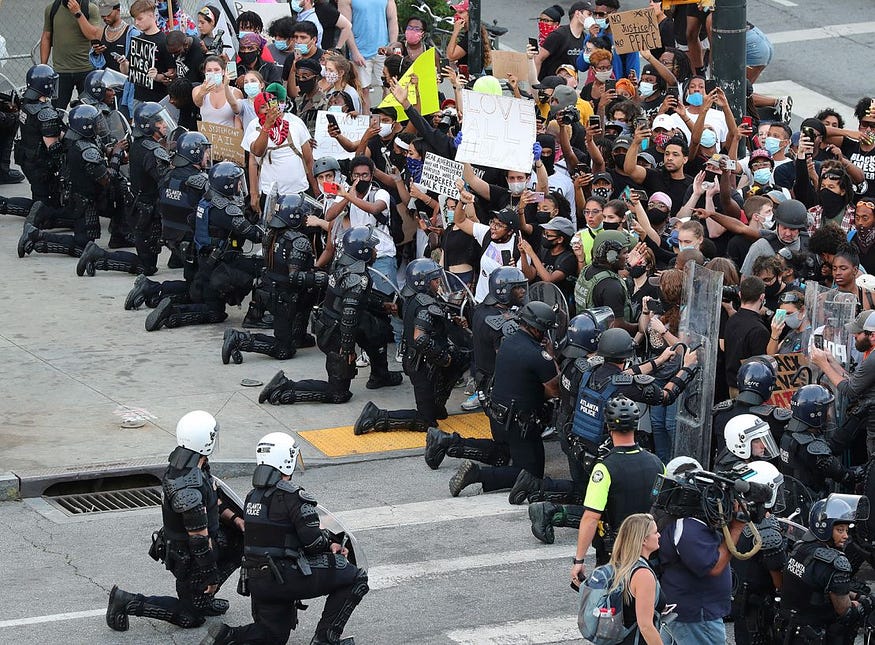
Repression doesn’t destroy that which is repressed, it merely sends it ‘underground’, which can be understood through Hegel. When a given group lacks recognition, or is actively stripped of it, it labors for that recognition. It does not die out. It often becomes stronger, fighting for what it feels is necessary for its sustained existence. We can see this in protests, wherein riots are often incited through a police presence meant ironically to deter riots. Or how the USSR failed entirely to eliminate religion despite oppressing religious organizations.
A democratic socialism, one in which reactionaries and religious folk alike can exist freely, is wholly necessary. As by repressing these groups, they will not die — they will only grow stronger. We can imagine a given group as a body: straining and pushing and fighting only makes the human body stronger. We tear our own muscles to bring more back, we break our souls to rebuild them bigger, and we strain our minds to garner more knowledge. It’s the embodiment of the Nietzschean ideal: when that which kills you only makes you stronger.
¹Here is the full passage from A Contribution to the Critique of Hegel’s Philosophy of Right:
Religious suffering is, at one and the same time, the expression of real suffering and a protest against real suffering. Religion is the sigh of the oppressed creature, the heart of a heartless world, and the soul of soulless conditions. It is the opium of the people.
The abolition of religion as the illusory happiness of the people is the demand for their real happiness. To call on them to give up their illusions about their condition is to call on them to give up a condition that requires illusions. The criticism of religion is, therefore, in embryo, the criticism of that vale of tears of which religion is the halo.
Criticism has plucked the imaginary flowers on the chain not in order that man shall continue to bear that chain without fantasy or consolation, but so that he shall throw off the chain and pluck the living flower. The criticism of religion disillusions man, so that he will think, act, and fashion his reality like a man who has discarded his illusions and regained his senses, so that he will move around himself as his own true Sun. Religion is only the illusory Sun which revolves around man as long as he does not revolve around himself.
It is, therefore, the task of history, once the other-world of truth has vanished, to establish the truth of this world. It is the immediate task of philosophy, which is in the service of history, to unmask self-estrangement in its unholy forms once the holy form of human self-estrangement has been unmasked. Thus, the criticism of Heaven turns into the criticism of Earth, the criticism of religion into the criticism of law, and the criticism of theology into the criticism of politics.
²While from a psychoanalytic perspective we can dispute this, what psychoanalyst Jacques Lacan theorizes pertaining to desire relates to ever-changing goals defined most of all by something immaterial: the gaze of the Other.
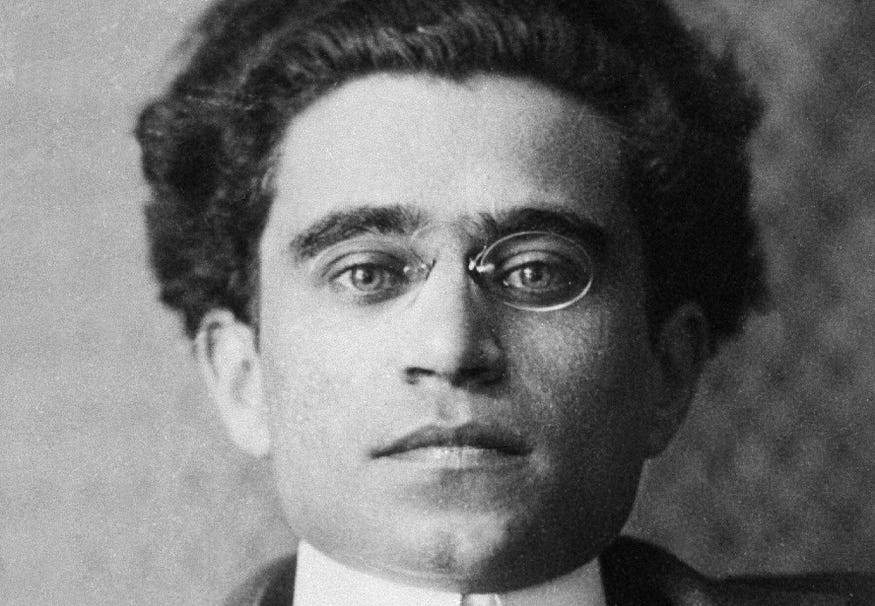
Italian philosopher Antonio Gramsci; source: Jacobin
Tribalism is an old, seemingly inevitable fact of American life. Everyone has opinions, none appear compatible, and the American political system remains a wreck; one which the rest of the world gawks at like a crowd watching a public execution. But this ideological division does not occur as per the centrist viewpoint: that Americans simply want radically different things, leading to an ideological conflict. To many, making the two sides collaborate would be like fitting a square peg into a round hole — it’s simply impossible.
The object of this article is to focus most of all on how the centrist narrative isn’t sufficient to explain why we are divided as a country. This leads to my thesis: Division in modern America is a problem of signification, not of belief.
Before I go any farther, I think it’s necessary that I diagnose the main source for this division. I believe the answers are found in Slovenian philosopher Slavoj Zizek, who applied the Lacanian point de capiton (a theory from French psychoanalyst Jacques Lacan) to ideology in his book The Sublime Object of Ideology,
… the multitude of ‘floating signifiers’, of proto-ideological elements, is structured into a unified field through the intervention of a certain ‘nodal point’ (the Lacanian point de capiton) which ‘quilts’ them, stops their sliding and fixes their meaning.
Ideological space is made of non-bound, non-tied elements, ‘floating signifiers’, whose very identity is ‘open’, overdetermined by their articulation in a chain with other elements — that is, their ‘literal’ signification depends on their metaphorical surplus-signification.¹
A floating signifier is an unsignified element in a signifying chain. This is a massive part of Zizekian ideology critique, being the means by which the subject is able to embrace contradictions.
Let’s take communism: communist states in the past have been brutal and tyrannical. Yet, communists to this day believe that such systems are integral for human flourishing and freedom. How is restricting freedom necessary for freedom? Because the floating signifier (freedom) is ‘quilted’ into the authoritarian (communist) ideology. Thus, ‘freedom’ is signified as ‘communism’, and vice versa. Other ideologies are not signified as free, but communism is, so the communist state is ‘free’ because all that isn’t communism is innately ‘unfree’. Therefore, communism is synonymous with freedom, both by process of elimination and direct association.
During this process, the ideology retroactively changes any past experiences, memories, and beliefs, and alters them to fit within the ideological framework. The communist sees their comfortable upbringing as a product of bourgeois privilege in the face of widespread struggle; the fascist sees their diverse schooling as the death of authentic culture and heritage, and so on.
By applying the aforementioned theory, I believe division is thus not just a problem of conflicting signifiers, but a problem of competing signification.
Donald Trump ran on a working class and populist basis. This is nothing new. What he did remarkably well was take working class concerns, like the price of eggs and milk, or housing costs and job security, and signify them into a right-wing quilt (rising housing costs are not an inevitable product of an unregulated free-market, but a product of immigrants, minorities, environmental regulation, and so on).
Such economic logic operates like this: The working class is only struggling because the wealthy are, too. They’re overregulated and tax dollars for social programs are in fact corrupt, as those are used and abused to exploit the victimized wealthy, who demand tax cuts and deregulation. The demanded upward transfer wealth manifests in the greater economy, which manifests in the working class’ collective wallet. In other words, the wealthy are suffering because of leftist regulation, and the economy is bad, therefore, to help the working class, the wealthy must be deregulated.
Let’s take this quote from the US Department of Labor,
The days of waste, fraud, and abuse are over. The Trump administration is bulldozing through red tape and big bureaucracy, returning freedom and purchasing power back to hardworking men and women.²
And,
Workers feel heard, respected, and empowered by this president.³
In what sense does bulldozing government programs give power back to workers? Do they vote for their CEOs, managers, wages, and so on? Do they vote for the oligarchs that control what they see and hear? The oligarchs who placed them in debt and increased the costs they’re so concerned with in the first place?
While we can choose what to buy, what we buy is to a degree determined by our income status, the advertisements we see, the retailers we have access to, and so on. We don’t have absolute freedom of choice in this case, thus we do not have a ‘free’ economic ‘vote’. In other words, purchasing power, which, in the above passage, is equated with ‘freedom’.
We have a range of choice, but that range is decided by factors either out of our control, or within our control but in which our control is limited. If I am poor, it is decided by demographic, region, lineage, and so on, as much as it is decided by personal choice (with exceptions, of course; e.g., addiction); if I am rich, it is the same way, and my purchasing power is determined solely by the value of the given currency.
So unless one runs society, they are the exploited — not the exploiter. The only true power they have is over the ‘democratic’ state, thus the only power they have is through regulation of that which they have little power over.
But even in my case, I operate under certain assumptions, such as the idea that ‘democracy’ implies universal power, as opposed to the opportunity for power; that a state in the midst of a democratic backsliding is better than an already undemocratic market; that a politician is better than a CEO, and so on.
But Trump understands — or at least functions as if he does — this signification process, alongside the contradictions baked into his thought. Let’s take this quote from his 2019 State of the Union address,
America was founded on liberty and independence — not government coercion, domination, and control… Tonight, we renew our resolve that America will never be a socialist country.⁴
Trump signifies past Marxist-Leninist communist regimes as the blanket term ‘socialism’, thus ‘oppression’ with ‘state-economic-power’, even if that state power is fundamentally different from the authoritarian hellscape his supporters fear. He signified normally socialist signifiers (working class liberation) as per a fascist ideological field. He took working class concerns and didn’t justify the right wing, but attacked the solutions to his voters’ problems and propped up himself and his economic class in the process. This also allows him to act as an authoritarian, doing precisely the “government coercion, domination, and control” he is quoted as opposing, as authoritarianism is reframed as a socialist symptom — one which is impossible under a non-socialist system such as his own.
This indicates something even more important: the working class has the same concerns practically universally. Bernie Sanders ran a tremendously successful presidential campaign in 2020, and proves himself still to be the most popular member of congress, meaning he is crossing the party line. He and Trump said they’d solve similar problems with different solutions, but, in the end, the American people simply wanted something consistent: some kind of change and a solution to their problems.
Division is even more deep-seated than before. Each side hates the other because they truly, in the most honest of ways, feel the other is destroying the country, as they fundamentally disagree, not on principle, but on definition. To one side, freedom means freedom from taxes and corporate regulation, to the other it means economic justice. Yet even economic justice means two different things. Economic justice could mean justice to imperialists and freedom from exploitation, to others it means the freedom to hold property. And what is property? Some may say it’s a path to theft, the other may declare their opposition to be the thieves.
This division won’t disappear with respectful discussion or unity of any kind. It’ll always exist, because in the end, it isn’t just ideological.
From the Human Rights Campaign,
Polling indicates that 64% of all likely voters, including 72% of Democrats, 65% of Independents, and 55% of Republicans think that there is “too much legislation” aimed at “limiting the rights of transgender and gay people in America.”⁵
The majority of conservatives take little to no issue with gay and transgender people, yet Donald Trump is known to be devoutly opposed to them, believing that they are a terrible problem leading to the corruption of moral society, pushing the need for book bans and restrictions on childhood expression of queer identity. Trump and the GOP as a whole, given hundreds of anti-transgender bills have come out in the past few years, would make such people out to be extreme threats and those who respect their right to live to be radicals and extremists. If congress mirrored the will of its voters and the news media honestly portrayed public opinion, transgender people would face little oppression. Yet, they face such oppression, indecating that this problem is not one of ideology, but one only pervasive within the ruling class.
‘Freedom’ is thus signified as freedom from the expression of minority identity, ‘immorality’ is signified as ‘queerness’, ‘extremism’ is signified as ‘social liberalism’, and basic queer expression is retroactively made into an ideological imposition. Those who support such ‘impositions’ are turned into scapegoats — alongside the queer community — for ideological oppression and social degradation, among other things.
This is arguably the most important thing to consider in understanding ideological dogmatism. To return to the previous example of communism, Zizek writes,
‘Communism’ means (in the perspective of the Communist, of course) progress in democracy and freedom, even if — on the factual, descriptive level — the political regime legitimized as ‘Communist’ produces extremely repressive and tyrannical phenomena. ‘Communism’ designates in all possible worlds, in all counterfactual situations, ‘democracy-and-freedom’, and that is why this connection cannot be refuted empirically, through reference to a factual state of things.⁶
To use this passage in our context, rational argumentation becomes impossible, as (1) opposing sides operate with different definitions; and (2) contradictions are inherent to the quilting process, yet this process still goes on, so contradictions to a given ideology are by default meaningless.
This signification is not the product of a working-class spontaneously animated toward general purpose bigotry, nor is it necessarily religious. Protestantism has little consistent stance on queer issues (many churches and theologians — and I am inclined strongly to agree with them⁷ — are highly supportive of the queer community), and the Catholic Church has roughly the same inconsistency, but the simultaneous stance that such people should be respected and loved regardless. Neither the church nor the Bible advocates for religious state intervention, and historical situations to the contrary have often been pandering by the church to the state to accumulate wealth and power — a class based distortion of scripture.
Thus, such an animation is a product of those who seem to care — those who establish transphobic and bigoted policies. This is the central problem: it is not the powerless, but the powerful, who are causing this division. It is not ideology on its own, but, as Gramsci put it, cultural hegemony. The working class is exploited, not just materially, but ideologically, by the property holding and political classes.
¹Slavoj Zizek, The Sublime Object of Ideology, 1989
²Lori Chavez-DeRemer, 100 days in, Trump’s Golden Age puts American workers first, 2025
³Ibid
⁴Library of Congress, President Donald J. Trump’s State of the Union Address, 2019
⁵Cullen Peele, Reality Check: Public Opinion on LGBTQ+ Issues Ahead of Second GOP Debate Highlights the Failure of Extremist Attacks, 2023
⁶Slavoj Zizek, The Sublime Object of Ideology, 1989
⁷I’m tempted to write an essay on this problem in the future, if only for myself in order to organize my thoughts.
I’m young, naive, a little bit optimistic. The world, as my older friends and coworkers have told me, hasn’t crushed me into a pulp. I’m glad, and I hope I won’t lose this slightly stupid optimism, because, in the end, bathing in hopelessness will bring me and this species nowhere.
But, in time, as I have expressed in past articles, I believe this optimism will become increasingly hard to hold on to. The world will fight me and berate me until I harden into a rock and lose all personality. Debt, in particular, frightens me. I hate even thinking about this, but the notion of affording a house is a distant and idealistic dream and the student debt I’m already saddled with ensures that.
But there’s more to the story than debt. Debt can be paid off. Debt can go away. But labor doesn’t. Humans love, and need, to work — and it doesn’t have to be ‘work’ in the traditional sense. It can be a family, friends, anything really. Anything that gives us a purpose, because as social beings, we are fundamentally subservient, thus laboring, to the social world.
But labor in modern life lacks what makes such work so enjoyable and meaningful. It lacks soul. It’s shallow and drab. And for lack of a better way to articulate it, it makes me rather depressed.
I dream of being a journalist, and quite a good one, too. But what happens if the costs of living exceed what I’m paid? I’ll be trapped in a position in which I’m forced to proceed, not according to what fulfills me, but what fulfills a dying economy which lacks any concern for the people whom it serves. And where will the fruits of my labor go? Not to myself or those I care about, but an abstract representation of an abstract monetary system which represents abstract value systems, all so an oligarch can take a flight to space or pay off the politician I probably voted for. Labor, because of where and when I live, is less and less meaningful. And, will achieving my goals make me happy to begin with?
This isn’t a new problem. None of it is. The problem of what philosophers call the ‘alienation of labor’ has been a key theme across leftist theory for nearly two centuries now. But political theory has existed for thousands of years and philosophy concerning labor nearly equally long. So what gives? Why are philosophers now so concerned with ‘alienation’?
I’m beginning to suspect a consistent through line, especially since reading the most radical of them all: Karl Marx.
Karl Marx theorized that a principle issue in capitalist labor is its adversarial nature. From The German Ideology,
For as soon as the distribution of labour comes into being, each man has a particular, exclusive sphere of activity, which is forced upon him and from which he cannot escape.
And,
In a real community the individuals obtain their freedom in and through their association.
He built off German philosopher G.W.F. Hegel, who argued that, in order to be authentically self-conscious, we must also realize that we are observed, that we are something other than a ‘floating consciousness’ and an actual being. And, other humans do that observing. Thus, humans aren’t their fullest selves without other humans, which means humans need other humans to exist meaningfully, rendering us collectivist by nature.
Therefore, the individualistic and deeply competitive nature of the labor market leads a person to anguish; all because, instead of collaborating, they’re obligated to fight and compete and win or lose. We are thus alienated from society at large and delegated to our individual, subjective worlds. This is the problem inherent to the ‘meritocratic’ division of labor: it takes from people what makes life enjoyable. It ensures that each and every person beneath or ascending, and even those who have already done so, are isolated and alienated, divided from their fellow people and forced into a prison of meaningless, spiteful, and gamified work. The individualist work-ethic fails for this reason: it hurts the individual and it kills the collective — none win.
But, if we were to take the meritocracy seriously, decide the working-class deserves poverty and debt and focus only on the most successful of us all — declaring wholeheartedly that the successful deserve what they have — how does this affect them? It may hurt the ‘greater good’, if there is such a thing, but perhaps it’s necessary; perhaps it delegates the best to the best, the worst to the worst, and the average to the average.
Let’s assume this is true. What now?
I’d like, as I so often do, to reference psychoanalyst Jacques Lacan. Through his framework, we gain a better understanding of desire. From Lacan’s Seminar II,
Desire, a function central to all human experience, is the desire for nothing nameable. And at the same time this desire lies at the origin of every variety of animation. If being were only what it is, there wouldn’t even be room to talk about it. Being comes into existence as an exact function of this lack.”
If we were to apply this quote to ‘achievement’, the career-person, whose life revolves around their job and the identity they’ve built for themselves surrounding this career, is driven by a desire for further recognition. In that, they are driven to success because (1) they want to be seen as successful and (2) they want to have their identity which is defined by their career validated to the greatest extent it can be. 1 and 2 are effectively the same: the subject wants to be seen as the ‘epitome’ of their respective occupation. Their identity is their occupation, thus to feel ‘whole’ they must embody their occupation. The ‘best’ lawyer, the ‘best’ doctor, the ‘best’ CEO or investor: in each of these cases, the ‘best’ of a given occupation is a role only assigned to a person by other people. If they want to achieve success and feel successful — not merely make more money — they need to be seen as successful.
Who sees a person as successful? Who cares for the success of a lawyer, doctor, CEO or investor whom we have no relation to? Those who care most are the subordinates of the aforementioned, the people pushed as far down as possible, the people whose livelihood and recognition is valid only insofar as they recognize their own inferiority. As, to compete, one must first identify their adversary. This is the key reason why success is so appealing: it is, in essence, a ‘recognition pump’ — a constant and unending stream of identity-validation and confirmation.
Competition becomes the most powerful drug. But, with this, we land at yet another problem: the inferior may be unequal materially, but they often, though not always, live more meaningful lives. They strive, they fight, they struggle, all for a better salary and access to the coveted recognition pump.
Struggle is the greatest source for purpose in life, since desire is the driving force for human behavior, as to fulfill our desires could be considered among the worst things to happen to a person. After all, what now, having managed great success, does one have left to look for? What reason does one have to live if all that once made life appealing has been eaten away? One gets bored with success and they begin desiring once again.
Recognition is what we desire, but desire itself is what makes recognition appealing — because to feel whole we seek recognition, yet to be recognized only means the creation of new aspirations: we never truly feel whole. As to fulfill our desires is hell and to be recognized is heaven. They are each treated the same yet they are fundamentally incompatible.
The joys of hierarchy are nothing beyond a condemnation. Capitalism is made for the career-person; the man, woman, or in-between who dedicates their whole existence to the production of profit. In other words, the hardworking, rugged individualist: the exploiter being exploited, the servant to the servant, the weakest among the strong.
This is why so many successful musicians, actors, and other celebrities, who seemingly achieved all that they set out to do — whom we assume should be happy — end up depressed. They have nowhere else to go. Their life has plateaued. It has reached its end because there is nothing left to do or desire except what will soon grow boring and meaningless.
While the working-class wallows in debt imposed by the white-collar, the white-collar debtor wallows in nihilism. Each are equally alienated.
I may be idealistic in saying so, and I believe I am, but perhaps this is where we can find an important form of resistance: in living a life actually worth living; not in pursuing success, but in living for other people — the people who make success appealing, but remain crushed by it. For by doing so — by actually living — we are taking from capitalism what makes it so potent: its power to, not only exploit our labor, but to exploit our happiness. By living a life despite it, we are materially taking from the capitalist market its most necessary asset: the alienated laborer.
To answer the question of ‘why now’ I asked before: life is only getting worse and alienation is a more profound problem than ever. Industrial labor and white-collar labor alike are frustratingly arbitrary and absurd, guided increasingly by AI and information technologies; new technologies which turn the modern educated laborer into just another processor crunching numbers and ‘knowledge’ to translate their value as a human into profit. Existence becomes defined by social media, turning recognition universal, opening the door to premature recognition of success through curation and editing, stealing from recognition the very desire it exists to satisfy.
Our lives are more devoid of meaning than ever before, as the very foundation thereof has been destroyed. Your exploiter feels the same as you do, so don’t just blame them: blame what incentivizes them to exploit.
Labor alienation is how capitalism keeps the individual subservient: their labor means nothing, thus they find meaning elsewhere, growing complacent by the hour as they assume the fruitlessness of labor is a default state. Therefore, one’s misery is associated with the economy or politics — changeable conditions — yet they feel this misery is normal, they won’t fight it. After all, life’s life. Thus, what they feel is controllable — family, friends; i.e., collective, social activities — are left to the individual to control, while both greater society and themselves care little for the damage done to them. The individual in individualist society remains wounded — they’re merely more alone than before.
Capitalism forces repentance: it mirrors the self-sabotaging, self-punishing zealots of the Middle Ages, who beat and whipped themselves for mistakes they identified within. The modern laborer punishes themselves for deviating, for wanting something better, for working a healthy amount and longing for rewarding work. Because to rebel against labor means to cease one’s labor. If one doesn’t labor, they’re ostracized as lazy, unemployed, stupid, and so on; and they lose a source of income, thus they risk even death. Thus, they repent for their laziness before the oligarchical gods of capitalism, losing both self-esteem and the means to live.
So, not to beat a dead horse, but I must ask, how the hell am I free?
Mountains in Washington State; Source: Shutterstock
Recently, I’ve been spending some time thinking about my future, as any 19-year-old may. Not only college or my future career in journalism: what’s fascinated me has been my retirement. That point in life when working becomes undesirable, when to labor would bring me little meaning, and all I want is to settle down with a partner, perhaps a dog, and relax.
What fascinates me is how that retirement would go. I live in Southern New Jersey — known for its farmlands and seemingly endless suburbs and retirement communities, both of which have a habit of trapping me in a maze-like loop, with sparse landmarks and cloned houses and trees gifting me the now frequent opportunity to get lost. This endowed me with a deep and fundamental hatred for such communities, and I’ve decided that to live in one would be my personal hell.
Thus, in thinking about that, I’ve found that to live in its negation — an isolated, natural, beautiful environment that features actual life on earth — is far more desirable. One of my favorite TV shows is Twin Peaks. If you haven’t seen it, I’ll insert a picture below. That is the life that hypnotizes me — among the mountains, away from the world, in nature.
Twin Peaks; Source: Nevertwhere
This has become a daunting task. Retiring and living a simple, content, quiet life — that’s seemingly an irrational want. This is my thesis to this essay: Being content is impossible in a world of wants. The modern world has ironically devolved with its simultaneous evolution: life is steeped in and utterly dysfunctional without consumption, without being bombarded with systems designed specially to play on human desire. To be content with little has become impossible; yet, to be content with lots remains impossible.
I’d like to preface my main argument with a statement on what leads a person to be content. In this case, I’d like to apply the theories of French psychoanalyst Jacques Lacan.
It is human nature to chase, but never to attain. To attain our desires would mean the creation of new desires for us to chase. What modern America is so good at doing is riding on our backs, holding the stick before our faces, letting us chase it in loops until we take the carrot (buy the product), then replacing it with another carrot — perhaps it’s bigger (advertisements, iPhones, and so on) — keeping planted on the saddle until we keel over and die. We only stop desiring once we die.
It is what mediates this desire that holds the most power over humanity: the state, the corporate world, our heroes, our villains, and so on. Desire is controlled by the world around us, by our culture, by language, by what we are taught and not taught. Desire, thus, is the desires of the Other — not our own. We desire what we want others to think we desire; i.e., we want to be seen a certain way, and we attempt to embody that ideal — the Ideal-I — and project it. This becomes our self-identity. As Lacan wrote,
The I is always in the field of the Other.
This is where I hope to elaborate on contentedness: the world of desire is not necessarily our own, as it is controlled by the world of symbolic systems — what Lacan called the symbolic order. It is with this that I come to my first conclusion: Authenticity is not primacy of the self, but primacy in the choice of selves.
The subject is incapable of the traditional, ‘existentialist’, libertarian type of authenticity: To use an example from Jean-Paul Sartre, the self one has when they think the mannequin is a real person, and the self they become when they realize it is fake, are one and the same; they are equal parts of the whole identity. One’s identity is formed by how they want to be perceived, and they become either happy if they are merely chasing it; or they become anxious if they feel they have already achieved it, but are not being recognized by the Other as such. Who a person is when they are watched is a version of their self, and who a person is when they are not is just as much a version of their self. But neither one is their ‘only’ self: they are each simply different selves. One projects internally in the pursuit and self-deception of the Ideal-I, and one projects externally in the projection of the Ideal-I.
Therefore, to become ‘authentic’, one must first acknowledge that such a thing is impossible. Authenticity is a myth, but a myth that remains important to human happiness. So, it is a myth that must be critiqued, but one that must also be supplanted with a non-myth: the idea that, instead of pursuing absolute ‘self-recognition’, one should achieve absolute ‘choice-recognition’. What this means is, I must choose how I am to be recognized, take steps to achieve that recognition, but avoid groups that recognize me differently to how I want to be recognized: in other words, authenticity manifests in choosing the groups you belong to, not necessarily in rejecting group identity. It comes in picking those who recognize you for who you are — who you want to be seen as — and not altering your sense of self to fit in with others, instead altering the others to fit your sense of self.
It is with this that I conclude that humans are fundamentally collectivist. Anti-social behavior thus often comes with a crisis of recognition: it comes when the Other fails to recognize the subject, alienating them from recognition as a basic precondition for happiness. Then, they reject recognition altogether, losing this communal edge to human nature. This would also be why altruism and ethical behavior is often important for individual happiness.
This is what capitalism does so well: it provides artificial means for recognition — watches, clothes, shoes, music, and other consumable products. Products that are sold to us as means to another identity, as pathways to a different self, as ways to fit in to the groups we choose. To build on a past metaphor, commodities are the carrot, corporations are the person holding the stick.
Contentedness comes in recognition without artificiality: e.g., a Buddhist monk may spend their time living a minimalist, basic existence, but they are purely content, as they are recognized within their group, and, whatever suffering they may endure pales in comparison to what they desire — true enlightenment. Desire overcomes pain, and with the meaning provided by recognition comes a warped happiness. This desire paired with pain emits a paradoxical attachment to the source for pain: the source for pain becomes a catalyst for the power of desire, as desire is amplified as the guiding light through times of suffering. Pain strengthens desire by bringing one closer to it emotionally.
Contentedness in the sense of the Buddhist monk is different from happiness as it is sold to us: the recipe for happiness has hardly changed for thousands of years, despite drastic changes in material conditions: it is predominantly social. Happiness is the satisfaction of recognition. Contentedness is the satisfaction of recognition wholly independent of material conditions. It is thus pure happiness.
Modern happiness is different: it is happiness mediated by commodification: it is the commodification of all that is social, happiness originates in the social, thus that which is commodified is also that which is social, therefore that which is happiness is also that which is commodified. Thus, in the modern schema, commodities equal happiness. This demands one desires what exists on the short term: what dies alongside the Buddhist monk, dies with the purchase of each new product for the American consumer. The Buddhist monk can be content through the whole of their life, despite enduring downright primitive material conditions. The commodified person is happy only as long as they are consuming. They cannot be content, they can only have false-joy and short-term pleasures. In other words, hedonism.
This is the source of my fear: I feel that I will not be content in retirement, for even to function in society requires I navigate the internet, own a cell phone, understand the media, and so on. While I hope I don’t end up a hermit, capitalist desire — consumerism — is utterly unavoidable. To be content in America, no matter how hard one may try, is becoming increasingly difficult, and it is a task that, while possible, is appearing more and more like a sheer, unclimbable cliff face towering before us. I fear for my retirement. I hope I won’t need to for much longer.
This is my desire.
I understand it must be ironic that I’m writing this and posting it on Medium and the internet at large. I must confess I enjoy these things — the commodities and infinite access to information. Capitalism is enjoyable on the short term. It is on the long term — contentedness — where the pains of American life as a commodity are discovered, yet it is also on the long term where desire is truly meaningful. Thus, the modern world is a factory for existential meaninglessness and shallow happiness; it is a world without character beyond the briefest of illusions and a life without true authenticity. For that authenticity, as much as it is touted by our individualist culture, is a commodity in-itself.
“People aren’t persuaded by fear and discomfort; they lash out against it.” (Alexander Cruz / Graphics Editor)
I don’t think many of us like hecklers. It doesn’t matter who — be it a salesman, a political organization, or a preacher. Having a person shout at me to manipulate me in their own favor is a genuinely dreadful experience.
So, it shouldn’t be a surprise that I’ve grown to dislike the preachers. It’s nothing personal. I’ve spoken to them, and they seem like lovely people. But their message, supposedly the good news, is nothing except an attempt to scare what they call sinners, i.e., college students deviating from a set mold, into submission.
Daily, I see LGBTQ+ kids rushing past them. Sometimes, someone gets daring and steals something or kicks a sign over. One even ripped a sign in half a few weeks ago. While I certainly don’t advocate for vandalism or violence, I get it. Truly.
Watching as two men rave about the end times, the cleansing of sinners, and eternity, isn’t in itself a miserable experience. But when you’re the one cleansed during the end times and given an eternity of suffering because you like the same sex, identify a certain way, or hold alternate beliefs, it becomes miserable.
Not too long ago, I wrote an article about them and a few other preachers. In speaking to students, the reviews weren’t positive. Non-Christian students mentioned preachers calling them out, shouting at them to remove religious garb and repent. LGBTQ+ students consistently despise them and their presence. Students outside both communities regularly found them disruptive and annoying. Even some Christians had real issues with them and their aggressive approach.
Obviously, this attitude isn’t universal. But it’s a problem for many students, not only me. These preachers are here five days a week, all semester long. They’re inescapable.
It might be reasonable just to ignore them. Walk by, maybe even run by, and tune them out. However, that’s easier said than done, especially when each word spoken is directed at you.
Words are potent. We can’t act like they mean nothing, like they can be ignored. But words are just symbols. So, all you have to do to change a word’s meaning is change what it represents.
In this case, sinners, as a term, carries weight, even if the aforementioned sinner isn’t religious. It signifies the sinner as a member of an out-group; someone to be attacked. In this way, it’s not just a religious term, it’s a scarlet letter marking rejection.
So when preachers condemn an oppressed and vulnerable group, they’re doing more than insulting them. They’re actively alienating students from the environment they’re in.
As a result, power walking by or avoiding the area may not be enough. Imagine having a random man harass you, attack your lifestyle, and literally declare you a cosmic failure, then print it all on a sign in big bold letters. Obviously, that’s not easy to ignore.
Of course, two preachers bothering students doesn’t justify violating the First Amendment. It’s not like they can be removed. Rowan University is a public institution, so they’re preaching on public property. They have a right, just as we have a right not to listen.
But even if they’re allowed to be here, it’s obnoxious and exhausting. I’m tired of spotting those signs and the ensuing urge to pick a different route to class.
It doesn’t help that it’s a bad approach. People aren’t persuaded by fear and discomfort; they lash out against it. Salesmen flatter and swoon for that reason. LGBTQ+ students aren’t drawn to this God because they’re told he’ll send them to be tortured; Muslims rarely turn to Christianity because they’re harassed by two random men on a street corner.
Regardless, they’re a problem. I appreciate their right to express themselves and spread their spiritual beliefs to anyone who will listen. But, given the clear backlash and the preexistence of campus Christian organizations, it should be clear to them that they’re unnecessary and unpopular.
If the administration can’t do anything, students need to. Cruelty and vandalism won’t get us anywhere, but confronting them may. Protesting, respectful arguments, calling them out, complaining to the administration, etc., aren’t unhelpful. Even if zeal ensures they don’t budge, anything that protests their presence or tells them they’re unwelcome is a step in the right direction.
“On her way to class at Rowan College of Burlington County, Louwinda Soy’s car broke down, hurting her grades and social life. As unpleasant as this was, it inspired something important: Baron Rides.” (Contributor / Lauwinda Soy)
On her way to class at Rowan College of Burlington County, Louwinda Soy’s car broke down, hurting her grades and social life. As unpleasant as this was, it inspired something important: Baron Rides.
Soy, who will graduate next May with a Master’s in Business Administration, depicts Baron Rides as a place where students can pay for transportation, not from random strangers, but from fellow students.
“Think of it as a matching app. Instead of you finding your soulmate or partner for life, you find your fellow students, your potential friends. For example, not too long ago, my car broke down. So let’s say you’re a student and this happened to you, it would match you to other students already living nearby who you can carpool with,” said Soy.
In part, Baron Rides exists to help international students, who often have a particularly challenging time finding affordable transportation and student community spaces.
“Born and raised in Haiti, I know how it is to learn English and live in another country,” said Soy.
To her, ride-share apps like Uber and Lyft can be overly expensive, and public transportation proves sporadic or unreliable.
“I found out that so many students were struggling with transportation issues … Since we are students, and we know we don’t make money like that, it’s a consistent price compared to what’s out there. You can actually budget for it,” said Soy.
Each of these plays into her community-centric ambitions, involving the creation of community spaces linked specifically to Baron Rides. To her, our world is devoid of solid connection. She aims to be the solution.
“In terms of buses and everything, I was really struggling … I want to move beyond Rowan. I want to move beyond having it just be an application. As life gets more complicated, it’s hard to make connections. So I want to make a community out of Baron Rides,” said Soy.
She met her cofounder, Pietra Oliverira, at RCBC, whose computer science background was indispensable. Oliverira returned to her home country of Brazil, but she remains Soy’s coding adviser.
“The short answer: she is still part of the story of Baron Rides,” said Soy.
The app’s name stems from RCBC’s mascot, Barry the Baron. At first, Soy tried changing it. But since Oliverira left, Soy liked it as a reminder of their close friendship.
“Initially, we considered changing the name; we didn’t want the ties to a specific college. But after Pietra moved back to Brazil, I decided to keep it,” said Soy.
Soy aims to create more apps in the future, all with her stated goal: bringing people together.
“At this very moment, my passion is literally bringing people together. I don’t know if it’s because I was born in a different country, but it’s a passion of mine to connect people. Eventually, it may be something bigger,” said Soy.
Her ambitions extend beyond ride-sharing, into non-profit work and further entrepreneurship.
“If I could put together students willing to learn to be social media managers, like for small companies … Having some sort of a media company run by students willing to help non-profits and stuff like that,” said Soy.
At the moment, Baron Rides isn’t complete. She hopes to release it by September 2026 — the beginning of the Fall semester.
“We will launch across universities in N.J. to really get feedback,” said Soy.
For comments/questions about this story, DM us on Instagram @thewhitatrowan or email features@thewhitonline.com