• by Aidan Vanhoof

    Aug. 23, 2025
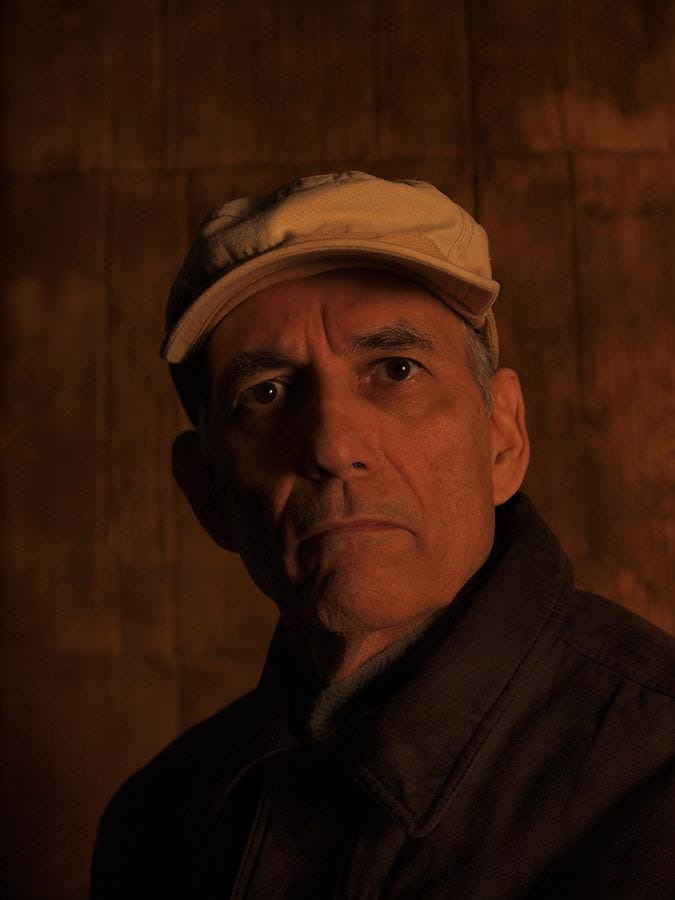
    A self portrait taken by Juan

    “A great man is not missed until you feel the loss of his greatness.” 

    -Juan Miguel Torres

    My uncle — Juan Miguel Torres — was a truly great man. In March of this year, I visited some family in Florida. I’m not sure when or why, but at one point we started talking about my uncle, whom we call Ruben, and the life he’s lived. A life which, in the time I have spent on this Earth, I have grown to feel needs to be observed. Socrates said, “The unexamined life is not worth living,” and while I do not entirely subscribe to that idea I feel it is applicable here: Ruben was an incredible man whose life and work deserve to have, at the very least, a 20-year-old college student write about it— and absolutely more people than that should learn from it. 

    Since then, I’ve started researching his life. The stories I was told were amazing — stories of advocacy, altruism, and art. However, such stories can describe, but by doing so they only scratch the surface. I hardly knew him as a kid. He died when I was just 11-years-old. As a result, I can’t talk to him. Despite this, I would say that death merely turns a person from matter to memory. In this sense he is kept alive, and I hope through this essay of sorts that I can preserve and deepen this memory. Not just by repeating stories — which I do not dare undermine the importance of — but by exploring his art and his work as much one might explore his career and family life. 

    Ruben was born in 1947 in Barranquitas, Puerto Rico. Eventually, he would move to North Philadelphia at the age of four. Being the son of Latino migrants in the 1950s, he learned a good bit about resilience; and, with that, did not take from struggle a desire to further struggle, but a desire to cease struggle for others. Paradoxically, this would elevate him above most of his peers by grounding him alongside them. In other words, he embraced the challenges in his life. In this, he acted alongside them. Yet, he rose above those challenges and became a better person for it. In this, he acted above them. 

    He wrote in a private letter:

    I tend not to be afraid of what the future may bring. I try my best to always tell myself that I am the master of my future. I am responsible for my future. I never allow myself to be a victim. If something happens to me… I don’t mope and crawl in a corner. 

    Struggle isn’t always something made to ruin, but to build. Just as in order to build muscle, one must first destroy it. To quote poet Charles Bukowski, “what matters most is how well you walk through the fire.” Some understandably don’t see it that way, but this small detail — that he didn’t let something as challenging as his circumstances stain the rest of his life — is a simple detail I admire. And it would help in defining who he became later in life, as I will hopefully display. 

    He spent his childhood immersed in the local Puerto Rican community, while he bounced between Camden and Philadelphia, the two cities across which his family was spread. When he was 17 he successfully fought for the construction of a much-needed public library in his neighborhood. He soon joined a series of Puerto Rican advocacy groups—Puerto Rico was poor, and its people faced prejudice and contempt: a radicalizing experience for Ruben. Then, he went underground, hardly talking to anyone. As it turns out, during this time he was active in a radical militant left-wing organization referred to as the National Caucus of Labor Committees—whom he joined following an event held by a front for the Communist Party. Outside the rally sat leftists of a rival organization—the aforementioned NCLC—who were polemicizing against the Communists. At the time, the NCLC was functionally a political party. It was these polemics that persuaded him to join. 

    While at Temple University, still involved with the labor committees, he worked as an editor for a bilingual newspaper. Eventually, juggling the two became impossible, and he stopped journalism, dedicating himself to activism. From then on, he agitated repeatedly against the Communist Party. In his notes, he describes “gang fights” with the Communists, one of which got him into legal trouble, motivating him to move away from Philadelphia and organize elsewhere. So he continued the struggle for years and organized across Albany, Youngstown, Chicago, Detroit, and New York, migrating from place to place. He lived a deeply chaotic life during this time—a lifestyle that would someday alienate him from his first wife. 

    As it turns out, the NCLC, led by Lyndon LaRouche, had developed a number of ‘cultlike’ tendencies, pushing Ruben to leave the NCLC in 1982. It had isolated Ruben from most of his family and friends, explaining his apparent disappearance. It seems like most of those I spoke to had little idea as to what he was doing during this time; it took reading private letters shown generously to me by his wife to know what went on. Everything I thought beforehand was just speculation. However, Ruben sustained a commitment to activism, writing in one of the aforementioned letters: 

    Those of us who have a deep commitment to make change start thinking we can change the world. As we get older and wise, we realize that it just ain’t so. But my heart is the same. My eyes moisten still when I see injustice and my anger still awakens. It’s the juice that keeps me centered and focused. 

    I’ve heard from my father that his more ‘radical’ leanings managed to land him on a no-fly list. This would make a lot of sense, even if it hasn’t yet been verified by anyone else: the NCLC was known for harassing FBI agents and had at one point been described by the FBI as a “violence-oriented Marxist revolutionary organization.” That’s no small deal. Strangely, I still respect what seems to be Ruben’s radical devotion to political change, even if he picked the wrong organization. Suppression is a badge of honor to any good activist or journalist. As what other reason is there to do anything of the sort except defiance? Truth is valueless unless it liberates — against power, against ignorance, or against fear. 

    In 1982, just after his exit, he became a bus operator for SEPTA (the public transit system in Philadelphia). He enjoyed it for its chaotic nature, swiftly rising in rank; at one point he managed two divisions (a role from which he got a few promotions). He was highly active in COMTO—an organization supporting minority workers in transportation. He remained high in rank until he left the transit business 22 years later.

    Following this, Ruben dedicated himself to humanistic study: to the arts, philosophy, and history. He mentions at points in his letters how different he would have been, given he had stayed in the NCLC. We will never know, but we do know that his exit and subsequent studies made him the best version of himself. As a young man, he was angry and he was idealistic. He describes himself as a “Puerto-Rican Nationalist” a few times. But he matured, allowing himself to grow open-minded while keeping the same passion for politics that defined his earlier life. A desire to see a just world kept him going, his maturity kept him rational. He wrote,

    I am too much of a realist to think that the world will conform to me but I am not that much of a defeatist to think that I will conform to the world. 

    Then, in 2003, he reunited with his high school sweetheart, Ann O’Donnel, and in that time he wrote hundreds of poems and letters to and about her. It’s clear to me, despite hardly having known him, that he loved her immensely.  Some of his writing is readable on his website, all of it is beautiful and exhibits a tremendous love for her. In particular, his brief essay melting the snow. My favorite passage from it being,

    many years passed. every year he could count the times that he felt a glimmer, like someone touching him on his shoulder, but he’d turn, only to find no one. a ghost of her no doubt.

    In 2009, at the age of 62, he battled stomach cancer, which drove him in the direction of photography. He would join photography school and marry Ann that same year. It was between this time and his death where his photography flourished; thus, it seems, his creativity soared. In 2013, he was honored with the Medal of Courage Award and became an active member of the Power Over Cancer dragon boat team.

    He died in 2016 when his stomach cancer tragically returned, and a few of his poems (and the quote below) reflected on death. In retrospect, they’re sometimes rather ominous, but this property only makes them more powerful. Take his poem aptly titled death:

    i feel a creeping void

    an unfilled part of me

    being occupied

    by a hollow nothingness.

    a solitary movement

    something barren

    crawls up my legs

    mesmerizing my nerves.

    alone

    i sense my death

    my life has vanished

    bare

    without me.

    deprived

    destitute

    i reach out

    For my last breath

    i yearn

    but then

    my life without me cries

    how fruitless

    how vain

    or, presumably writing about Ann towards the end of his life, he wrote:

    I can die now, darling, and I would feel that at least now I have no regrets. Imagine dying with my last thought being a regret over never having met you again, never knowing what became of you. So now, I smile, even with tears in my eyes, and appreciate the hand of God, what must have been a greater plan that sought to do right by us.

    It’s grim, and that’s the point. But these poems and these quotes — when mixed with the overwhelming joy found in some of his other work, whether it be photography, poetry, or essay writing — add nuance. After all, there can be no joy in life without sadness and there can be no good in this world without evil — the same goes for art. 

    From his youth, he immersed himself in art. Art would feature itself everywhere in his life, in particular that of the impressionists. Van Gogh, Monet, Cezanne, Chardin, Vermeer and Rembrandt were his favorites. This love for art would never disappear, forming fundamentally who he was and who he became. 

    His journey in photography began later in life, but carried with it an impressionist edge: from his artist statement, “I photograph in a painterly style, determined not to rebel against representational or impressionist art but to utilize the art form’s fundamentals to continue to capture the inner essence and beauty of what I photograph.”

    His wife, Ann, told me about his time as a photographer, saying, “He began his journey with photography after his cancer diagnosis. He took classes and worked diligently to perfect his craft. He would spend hours in the basement working on still lifes. He even had a few exhibits at a local restaurant and Penn Charter private school in Philadelphia. He donated the sale proceeds to the Cancer Support Community of Philadelphia where we were members. Juan was very generous and kind that way. He always gave more than he took.”

    Art isn’t just abstract ‘expression’—it’s living as per who you are: as the most powerful form of expression will always be one’s own actions. In this way, he was an artist in the purest form. His photos were a privilege to observe, but just as much a privilege even for those who could not see them. As he ensured that whatever he could do for others, he did. He was a man whose life was nothing except an expression of himself and his ideals: not only his emotions or innermost feelings, but his values and beliefs about how the world should be.

    He was also a prolific poet, and armed with a profound style of prose, he would fight for, and, thus, live according to, what he believed in. His poetry and few essays (my personal favorite being as she pushes to be free) are both powerful and beautiful. Some passages, too, from unpublished letters, lend a deep philosophical edge to his writing — passages like this:

    In our arrogant youth, we rebelled against fate’s plan and we now feel the pain of that decision. Now fate leaves us to ourselves, leaving it up to us to decide. So you ask what now? Yes, what now is the proper question. The answer will unfold just as easily as the question asked. Only, the question will unfold slowly and when it does, acting on it will be the challenge. 

    I chose this quote initially because of its decisively existentialist flavor, mirroring Sartre’s “Man is condemned to be free; because once thrown into the world, he is responsible for everything he does.” But besides this, the prose is something more powerful than anything most people (especially me) could possibly write. Within 71 words he summarizes, both in form and in syntax, a profound philosophical concept: if we decide what to do with our lives, then the question of “What now?” is arguably the most important, and the first thing, we can and should ask. 

    It seems to me like almost everything he did was done in accordance with this maxim. He did not by any means waste the life he had. It is this life — a life guided by principles, ethics, creativity, and beauty — I’ve grown to admire. I’d like to end this brief essay with one more of his quotes, which I feel encapsulates his philosophy in life:

    You can’t live your life by yourself simply because life is much more than yourself. Life is you and the people around you. It’s what you think of yourself and what you think of others. It’s giving to yourself and giving to others as much as it is taking from yourself and others. Life surrounds no one person but envelops one whole people. 

    A person’s life — no matter how much money they make, how athletic they may be, or how famous they’ve become — is seldom complete until they’ve loved and they’ve been loved. Meaning accompanies one’s friends, family, and peers at the hip, and comes from few other places. Love, in the myriad forms it takes, is everything. Ruben knew this and thus lived a profoundly meaningful life — a life I hope to replicate in my own way.

    Ruben was a beautiful person who left joy in his wake. He was, and remains, an example to us all. I wish I knew him better, but I’m glad nonetheless that I’ve had the opportunity to learn who he was. He lives on in memory, as we all will someday. 


    Information about Rubens life was pulled from the website Ann made for him following his death (theycalledmeruben.com), his obituary, testimonials, and private notes/letters. All pictures are either Ruben himself or taken by Ruben. 

    Have a lovely day.

    If you would like to read the fully formatted essay with pictures, here is the Google Docs link: https://docs.google.com/document/d/1EDvpsWffG-GCGJFy0Z71WZFC_qyJ-Pf032XCrd-yg_M/edit?tab=t.0
  • by Aidan Vanhoof

    11 min read

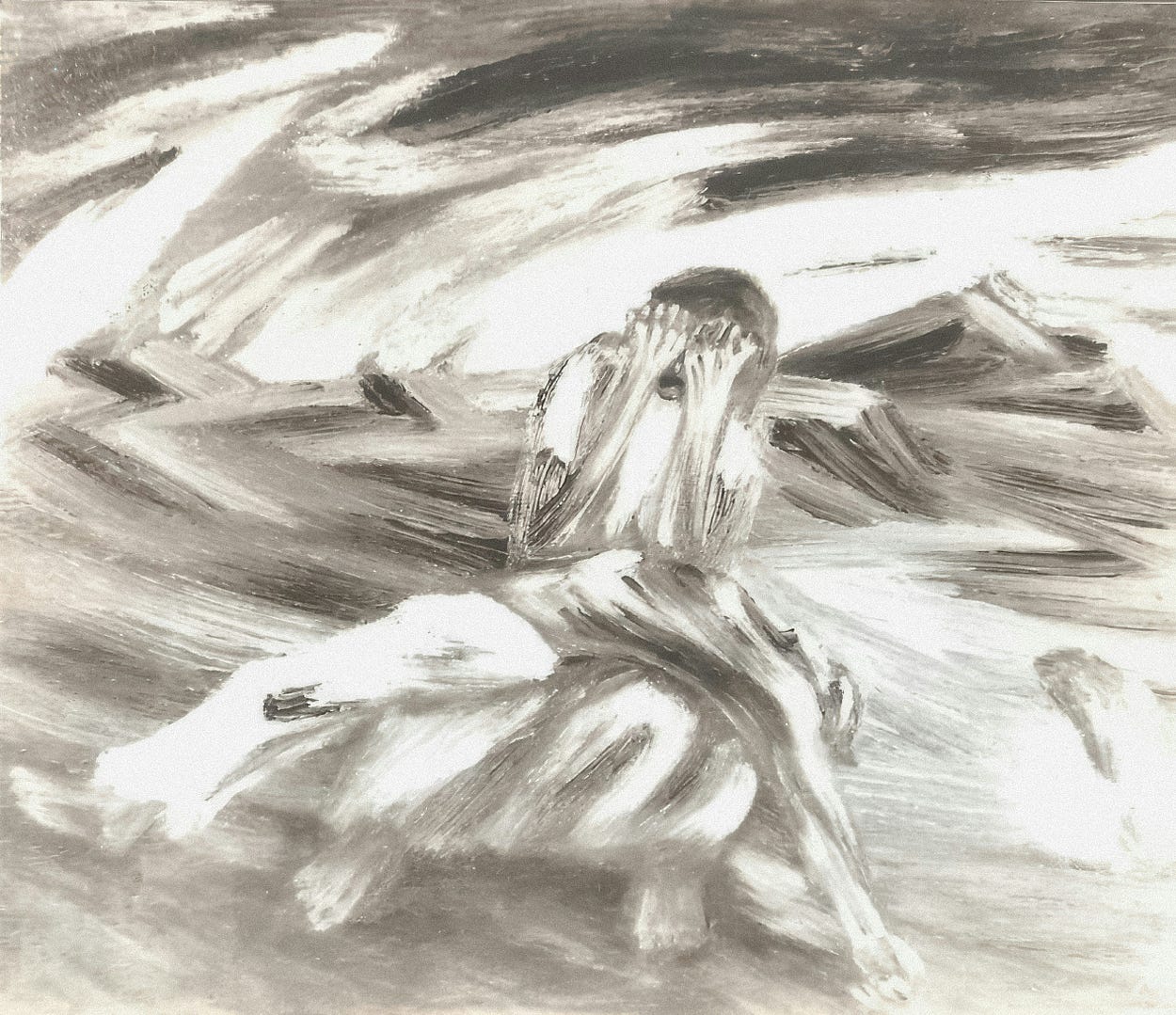
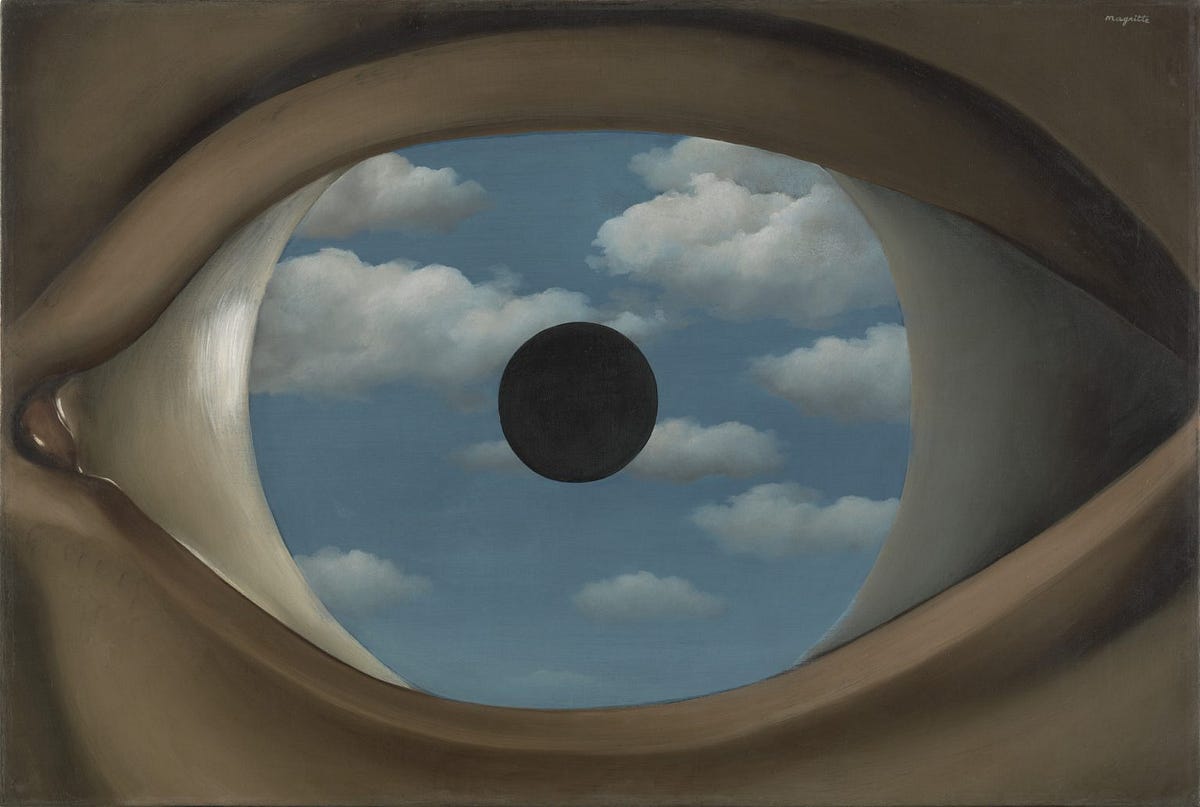
    René Magritte, The False Mirror (1929)

    “We shape our tools and thereafter our tools shape us.”

    — Marshall McLuhan

    Having been born in 2005, just prior to the iPhone and just in time for social media, it didn’t take long for my father to familiarize me with the internet. He taught me technological literacy from a young age. Being an engineer himself, to him, the emerging technological world was nothing except beautiful; a new, unprecedented time to explore and admire with everyone else in the world.

    His love for new technology seemed genetic, as it soon revealed its nerdy little face in me. From a young age, I mirrored my father perfectly. I looked like him, still look like him, and his personality and interests were contagious, as each one infected me minutes after they did him. I dressed up as a naval engineer — his occupation — for first grade’s career day. Every Christmas, I’d receive engineering kits and electrical playthings. When considering my future, engineering was a consistent and desirable option, alongside the tragically fantastical career dreams each child has and loses as time goes on.

    This lasted until the eighth grade, when, in picking between trade school or public high school, I seriously considered pursuing engineering, realized I hated it, and decided against it. Math was nihilistic to me, but writing gave me a purpose.

    This made it clear that engineering wasn’t my calling. This was among the few key differences between me and him. I love philosophy and critical theory, he loves science and mathematics. I love writing and the arts, he loves experimentation and certainty. As is reflected in my pursuit of journalism, I wanted to question everything, spiral into chaotic abstract dialectics while harassing public officials. As an engineer, nothing about that was and still is appealing to him. I suspect it’s the uncertainty: I like open-ended questions, he likes something solvable.

    However, we remain quite close, and as time sewed a modicum of division between us, we kept one of many similarities: technology. As an aspiring engineer, I loved watching as new technologies came out. And while a new generation of quirky, ingenious CEO’s acted as figureheads ushering us into the unknown, it felt like I was coming of age in a world just being born.

    However, as Antonio Gramsci said,

    The old world is dying, and the new world struggles to be born: now is the time of monsters.

    The Monsters of Our Time

    The monsters we face today are artificial, concocted by those same geniuses I once admired. It’s an ugly and intimidating time to be shoved into adulthood.

    Yet, while times have undeniably changed, that love of technology hasn’t disappeared, though maybe it’s been tinged with a clear concern for the future. I still find myself entranced by the gorgeous pictures taken with cameras orders of magnitude smaller than cameras of the same quality ten years ago. Or when I access thousands of years of learning and knowledge within seconds with unreal ease. It’s surreal living in the future envisioned by the past, with handheld computers and robotic servants capable of near-sentience.

    Sometimes, if I squint hard enough or cover my ears, I can see the dream my parents raised me to believe in. When my father talked to me about politics, he’d outline to me the wonders of the market economy. Any systemic problems could be reformed away, any crisis or injustice could be brought to balance with an economy in equilibrium.

    It’s not uncommon to see bits of this utopia in our current reality. ChatGPT is an astonishing research partner, my cell phone feels essential to life, and I’m writing this with an $80 keyboard.

    But any amount of optimism welcomes its opposite. OpenAI pollutes unrelentingly to refine an unsupervised technological time bomb; my cell phone shouldn’t be necessary to life, and consumerism assumes fulfillment can be commodified. Each of these are blights on society, yet their convenience veils their destructive tendencies, making us complacent in the face of brazen injustice.

    It’s not a problem with the products themselves. It’s a problem with why and how they’ve gone about the innovation preached to me by my father.

    Convenience has come at the cost of our humanity. Per the logic of the modern world, there is no such thing as free lunch; every positive comes with a negative; each thesis comes with its antithesis.

    My relationship with technology, therefore, is a mixed one. On one hand, innovation can be a symptom of deeper exploitation. On the other, it’s a wonder of human achievement. All I know, and all I believe I can know, is that the world I’m preparing to join is a daunting one. It’s uncomfortable because it’s unknown, yet in that same sense, it’s original. It’s new, unprecedented, meaning it’s scarce, and scarcity begets value.

    A New Hansel & Gretel

    It’s something I need to embrace. What else can I do? I can reject AI, then watch as my peers outpace me in virtually every way. I can stop using my cell phone, then cut myself off from the outside world. I can buy a typewriter and mail drafts to my editor when I’m assigned something remote. Time won’t wait for me or anyone else, no matter how much I complain about oligarchs or democratic backsliding or right-wing ideology. Politics, clearly, is a big part of my life; I think and care a lot about it. But doing something about it asks that I embrace the tools at my disposal, not cover my ears and shout.

    Old-guard newspapers learned that lesson. Their business model simply hasn’t adapted to the modern age. Consequently, journalists like me are stuck with mass layoffs and a profoundly competitive job market. It’ll likely improve as the industry rebounds, but this doesn’t offer me much hope. As technology advances, will another round of layoffs happen? Will I be one of them? That is, assuming I discover solid employment after graduation.

    My girlfriend, Nicole, regularly feels the same, being an art student. Together, we make an anxious pair. Yet, anxiety is an often irrational emotion. It’s an underlying concern, a nervousness nagging at you that refuses to die. Many, including myself, take medication to ease it. However, medication can’t give me a stable income or a full-time job.

    I shouldn’t be surprised. Every technological revolution does the same thing: displace workers. But everyone ends up okay. Blue-collar factory work travels overseas, while white collar information processing lingers. Eventually, as the economy inflates, more blue-collar jobs migrate away, along with the domestic working class.

    Jobs once filled by humans are automated, leaving little space for actual workers. Wealth is transferred upwards, making the economy richer but the people poorer. Yes, we recover from job displacement. But this time, the next time, the time after that, and so on — eventually, there won’t be jobs to displace. Only austerity.

    As jobs require exponentially more education, degrees lose their value. People need degrees, so more people get degrees, making the job market ruthlessly competitive. More people fight for fewer jobs, fewer jobs mean less income. As the economy advances, the interests of the average person are swept away like dirt.

    This doesn’t sound like the futuristic utopia I was promised.

    The Ugliness of the Entrepreneurial Spirit

    I’d love a utopia, I think we all would. So now we’re stuck questioning why everything’s lost its utopian luster. If we don’t know what to fix, we don’t know how to fix it.

    My father is a centrist Democrat, but a specific kind. He hated corporate exploitation, but bent the knee to the innovation exploitation wrought. He simultaneously despised and admired the Sam Altmans and Elon Musks of the world, although Trump and his band of oligarchs, like Altman and formerly Musk, have mostly soured his view. But most of the time, technological acumen subsumed Altman’s corporate recklessness or Musk’s general purpose ignorance.

    To my father and myself for most of my life, entrepreneurship gave us a potential utopia, so why not love it?

    But by glorifying entrepreneurship, we deify personal, subjective greatness instead of working towards the interests of greater society. This ‘entrepreneurial spirit’ doesn’t come from me, or you, or the entrepreneur themselves. Owning a business isn’t some innate feature of the universe; it’s not bound to human nature.

    It’s bound to one thing: the free market.

    Media theorist Marshall McLuhan wrote in Understanding Media: The Extensions of Man (1964),

    The medium is the message.

    The internet as a platform is more influential than the websites comprising it, the 24-hour news cycle as a method of information distribution has more influence than the stories it issues, and so on. I’ve been morphed into who I am today, in part by my cell phones, not so much by what I looked at on them.

    Similarly, the billionaires who are so easily blamed for each and every problem my generation faces shouldn’t be blamed. They’re doing precisely what they’re supposed to do as businesspeople: inflate until they pop. It just so happens that, by turning our world into their world, the rest of the world suffers.

    I don’t think I’m unreasonable to prefer something better. Something that doesn’t artificially produce and perpetuate the problems we’re trapped with, like climate change and global austerity, for profit or personal gain.

    The Entrepreneurial Spirit as a Systemic Symptom

    People sometimes imply my clear radical anti-capitalism is just youthful fervor. They’re probably right. As a dedicated pragmatist, my father’s responses normally orbit the efficiency of capitalism when compared to Soviet central planning, even though ironically I’m a devout anti-authoritarian myself.

    But that doesn’t change the fact that framing the entrepreneurial spirit as more than a lust for profit, as if it’s a mark of creativity, bravery and daring, bothers me constantly. There’s nothing wrong with owning a business, but it doesn’t make you a knight — it makes you a soldier of fortune.

    There is virtue in entrepreneurship. But it absolutely cannot be understood in isolation, so it cannot be evaluated in isolation, either. I respect those who start a business, innovate, and make the world even the slightest bit better to live in. I adore the delicious cookies baked by my local bakery, or the services from the mechanic just down the street from me. But they’re not such valuable pieces in our community for their business alone. It’s what they bring to the table that matters. They’re good because they give high-quality service while treating their employees and communities with dignity and respect. Anything else is just economic activity — virtueless in itself.

    On the contrary, my father’s love for billionaire innovators wasn’t virtueless. But every second spent bowing to progress is one spent unaware of the weight it carries.

    McLuhan and Marx

    Nothing can be honestly understood in isolation. Likewise, media is hardly the sum of its isolated, remote parts. Marshall McLuhan was a systemic thinker. To him, history isn’t a sequence of somewhat disconnected, sporadic events or ideas, but the advancement of large-scale systems clashing against each other with monolithic antagonisms defining them.

    In other words, historical materialism beautifully applied to the media landscape.

    However, he deviates from Marx in one key way: to a Marxist, it’s not so much the medium defining the message, but the system defining the medium and the message simultaneously.

    Marx, like McLuhan, was a pure, unadulterated systemic thinker. A culture like ours, favoring individual achievement instead of collective flourishing, is built to serve a master. Each device, each gadget and technological tidbit, doesn’t spawn from thin air. It’s made to fill a gap in the market, a gap unfilled or underappreciated by other innovators. Anything subject to the market contours to capital. The medium is shaped by capital; the message is whatever is profitable.

    Marx and McLuhan are inseparable: the base-superstructure, economic determinist materialist logic Marx flourished in is precisely the same as McLuhan’s materialism and technological determinism. To Marx, the base is political economy, like corporations and the state. The superstructure comprises culture, media, and social hierarchies formed by political economy. The base is vastly more influential, as it fundamentally drives every other aspect of society.

    When applied to McLuhan, the base is the medium; the superstructure is the message. The medium is vastly more influential, as it fundamentally drives every way the medium is used, i.e., the message. They don’t just correlate — McLuhan applied Marxian logic directly. Through this, McLuhan conjured a powerful framework for understanding technology.

    A New Uncertainty

    Moreover, like Neil Postman, we’re stuck with fear. Neil Postman opposed computers in classrooms, claiming they stripped education of its most important feature: socializing. While he died decades ago, Postman’s skepticism towards technology’s social impact extends to the modern day.

    Personally, I make regular use of social media, but mostly out of necessity. The conquering of analog spaces by technology ensures we can’t function without it. Our world has been shoved into cell phones, distilled into Instagram posts and short paragraphs on X. All of which lacks connective tissue. I’m not by any means the first to say social media divides us as much as it brings us together. It’s made, ideally, to help us socialize. But by permitting us to project our ideal selves, i.e., what we think the world wants to see us become, it’s rendered a widespread clash between false identities. Like oil and water, they’re interacting, but they remain fundamentally separate.

    On a more economic level, technological advancement turns collective labor solitary, as was seen with the Industrial Revolution. New divisions of labor emerged, wherein skilled tradesmen became machine operators, pulling levers and shoveling coal behind an isolating wall of smog. They no longer had to collaborate to complete a task — machines could do that for them.

    Every technology is inseparable from its origins. Just as it’s an extension of ourselves, it’s also an extension of the systems realizing it. Therefore, it’s a double-edged sword: with each refinement, with each step forward, we are set back just as far.

    These setbacks often attract more attention, mostly because reporters focus predominantly on said setbacks. After all, the societal good brought by a widespread knowledge of cute puppy videos is nothing compared to a government shutdown, regime change, and so on. But sometimes, we all need something. A crutch or anything soft to cushion our fall.

    Specks of horror float around in my and many others’ heads, and have for decades. My father had nuclear war to worry about, after all. I yearn for a world devoid of existential threats. We all do — or at least, I hope we all do. Yet, it’s in the medium’s nature to cover the disquieting. Maybe, like a tough parent, we need a thorough sandblasting from time to time. Just because it squelches optimism, doesn’t mean it should be feared. In that way, anxiety is often a symptom of a fading indoctrination.

    Despite this, my father was right to feel optimistic. Just as I walked in my father’s footprints, thinking his route was the safest, he walked in those of the media, his education, and his own parents. He was born at the tail end of America’s economic zenith, July 1969. His childhood crescendoed into the 1980s, with Reaganomics bringing new wealth and new risks. The Cold War offered a virtually flawless ideological enemy, and America appeared to be on top of the world.

    During this time, the Bretton Woods Agreement died, spurring the slow decline of American capitalism to be replaced with what philosopher Yanis Varoufakis calls techno-feudalism. Under techno-feudalism, capital flows, not from private property, but from near-monopolistic control over distribution (e.g., Amazon), control over the flow of money (e.g., Wall Street, banking, etc.), and financial domination over computation (e.g., Silicon Valley). Applying Marx once again, he wouldn’t seek to “seize the means of production” anymore, but the means of computation and financial gatekeeping.

    My father’s and my own indoctrination alike don’t demand a totalitarian state — indoctrination shapeshifts according to its role. It’s materialistic, as in, it takes the form of commodities. And it’s symbolic, as in, it disguises. For example, the recoloring of greed via the worship of enterprise and the fruits thereof as “vision” or “ambition”.

    My father grew up in a world wherein optimism was the only rational response. I’m growing up in a world hinged on the opposite. Everything about the modern world, with its searing bright lights and pessimistic futurism, tells us one thing: something isn’t right. Or, at the very least, I hope something isn’t right. If everything is as it should be, nothing can be as it needs to be.

  • by Aidan Vanhoof

    Oct. 19, 2025

    12 min read

    Photo by Jonathan Harrison on Unsplash.

    In Philadelphia, Pennsylvania, Wooden Shoe Books is the state’s only leftist bookstore. Selling anarchist, Marxist, and generally anti-fascist leftist literature, they serve an important role: to preserve radical ideology in a world in desperate need of it. Their anarchic ideology isn’t just posing: they’re fully volunteer-led and non-profit; in fact, they describe themselves on their website as “anti-profit,” writing,

    We seek to be an example of the society we envision and what we are working towards as radicals… We are a non-hierarchical collective that hopes to empower members through worker self-management and a consensus decision-making process.

    Walking in, this mentality is clear. Anarchist and Marxist literature sits in full display on shelves and tables; posters and stickers decrying the state and capitalism cover every surface without a book.

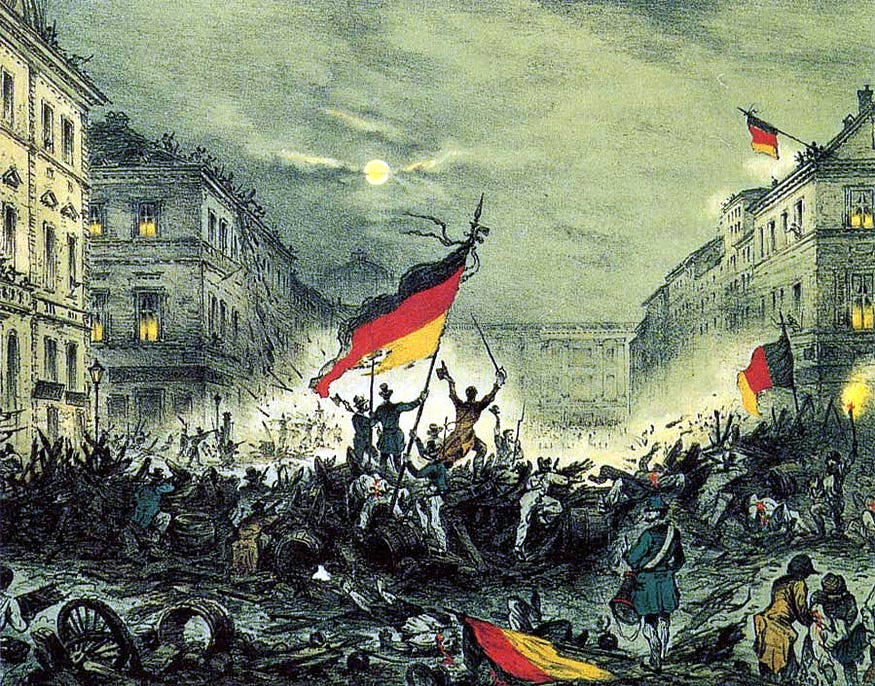
    But is their ideology, anarchism, a genuinely anti-hegemonic ideology like they claim it is? Does it seriously challenge the status quo? In this essay, I’d like to explore the idea of hegemony, how to prevent it, and whether prevention is even possible.

    Rebellion feeds into itself

    … Power is exercised rather than possessed; it is not the ‘privilege’, acquired or preserved, of the dominant class, but the overall effect of its strategic positions — an effect that is manifested and sometimes extended by the position of those who are dominated. Furthermore, this power is not exercised simply as an obligation or a prohibition on those who ‘do not have it’; it invests them, is transmitted by them and through them; it exerts pressure upon them, just as they themselves, in their struggle against it, resist the grip it has on them.

    Michel Foucault, Discipline & Punish (1975)

    Foucault’s idea that power is self-reinforcing applies well here. Rebellion can’t be formalized. By formalizing rebellion, it’s made another form of conformity, a doctrine to be followed. Revolution — rebellion to enact something new — embodies this: to rebel for a new world implies the creation of new conditions to rebel against.

    Let’s take art. To create, one expresses oneself, as even when art expresses a collective act, like a mural or a band, it’s either a subjective interpretation of a collective thing, or a series of such interpretations. For example, when a band writes a song together, the lyrics and melodies they create, while they feed off of one another, are only as strong as the individuals who created them. Each lyric comes from the mind of a single person, another edits it, another moves a line around, and so on. Each movement, each action, is the action of an individual, which eventually results in a greater ‘collective action.’

    Either way, the creative act is defiant. It abandons society and distills this abandonment into a product, expressing the independent self, or at least as independent as they can be. However, each individual, given that they absorb external influences, unloads these external biases onto the page, canvas, mic, and so on. So, while art still mirrors the individual (as the individual remains the filter through which external factors travel), the individual also mirrors greater society. In this process, hegemonic systems gain territory over art.

    Such systems are discovered easily in the bourgeois influence over the arts. Yet, they’re also found in artistic movements on their own. The ‘movement’ is hegemonic, similar to ideology. By being a separate movement, it’s severing itself from a previous status quo, rebelling, creating a new status quo, and morphing into a revolution. By gaining independence, it produces new conditions to be defied, perpetuating the cycle of artistic rebellion and originality.

    Let’s take modernism, once revolutionary. Now it’s a well-established style taught to art students. Rock music was once outrageous. Now it’s stereotypical, not solely among baby boomers. Each revolution becomes tradition — what was once new grows old, what was once thrilling turns boring.

    Trotsky’s permanent revolution

    Trotskyism echoes here: A revolution cannot stop in one country. It has to continue, spreading itself across the globe, engulfing the world in socialism and rendering the working class a unified whole; a new hegemony. At this point, the revolution will have been complete.

    Leon Trotsky writes in Theory of Permanent Revolution (1931),

    The dictatorship of the proletariat which has risen to power as the leader of the democratic revolution is inevitably and very quickly confronted with tasks, the fulfillment of which is bound up with deep inroads into the rights of bourgeois property. The democratic revolution grows over directly into the socialist revolution and thereby becomes a permanent revolution.

    By continually rebelling against previous systems and establishing new systems, hegemony doesn’t disappear. It repeats itself. And, internationally and domestically, Trotsky’s theory faced further challenges. Stalin, due to Western pressure and the frequent failure of foreign revolutions (e.g., the German revolution), decided against world communism. He dissolved the Soviet Comintern and concocted a theory of ‘socialism in one country’ as an alternative to Trotsky’s — his political and theoretical rival at the time.

    Trotsky mistakenly assumed foreign proletarian movements could dissolve domestic hegemony. But hegemonic systems, e.g., capitalism, naturally become worldwide as they develop; meaning Western support, alongside basic military superiority, crushed working-class movements as quickly as they emerged.

    The Soviets certainly could provide support, and they tried in some cases, such as Cuba, Vietnam, China, and North Korea. But by ignorantly attempting to rival Western powers militarily and economically, they dedicated swaths of their economy to military and foreign projects instead of domestic human wellbeing. They were a developing nation, one still escaping a brutal monarchical feudal system — they were not a capitalist power with centuries of development.

    So while Trotsky’s theory was a tad unrealistic, so was Stalin’s. Stalin’s nationalistic obsession led to external pressure and an inevitable authoritarian backslide; Trotsky’s theory could only work in a developed nation with resources to spend on foreign aid and combating rival hegemony.

    In either case, it’s a contradiction: hegemony requires either obedience or a clone. It’s a virus that kills or spreads depending on the host’s response.

    The state’s role in combating hegemony

    Considering this, we land right back where we started: with the rebel’s paradox. To rebel requires perpetual rebellion, which means submission to a sort of ‘doctrine of rebellion.’

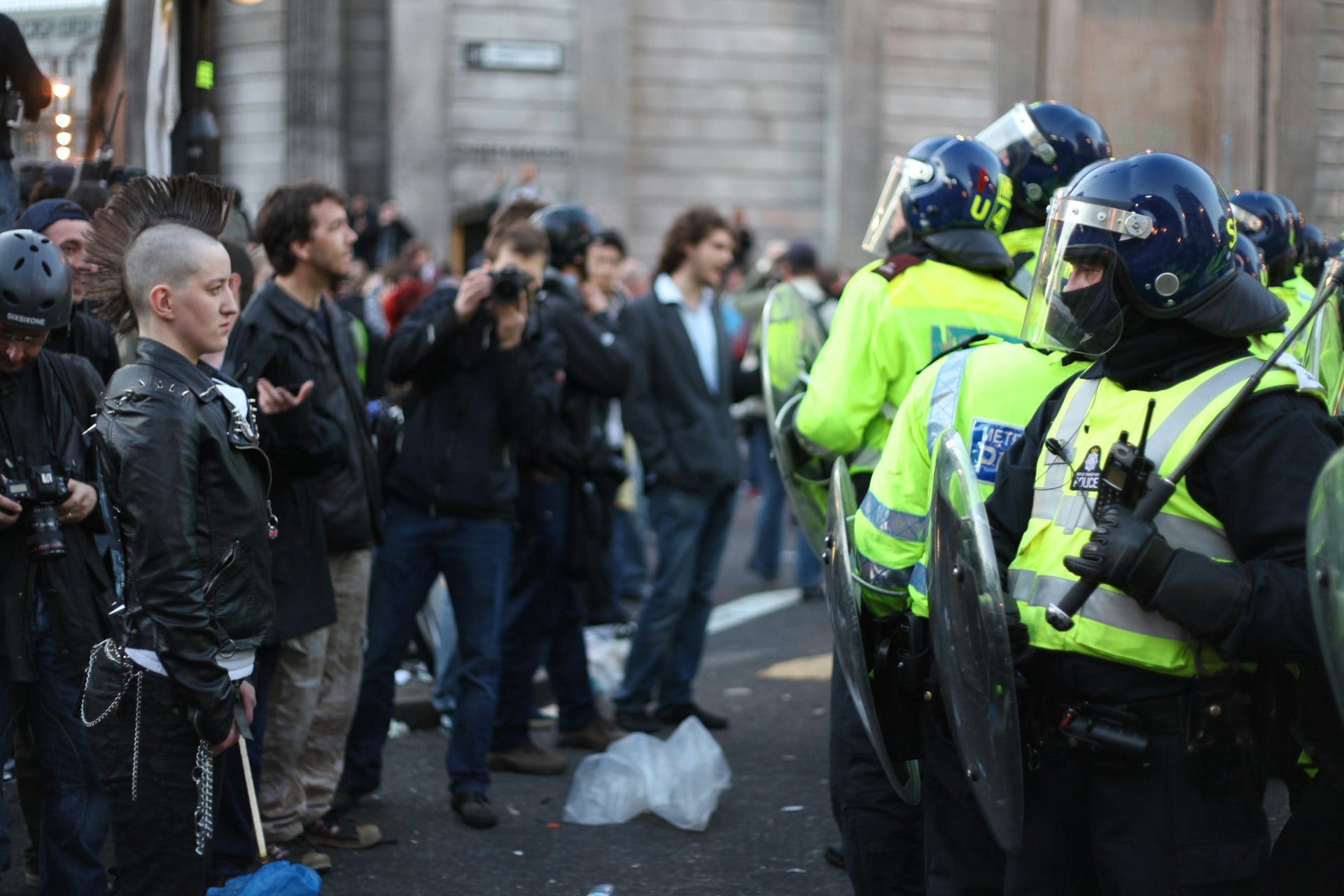
    Let’s take punk music: the punk community, spawning from early skinhead movements, ska music, and various alt-rock bands of the 1960s (e.g., the Velvet Underground) served as music’s voice for defiant, polemical, politically charged youth anger. However, by focusing mostly on defiance, those deemed ‘not defiant enough’ were kicked out, creating an in-group; a new status quo, i.e., hegemony. The punk movement would die out over time, its corpse fertilizing various new subcultures.

    The anti-gatekeeping gatekeepers killed themselves off.

    Similarly, the Soviet Union, early on, ended workers councils (soviets), taking away worker control over the means of production. This is why Trotskyists criticize central planning, calling it state capitalism instead of socialism.

    Ironically, Trotsky initially supported these measures, grifting his way through the Bolsheviks’ ranks despite his previously extensive criticism of Bolshevism’s right-leaning tendencies.

    In part, the Russian proletariat was nonexistent at the time, meaning socialism couldn’t exist in a fully developed form. Workers councils wouldn’t have made sense, as there weren’t any workers to council. But as the Soviet Union rapidly developed into an industrialized power, workers’ rights only shrank. Stalin initially stripped back any workplace democracy or scientific planning previously implemented under Lenin, and future reforms failed to render the Soviet Union genuinely socialist.

    Working-class state hegemony destroyed working-class power.

    Is anarchy the solution?

    To liberate the working class, and by extension, to liberate oppressed classes everywhere, hegemony itself must be identified as the problem. Material needs may be satisfied. Comforts, like stability, once afforded only by the ruling classes, may be distributed universally and without cost. But it doesn’t matter. The exploitation inherent to class society arises, this time between the state and the worker, the ruler and the ruled. Avoiding this implies not only ending private property, but ending hierarchies of coercive authority.

    Chris Harman writes in A People’s History of the World (1999),

    Humanity increased its degree of control over nature, but at the price of most people becoming subject to control and exploitation by privileged minority groups.

    Such groups could only keep the surplus [resources] in their own hands at times when the whole of society was suffering great hardship if they found ways of imposing their will on the rest of society by establishing coercive structures — states. Control over the surplus provided them with the means to do so, by hiring armed men and investing in expensive techniques such as metal working which could give them a monopoly of the most efficient means of killing.

    Armed force is most effective when backed by legal codes and ideologies which sanctify ruling class power by making it seem like the source of people’s livelihoods.

    When agriculture emerges, a surplus of resources comes with it. Thus, control and distribution systems for that surplus, with this, the state and a class of police, soldiers, and those who manage them. Class is the immediate consequence of statism. In other words, socialism demands a horizontal — never vertical — distribution of authority. In essence, anarchy. What anarchy looks like depends on who you ask, on historical progression, and on material conditions.

    Emma Goldman writes in her essay Anarchism: What It Really Stands for (1911),

    It is a living force in the affairs of our life, constantly creating new conditions. The methods of Anarchism therefore do not comprise an iron-clad program to be carried out under all circumstances. Methods must grow out of the economic needs of each place and time, and of the intellectual and temperamental requirements of the individual.

    Anarchy isn’t the absence of organization. It’s a new form of organization, based entirely on free association between people whose lives don’t depend on the state, but on each other and themselves. Each person, by freely associating with groups, ideas, and societal roles, without coercion or command, guides society, alongside their groups, in a sort of ‘market of roles.’ What doesn’t need to get done, or what people don’t want to do, doesn’t get done. Groups dedicated to it die out, and vice versa.

    This interaction between organizations, which clash in a separate yet necessarily intertwined way, drives the anarchist economy. It’s not democracy, nor is it authority. It’s absolute liberty, not to do as one wishes — like rob, rape, and murder — but to associate as one sees fit.

    Goldman writes,

    That being the ideal of Anarchism, its economic arrangements must consist of voluntary productive and distributive associations, gradually developing into free communism, as the best means of producing with the least waste of human energy. Anarchism, however, also recognizes the right of the individual, or numbers of individuals, to arrange at all times for other forms of work, in harmony with their tastes and desires.

    Trotsky, Stalin, punks, and artistic revolution all have one thing in common: they assume authority isn’t the problem. The punks religiously opposed authority. Yet by doing so, they enforced an anti-authoritarian doctrine. Stalin cultivated a profoundly oppressive political class, and Trotsky assumed a universal socialist hegemony would somehow end hegemony, domination, and exploitation. Each is a case study against replacing domination with domination to destroy domination. History repeats itself over and over again, dialectically. Materialist analysis leads us to one culprit: class. But the state is the mother of class.

    Of course, anarchy doesn’t mean all authority disappears. It’s reframed as refusal, but it’s authoritative nonetheless. But the authority anarchy thwarts isn’t hierarchies themselves, but coercion. It’s the absence of commands. The only rule one’s held to is the lack thereof. Respect, community, protection, and so on — they remain. Social norms bind the anarchic commune; people may even pick someone they admire and treat them as a guiding force. But they won’t have a gun to their head, they won’t have a police officer shouting at them to obey.

    The structure is hegemonic, but the hierarchy is not — exploitation ceases.

    Anarchism destroys itself

    Yet, is any of this actually practical? We’ve all heard the criticisms of anarchy: chaos, mayhem, selfishness, and aimless nihilism. But this misunderstands anarchy and the supposed ‘human nature.’ Anarchy can be organized, such as through anarcho-syndicalism’s federalist model. And humans are naturally collaborative, as proven through ancient primitive communism, as well as primitive societies today.

    The end goal of any communist ideology is, in that sense, essentially anarchy. The critical aspect of anarchy, dividing it from something like Trotskyism, is the absence of a transitional state. Anarchists topple the state, society is free; socialists topple capitalism, society is free. One goes for everything, the other only eats half.

    The Marxist approach risks perpetuating hegemony, but doesn’t anarchy do, too? If society is kept together socially, what if that social element itself grows oppressive? What if conformity to the culture keeping anarchy alive becomes the rule, and a new authority emerges? People, psychologically, cite and rely on authority. The big Other, symbolic order, alongside libidinal obsession, dominate our lives. The state only asks that people truly believe in it. The population must have faith; otherwise, the symbolic systems preventing the state from collapsing in on itself die out.

    The state, fundamentally, is the symbolic order formalized: it’s the subjective understanding of symbolic, communal systems, manifested materially.

    In other words, a new state structure can emerge without material causes. All it requires is someone manipulative enough to centralize power. So how can anarchy be protected without a regulatory structure? To rephrase, how can anarchy survive without a state? Anarchism demands a rational population, but psychologically, we’re equally irrational and rational. We have a whole subconscious and deeply unreasonable world framing massive portions of who we are and who we will become.

    And how can anarchy restructure society and end capitalism while foreign hegemonic systems remain? The anarchic militia can’t defend itself against the United States’ military or the economic force of Western Europe. How can the federalist structure of anarcho-syndicalism keep itself together without a centralized authority? Mutual trust and self-interest, as I’ve established, are cheap compared to the state’s binding power.

    How can the working class direct its political interests meaningfully without a vanguard party? Donald Trump’s populism used socialist tendencies and turned them fascistic. How can we prevent such a thing without a vanguard to direct class consciousness?

    Anarchy is synonymous with statism, as each breeds its opposite. A socialist worker’s state, one without the hellish totalitarianism of Maoism and Stalinism, may be the only path to genuine liberation: whether from class division, the environmental devastation of climate change, or the emergence of new technologies and conflicts bent on humanity’s destruction.

    Capitalism only continues to spread one class from the other, while a vile cabal of oligarchs exploits every resource, including people, they can. The question, however, remains: Where to now?

    Climate change is impossible to end with grassroots action — state intervention is necessary. The material causes for climate change are strictly capitalist production; thus, capitalist production must end for climate change to end.

    Material inequality, following the state’s death, will likely remain, and a socialist state assigned the task of resolving inequity seems to me like the only path forward.

    Anarchy is an ideal, anti-authoritarianism is a necessity, but it’s as much an ideal as it is a tragic fantasy: anarchy is unachievable by anarchist means. Yet, with the virtues of anarchism, we are left with yet another irony: like anarchism, socialism is unachievable by socialist means. The only certainty is that power regurgitates itself.

    Politics is a game of contradictions. The key is deciding which side is less wrong than the other.

  • Aidan Vanhoof

    6 min read

    Sep 20, 2025

    Image source: https://www.latimes.com/world-nation/story/2023-10-10/how-trumps-maga-movement-helped-a-29-year-old-activist-become-a-millionaire

    Charlie Kirk’s death has become among the most vicious battlegrounds in American politics. AOC delivered a speech condemning Kirk to a Congress ready to honor him as a true American hero; Trump’s pseudo-fascistic nature continues to reveal itself as he begins a campaign of repression against the left; and the right has taken a firm position against anyone speaking ill of him.

    His death follows a worldwide pattern. Just two weeks ago, Nepal and Indonesia alike faced widespread anti-government protests, which for a time appeared to be decentralized, populist revolutions; each of which panned out like most: ending with just another, somewhat more liberal candidate — as we saw in Greece, for example.

    Of course, Charlie Kirk’s death isn’t entirely the same. Charlie Kirk isn’t a government to be deposed, and his killer was a random college student. However, his death serves a similar symbolic purpose: His murder won’t end fascism, in fact it may make it worse; and his absence won’t spell the demise of Turning Point USA. But it absolutely means a paradigm shift in American politics, as we’re seeing in newfound, but deeply unsurprising, political repression.

    In that same respect, the decentralized and generational nature of the aforementioned protests won’t end corruption or authoritarianism. But they symbolize an increasing disdain for a rotting status quo. His death marks, per the title of his organization, a ‘turning point’: an ugly and profoundly bloody martyrdom capable of enacting serious, albeit maybe undesirable, change.

    To many, Trump and Kirk were the ideology. Their ideas were like supernatural properties engrained into their being, and Kirk’s death only ossifies this. The man who killed him, though this has since been disproven, was for a time assumed to be a leftist involved in anti-fascist circles (which Trump’s been using as a justification to classify Antifa (which isn’t an organization) as a terrorist organization). This assumption meant the man who killed a fetishized Kirk was his antithesis, his opposite, his absolute negation. And because Kirk was likely killed for his beliefs, Kirk’s fetishism only grew deeper with his death; martyring him, rendering him a man who died for his ideology wearing the emblem thereof.

    The right’s rather immediate trauma was by no means subtle. Social media posts about how he was killed for speaking the truth, or how he was a good faith debater striving to spread traditional, Christian values across college campuses, would flood my and many other peoples’ feeds.

    There wasn’t much to seriously warrant such a reaction. A common talking point from the left and liberals alike is that he continually ignored or embraced mass murders, school shootings, and gun violence as a necessary side effect of a free society; yet he himself was killed by gun violence (and his last words justified the Second Amendment), making his death seem somewhat self-inflicted.

    He embodied a violent ideology, so Kirk’s fetishism extends to the left. He embodies the hypocrisy inherent to right wing ideology, instead of the violence inherent to leftism. To each side, his death means something greater than what it is — an ignorant, bigoted fascist shot and killed in front of a crowd by an angry college student. He’s just another gun death in America — one of thousands — yet to each side he’s something far deeper.

    The death of a fetish is always traumatic for both sides. One side loses an object, an idealized fetish representing a society that has yet to come; the other, rationalized racism taking a human form, the enemy to be destroyed and the figure restraining a better world. The right lost their God figure, the left lost their rival.

    Both mostly enjoyed this dynamic. Kirk’s dominance over political discourse was infuriating and enjoyable. Thus, his loss is disturbing, alarming, and frightening, far more so than the school shooting happening at roughly the same time as his death.

    But to understand this deeper, it may help to look in literature.

    In The Wall by Marlen Haushofer, the main protagonist’s stuck in a forest when an invisible wall, which descends as far into the ground as she can dig and as high as she can see, spawns into the world, alongside the deaths of everyone she knows. She eventually begins the arduous process of survival in a novel that explores the powers of patriarchy, social conservatism, and animal companionship. (Warning, spoilers) At the end, the only other person she sees, she kills, as he seeks to kill her and her animals for food and resources. Now, she is truly alone.

    The wall, to the protagonist, is restriction. It’s a barrier confining her to one half of the world while keeping the rest out of reach — a world that’s visible to her yet riddled with the petrified corpses of the past. The man she kills was at one point the man she’d been searching for: he was the only hope, the object of desire whom she thought would fill a gap in her being; who kept her going, searching, and gifted her meaning and purpose in life. Once he died, that collapsed; thus his death was not only traumatic because she murdered someone, but because she lost something libidinally satisfying.

    Kirk filled one of these roles to each side: to the leftist, he was the wall; to the conservative, he was the man. In the novel, the protagonist, despite having been put in such an awful position by the wall, simultaneously finds it liberating: the wall distances her from the confines of state, patriarchy, and so on; her newfound purpose derives from the wall in searching for another person, in establishing what the wall is; thus she finds it has a personified role in her identity: it’s not a wall, but a mirror for identity formation, as her life is centered around it.

    The leftist response to Charlie Kirk’s death — in large part attacking him but condemning his assassination — is a symptom of this trauma. His death, not him, was the focus. The barrier he represented has fallen, so it makes some level of sense that his death wasn’t traumatic: it’s what his death means for greater society that matters (democratic backsliding, leftist persecution, etc.). For the rightist, the relationship is inverted: the ruthless condemnation of the left for Kirk’s assassination, given the right neglects gun violence otherwise, was an afterthought compared to Kirk himself.

    Violence is thus acceptable depending on who died. Violence only matters to the right wing if a leftist perpetrates it or if a rightist dies; violence only matters to the left if a rightist perpetrates it or a leftist dies.

    For this reason, Kirk’s death is overinflated in the attention directed towards it, almost obsessively. It’s ugly, somewhat irrational, but strictly ideological: the right mourns the loss of an ideological idol, the left either mourns or celebrates the rise of political violence in America.

    This contradiction extends to every function of government; to the existence of the state itself. Why is it that those who condemn political violence don’t condemn the police, authority, the military, etc.? Why is it that anarchy isn’t their first and only choice if violence is so cruel, so unnecessary and vile?

    The state is contingent on violence. It can’t exist without it. Yet if a citizen does what police do every day, it’s a crime.

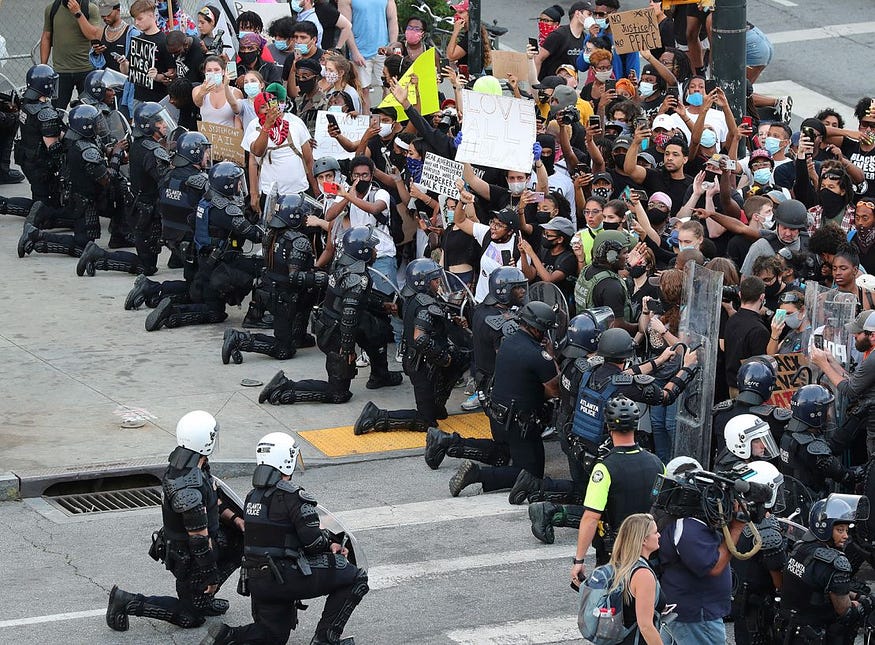
    Political violence is thus acceptable to most Americans, but once again it depends on the party under attack, and Charlie Kirk’s death mirrors this perfectly. The countless condemnations of political violence and degrading discourse; the horrified gasps as we watched democracy undermine itself in such a bloody way. The same people flying thin-blue-line flags, who claim to support the police and law and order, condemn such a senseless act. Yet few, except the students who painted a BLM symbol over Charlie Kirk’s name at a memorial, realized this contradiction.

  • by Aidan Vanhoof

    9 min read

    Sep. 16, 2025

    Image by Wiki Sinaloa on Unsplash.

    In Mary Shelley’s Frankenstein, the monster is defined as a ‘monster’ per its relation to its creator. It was created; therefore, it’s not ‘human’ like everyone else, despite being made of humans, having a conscious mind, desires, and so on. It is worthy of scorn, hatred, and complete societal rejection. In this process, it loses recognition — alienated, sidelined, and relegated to otherness as an outsider, a non-human. Thus, it is no longer a creature: it is a threat, a fetishized object symbolizing certain value judgments: ugly, menacing, violent, imposing, etc. It’s hunted down, leading to an implied suicide.

    The otherness the monster is subjected to only promotes further antagonisms. But on a deeper level, the monster is a direct product of its master, yet vilified and blamed by the master for how it was created by him and for the actions taken because of conditions imposed upon it by greater society. This culminated in the monster declaring,

    From you only could I hope for succour, although towards you I felt no sentiment but that of hatred. Unfeeling, heartless creator! You had endowed me with perceptions and passions and then cast me abroad, an object for the scorn and horror of mankind.

    Frankenstein is a mirror for neoliberal logic: a snake eating its own tail. But such logic comes from a seemingly, though debatably, well-intentioned place. If I decide to pursue freedom, to create the freest, most perfect society from the bejeweled corpse of monarchy, what should I do? In this case, it would make sense to identify the main issue at hand: philosophers at the time of the American Revolution saw it as centralized authority, unjust taxation, and restrictions on what they perceived as innate human rights.

    After identifying the problem, they acted, having made the complete antithesis to monarchy: liberalism. Decentralized authority, an unregulated market economy, and human rights for some, not for others. This, of course, would pave the way for further abuses of power. Human rights only apply to that which is ‘human.’ In that, if something is seen as subhuman, e.g., a racial minority, gay people, etc., human rights seemingly no longer apply. ‘Human’ as an ideological sign is nebulous, being as much defined by one’s belonging to a species as it is by their assimilation into a cultural zeitgeist: an ethical statement and description of conformity, class, and hegemony.

    Those atop the hierarchy — the property owning classes, political elite, etc. — are more human than those beneath them. In that, by having greater access to rights in practice, fetishizing those beneath them (I’ve written about this before), and conforming perfectly to the system, they transcend any ‘subhuman’ properties they may otherwise have. This hegemonic control over what is human and what isn’t extends not just to hypocritically violating one’s own principles, but also to the broader symbolic structure of capitalist ideology.

    Resignification

    It is true, we shall be monsters, cut off from all the world; but on that account we shall be more attached to one another.

    A given thing, by existing as its own thing, excludes the possibility of it being anything other than itself. So, every sign and event has meaning beyond its use and definitions, causes and effects. WW2 isn’t just influential for the wholesale annihilation of swaths of Europe, but for being a case study on the terrors of totalitarian ideology. It means something for its apparent good vs. evil binary, making it a perfect propaganda piece.

    The Russians have a massive military parade each year to celebrate their victory over the Germans, despite Putin’s regime having nothing to do with it. Americans use it as an example of a world that could have been had their liberal democracy and freedom not stepped in to save the day. To the Russians, WW2 was a fight for nationalist supremacy. To the Americans, the preservation of Western liberal hegemony. In either case, the Nazis are more than a totalitarian, right-wing, nationalist fascist regime. They’re the embodiment of evil.

    By identifying its antithesis, ideology implies its thesis: what it is, what it will be, and what it hopes to be. It defines itself by defining what it is not. In this process, a word is given surplus signification: a deeper, necessarily ideological definition. During the McCarthy era, communists were suspicious, untrustworthy, subversive, and traitorous. In other words, innately immoral. They were everywhere, penetrating deep into the heart of America.

    Symbolically, communists were as Jews were to the Nazis: an invisible yet conceivably visible boogie-man, a monster hiding behind a deeply human disguise. Marxism wasn’t just a philosophy of liberation distorted and weaponized by authoritarian dictatorships, fundamentally shaped by Soviet hegemony and global influence paired with military overspending and competition with the West, but a necessarily terrible and cruel ideology of epic proportions, hellbent on world domination.

    By reducing its opponents to dust, ideology made itself look like a skyscraper.

    The Other

    If such lovely creatures were miserable, it was less strange that I, an imperfect and solitary being, should be wretched.

    By signifying liberty as inherently virtuous and its opposite evil, neoliberalism can justify itself to itself. What has liberty, regardless of how it manifests, is automatically permissible, even actively supported, under capitalism. The Chileans under Salvador Allende enjoyed a higher quality of life, literacy programs, and housing and food distributions. His administration introduced new technologies for central planning, making more efficient economic calculation a serious possibility.

    After seeing this, despite him being democratically elected, because Allende restricted private property and the rights of property owners, the US deliberately devastated their economy, performed a coup, assassinated Allende, and then installed a tyrannical dictatorship, leading to the deaths of thousands and the repression of millions.

    All for liberty.

    By reframing overt poverty, slums, and inequality as seen in parts of America and all across the undeveloped world — which is a direct result of neoliberalism and imperialist capitalism as a whole — as a byproduct of freedom and a failure of a country or people to elevate itself out of poverty, squalor is made a ‘misuse of liberty,’ thus negligible. The poor are not downtrodden, but a vast array of individual failures. Neoliberal ideology and its countless predecessors take from terms like ‘poverty’ any serious meaning: they become non-words, ignorable, pointless, societal troughs worthy of neglect.

    With the individualism inherent to neoliberalism, the working-class thus loses a cohesive sense of identity, as it’s tainted with a sense of ‘otherness.’ It’s no longer a ‘class’, as individualist ideology and economics mean each individual is seen as an isolated unit, not as a person with an identity contingent on the collective. The working class is a mass of neoliberalism’s disappointments; an aggregate of lost causes with a dormant potential for improvement, instead of a class whose poverty is a systemic symptom.

    A focus on ‘opportunity’ as opposed to outcomes leads to a society in which the definition of ‘human’ is realized in relation to the economy. This definition only applies if opportunities are provided, ensuring the state fulfills its only real responsibility in protecting the right to private property. In that process, the working class loses coherence.

    It’s misrecognized by a potent, traumatic Other, a Big Other, whose identity is made, not through solidarity, but by reference to the only recognized class, the group designated as the ‘most human’: that of the corporate, property-owning class.

    Neoliberal otherness and Hegel

    Listen to me, Frankenstein. You accuse me of murder; and yet you would, with a satisfied conscience, destroy your own creature. Oh, praise the eternal justice of man!

    From the start, American private property justified genocide. Early drafts of the Declaration of Independence included condemnations of slavery. But the economic interests of Southern Planters ensured abolition would take millions of deaths to enact, using the perceived inferiority of the black population alongside passages from the Bible to disguise a naked obsession with profit. During Westward expansion, while Manifest Destiny motivated many, it acted solely as a religious justification for market imperialism, similar to Christian Nationalism or the early libertarian Christian organizations of the 1930s, 40s, 50s, and 60s. Settlers were given private property and free lots out West, but Native Americans weren’t given full citizenship, as they were recognized as their own nations. They were not American citizens worthy of the opportunity for property ownership, nor were they subject to human rights.

    They were an Other. They were a foreign entity, an infestation to be resolved or exploited for land and labor. A people to be purged, expelled, and stripped of their native lands to facilitate American colonization, imperialism, and natural capitalist expansion. In Frantz Fanon’s Engagement with Hegel’s Master-Slave Dialectic, Brandon Hogan writes,

    According to Fanon, while Hegel’s master seeks recognition from the slave, the colonial master seeks only work. Moreover, for Fanon, the Hegelian slave differs from the colonial slave because the former eventually gains self-consciousness and freedom through labor, while the latter seeks to be like his master — that is, he seeks to be white — and is thus unable to find liberation through labor alone.

    Fanon’s critique of Hegel, while made in a European colonial context, is universal to class dialectics: Hegel’s theory of recognition doesn’t account for those who are unrecognized and unaccounted for, whose recognition is traumatic for either party. In this case, the foreign working class producing commodities the domestic working class consumes: the Indonesian textile worker, the Chinese Uyghur assembling plastic toys, and so on. These groups are beyond the gaze of the domestic working class and corporate class alike; they are exploited for labor, but society does not recognize them; they’re beyond our culture, our government, our beliefs, and way of life. They are commodities: values producing more values.

    Yet, neoliberals defend this. Neoliberalism builds wealth, but typically domestically at the expense of foreign markets. However, the wealthy nation provides a beacon, a model to emulate, representing the potential neoliberal capitalism has for the impoverished foreign worker. Inequality is the soul of neoliberalism, as even that inequality elevates the corporate class to idols.

    Here in America, South Americans, by acting as unrecognized laborers for jobs the middle class rarely occupied, took the role of the dehumanized human, the person without personhood. They are ‘illegals,’ and because they fail to assimilate into the American status quo, they lose their humanity, fetishized into a mass of invaders whose double nature permits them to be both docile, hard workers stealing American jobs, and an evil, crime-causing army of pseudo-terrorists. By distracting the population from the sins of the ruling class — which are blamed on the Mexicans — millions lose their humanity, thus their human rights. The victims are the American people; the enemies are illegals; freedom of opportunity is stolen from hardworking Americans. The thieves — illegals.

    Neoliberal logic continues to invent a third party, a ‘third class’ sitting just outside the dialectic, whose absence of legal recognition and overt poverty deprives them of economic opportunities. A group to be neglected and exploited, then thrown out once it’s convenient. Class society remains the problem, but the property-owner/worker binary, alongside its subcategories— i.e., the labor aristocracy — is dated. As with the emergence of neoliberalism, we can see the simultaneous emergence of a new type of class, one visible solely on a global scale — the unrecognized subclass.

    In each case, the concept of liberty, as realized in private property, was itself oppressive. The liberty of the American is the suffering of the exploited. In that, ‘liberty’ isn’t freedom. Economic freedom justifies itself by reframing liberty as a virtue, oppression as the failure of the oppressed, and history, not as the advancement of exploitation but of society, seen through the eyes of the property owner.

    Neoliberalism thus only makes sense thanks to the mechanisms of neoliberal logic. Liberty only makes sense when understood and disseminated by the property-owning class. Humans are only ‘human’ given they exist to serve the capitalist world order (as proven by the Chilean people, Native Americans, Vietnamese, Russians, etc.), and ‘rights’ are wholly alienable. That is, if they are not human, as that which is unalienable is only unalienable for the select few.

    The paradoxically inhuman obsession with distinguishing between different types of humans allows for an enjoyable contradiction: while one does not feel free, they feel free; they are not free, yet they think they’re free; thus, they grow complacent, tolerant, and through the promises passed down to them from prior generations, they venerate the technology, beauty, and power brought by the hegemony dehumanizing them.

    This is neoliberalism’s totalitarian force: a leviathan isn’t needed to ossify ideology, as the ossification process is baked into the ideology itself, at its atomic level.

  • Aidan Vanhoof

    6 min read

    Sep 5, 2025

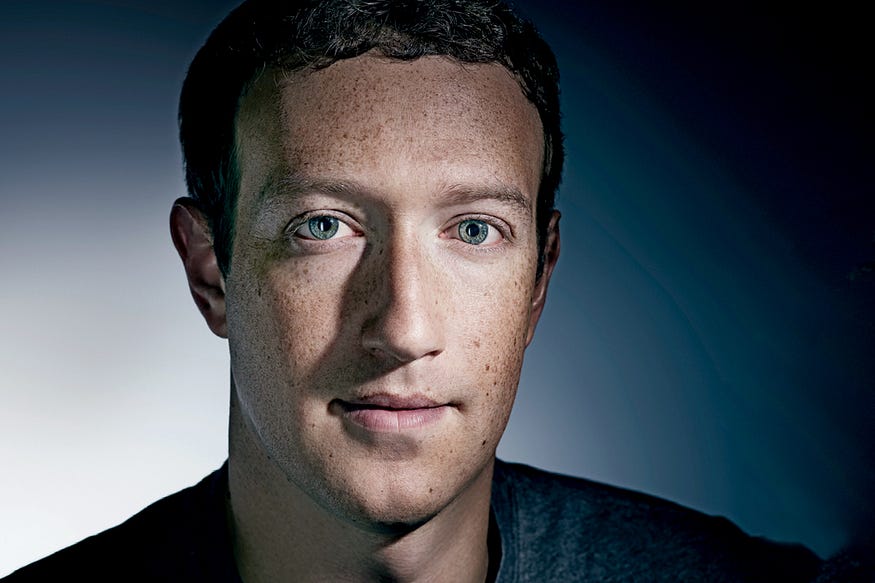
    Meta CEO Mark Zuckerberg; Source

    I’m not the first to say social media divides us, makes us less social, and by and large alters the way people interact in strange ways. It’s not hard to see in everyday life: even some of my classes integrate social media and modern communications technology into lectures and assignments.

    To explain how social media affects the social bits of our lives would make this essay at the very least unoriginal, at worst, exceedingly boring. So I’m not going to do that. The problem extends farther, deeper, to the economic base of our society, and will continue to do so as long as we allow and rely on the corporate world to mediate our social lives.

    Social media has democratized the political process in ways never before imagined. Those previously silent or voiceless can shout and hear their voice echo back to them. Ideas once too radical for the mainstream media now have a home. On the surface, it’s an absolute positive for greater society and the individual alike. I wouldn’t be where I am, and I doubt you would be too, without it. However, what was previously rational, informed discourse (or at least as close as our society can get to it) is made diluted and confusing. In a massive shift from older forms of media, like a grenade, fragments of information come at us from all angles, helping some, hurting others. Those who previously had no interest in politics now have a platform, ideas spread (good or bad), extremism emerges, and with it, figureheads representing each group in what becomes a sort of ‘dialectic’.

    From Social Media Effects: Hijacking Democracy and Civility in Civic Engagement by Bolane Olaniran and Indi Williams,

    More specifically, the coherent discussion of ideas has been substituted with the spread of fragmented ideas, resulting in the spread of populism (Wirth et al., 2016). To this end, social media in political discourse are rife with a pathological form of democracy (Betz, 1994; Engesser, Ernst, Esser, & Büchel, 2017).

    Through the internet, democracy loses its rational edge. Irrationality conquers, then by appealing to the internet’s radical democracy, the people grant populist leaders power. I’ve explored how populist ideology has changed since the 20th century, here. New communication technologies alter ideology and the ways it’s distributed. If we are to understand this, then it’s necessary to consider those who control said communication technologies, as those are ultimately, given they’re overseeing and facilitating the distribution and regulation of that information, the arbiters of contemporary ideology.

    The media, more specifically social media, is wholly privatized, unleashing the hand of profit to guide what we see and how we see it. Social media is made profitable by the selling of advertising spots, so the higher the engagement, the more attractive the platform. Then, advertisers purchase user data to further curate and target ads to individual markets and consumers. Thus, engagement is a necessary component of social media profit.

    To make engagement more efficient, each user’s data is harvested. Their feed is decided by algorithms watching over their shoulder, looking at what they linger on and avoid, what they like, comment on, click, tap, and so on. In other words, one’s social media experience is shaped by profit and specifically tailored, not so much to what one may want or need, but what farms the most attention, the most engagement, thus profit.

    If information and media is turned into engagement data, and if that engagement data creates profit, then that information and media is turned into profit. It’s now a magnet for engagement, not a product of a person’s creative labor and a member of a social ecosystem. Thus, it’s abstracted into its exchange value. This data is then translated into profit and sold on a marketplace for other platforms to exploit. Both the creator and the consumer are fetishized: the creator has their information turned into data, thus their role in that platform is one of data; the consumer, by interacting with that platform, is also turned into data. To the platform and to the corporation running it, users are data and nothing more.

    In this process, the average person is stripped of their status as a human being. They’re no longer a person with a mother and a father, who aspires and celebrates and mourns; who kisses their partner and feels love’s euphoria. To the modern capitalist, they’re no longer someone. Now, they’re an abstract collage of data and monetary values. We are seen as the industrial farmer sees livestock.

    This is what Karl Marx called, in his seminal work Capital: Volume One, commodity fetishism.

    When something’s prepared for sale, it’s translated from a product of labor, a thing with an identity, properties, and a use, to an impersonal batch of values, a vessel for profit. This abandonment of reality in favor of an illusion, a sort of supernatural veneration of value, of data, is a fetish: an elevation of an otherwise normal thing or property into something transcendent, the material object acting as a shell for some hidden world.

    If fetishism wasn’t a fact of capitalism, capitalism would die. The producer needs it, as profit is necessarily fetishistic. And the worker needs it, as they’re paid by fetishizing labor and changing it into an exchange value, their role as a worker being one of a commodity obligated to compete for higher wages, higher productive value, and for jobs in a job market. This, of course, isn’t a nice experience for the laborer.

    In this process, the worker is alienated from their labor — a separate concept from fetishism, but a direct evolution of it. In that, they are disconnected from both the process and the ends. Their labor feels foreign, like it’s not for anything except subsistence and profit for someone whom they’ll never see, meet, and who cares nothing for them. It’s repetitive, the product of their labor is beyond them. And because of the division of labor, the community and collaboration inherent to work disappears. The property owner benefits, the mass of laborers suffers.

    Marx, of course, concerned himself with industrial labor. But we Americans progressed beyond industry, nowadays exporting such labor to poorer and developing countries. But the features inherent to capitalism haven’t gone away. They’ve only morphed, retreated to more subtle areas. Beneath the content we consume and create, the messages and moments we share; beneath the words plastered across each and every screen, inside each letter, print or pixel.

    By rendering the user data, the creation thereof becomes data. In that, because the profit motive structures how media is shared, if that media is to be successful, it too needs to conform to profit. Thus, media, not just on the corporate side, but on the artist’s side, is fetishized. We can see this easily in influencer culture. Across social media, users called influencers project an image made specially for their platform. Their lives, their words, the products they use and the house they live in, is perfectly shaped for social media consumption. On YouTube, creators like Mr. Beast post content edited, scripted, and overall, conceptualized, around profit, growth, and absorbing the most possible views. These creators happen to be the most popular, thus influential, on their platforms. Because these platforms are hubs for culture, they’re deeply influential to culture. So, the corporate fetishism inherent to capitalism spreads like a disease to the whole population.

    This contributes to a culture alienated in much the same way industrial workers were and still are. Art and media alike are made vapid. Commodification strips it of its human character. The division inherent to the internet, as described above, divides the population and renders a community otherwise united, divided — emulating the alienation of one from the collective caused by an exploitative division of labor. This leads to a population with capitalist fetishism flowing through their veins, enabling exploitative ideologies and systems, such as right-wing populism, to take power.

    Why? Capitalism.

    Marx’s, or more accurately, Lenin’s proposed solution was by no means perfect. To say otherwise is to reject history. But social control over both the means of production and communication isn’t impossible, and doesn’t demand a viciously totalitarian regime to maintain it. What perpetuates capitalism isn’t the will of the working class at large, as Trump exhibits. His populist message appealed to a sort of ‘liberation’, only he diverted the working class’ gaze to the wrong places, the wrong things, and the wrong people. What perpetuates capitalism is the will of the wealthy projected onto the poor — hegemony. And modern social media is the most powerful form ideological hegemony takes, it’s totalitarian yet free at the same time. It’s beautifully contradictory in the most fundamental way.

  • Aidan Vanhoof

    13 min read

    Aug 29, 2025

    Source

    The old world is dying, and the new world struggles to be born: now is the time of monsters.

    -Antonio Gramsci

    Trump played us, but we shouldn’t be surprised. Trump is a product of an unregulated market, a desperate people, and a crumbling system holding on to whatever power it can before it dies — another link in a lengthy chain of populist pseudo-fascists across the globe. He’s no isolated incident, but he’s worthy of analysis on his own, especially given his election should tell us something quite concerning:

    The American system is slowly and quietly collapsing.

    He’s nothing new historically, nor is he anything new ideologically, but he’s unique in how severe an example he is. He’s an inevitable and brazen mutation of American late-stage capitalism, and a sign of oligarchic control emerging all across the world. He’s a new kind of authoritarian — softer, less overt, and perfect for the 21st century.

    But, strangely, this should give us a vague feeling of hope: Trump is no Hitler, and he’s far too old to continue on through a third term. What he mirrors is a working class longing for any amount of power, representation, or recognition — in other words, class consciousness.

    By analyzing him and his ideology, we can understand how authoritarianism has adapted to the modern world — if it even needed to do so. I’d like to explain in three parts how Trump manipulated us ideologically, is a symptom of a diseased system, and why he’s symbolic of something much deeper. In two parts, with a more so journalistic structure; in the third part, on a theoretical basis, using Marx and Hegel specifically.

    Part I: MAGA Ideology

    America’s “Golden Age”

    Trump ran promising a fresh golden age, an American Pax Romana. A time of flourishing and newfound comfort in which America would once again be a bastion of freedom and power.

    It’s clear no such thing has happened.

    Economists, even before he was elected, knew his economics would fail;¹ and he stated he would be “a dictator on day 1.”²

    As of August 2025, the economy is wretchedly volatile, much more so than before. GDP, job, export and import growth has either stagnated or stayed the same.³ Yet, Trump’s inauguration was populated with among the richest men on Earth, who were given the keys to the government, able to purge those charged with regulating them to their hearts content.⁴ Plus, extensive tax cuts to the most wealthy classes.

    His 2024 campaign, even some of his behavior now, displays an affinity for authoritarianism. He recently deployed the national guard to combat crime in Washington, D.C. despite declining crime rates.⁵ He sent 2000 national guard troops and 700 marines to L.A. to combat protesters⁶ — a move that likely only contributed to further rioting among otherwise peaceful protests.⁷

    Despite this, it wasn’t just the electoral college that won him the election — he won the popular vote. Meaning that, despite his projected policy failures and the historical detriments of policies like protectionism and excessive tariffs, people still voted for them.

    This should tell us that, during Trump’s rise to power, policy was far from the main focus — it was Trump himself.

    Trump’s Cult

    Trump maintains his cult of true believers. While his approval rating continues to tank, it rests at a consistent 37%.⁸ 37% of Americans, despite his extensive policy failures and a nonexistent “Golden Age,” still support him. But this isn’t surprising: objections to Trump’s critics are baked into his ideology. Faux populism, anti-intellectualism, “fake news,” and so on, each churned to become a vicious cocktail of willful and extremely active ignorance. He has a fan base within which ignorance is considered a virtue, not a failing.

    So, even if the world seems against him, it’s not because Trump’s policies are poorly thought through, historically illiterate, and deeply authoritarian. It’s because the world is out to get him as he strives to challenge existing power structures.

    This attitude comes from the fact that Trump, during both terms, identified himself as an outsider against the elites, dedicated to purging the world of its most corrupt people. We were asked to disregard who he actually was — a felon and a member of the wealthy elite known for his deeply corrupt business practices. Through this, he created a sort of ‘honest corruption’: he was obvious, but to his supporters such corruption was the defiance necessary to bring about meaningful change.

    Paired with a vulgar charisma quite unique to him, he cultivated a downright religious following. According to the European Consortium for Political Research,⁹

    …self-professed ‘forgotten men and women’ are willing to subordinate themselves to an authoritarian leader who defies social rules and legal orders. Trump promises to ‘make America great again’ (mission), attacks internal and external enemies (Manichean demonisation), exhibits a strong personal presence, and uses derogatory language against opponents (makes supporters feel part of the in-group).

    Trump doesn’t come across as a politician. He looks like a fool, but in that same sense, he doesn’t hide much, at least as far as we can see. He doesn’t sugarcoat or speak in neutral, egalitarian terms as many politicians do; he doesn’t talk down to people or use words none can understand; and he’s as far from pretentious as it gets.

    However, this ideological satire isn’t always directed at the political elite, which would be nothing unsurprising on its own, given he’s a populist. What turns his persona from charisma into something far more dangerous is his use of minorities as the satirized. Through this, Trump can both direct blame from the institutions he’s protecting, e.g., corporate interests, and towards those who genuinely need protecting, i.e., minorities and oppressed groups. Then, by calling his administration an American “Golden Age,” he cultivates an ideal, an illusion, which all of his followers hope for, long for, and will do anything for. This permits even the most atrocious of crimes, given they contribute to the cause.

    With all of these, Trump becomes a cult figure. Loyalty to him and his ideology is paramount, given he is the only mechanism by which his utopia can be realized.

    Part II: Trump is a Corporate Tool

    Politics is Money, Althusser’s Ideological State Apparatus

    Trump isn’t the cause, as some liberals may make him out to be. He’s a symptom. As in, his election tells us of a disease hidden beneath the surface. In this case, widespread systemic failure.

    America is the wealthiest it’s ever been, but that wealth seldom makes its way down to the middle and lower classes. It’s stuck on top, with inequality widening, and with it a drastic shift in the distribution of power.¹⁰ Through lobbying agencies, campaign funding, and so on, the wealthy can control who is elected and the policies they enact. Corporations control the news and the media, alongside the machinery by which information is spread.

    In essence, because the democratic process is infested with financial interest and legalized bribery, and because the economy controls the distribution of resources and information, the interests of the market often help determine the dominant ideology. And, while we are free agents who can decide on our own who to vote for, we are free only insofar as we interpret: If the information itself is tainted ideologically, one can only exercise their agency by understanding and interpreting already biased information. Thus, one’s ideology, or at least the information leading to ideology, can be predetermined by the market.

    For example, if I am raised in the Cold War United States, and all I’ve been told about the Soviet Union is that they’re a horrific, evil, totalitarian regime, and I’m allowed no access to alternative information, I would be irrational to think they’re anything but terrible. The only rational conclusion based on the information given to me is that they’re evil. So, whatever group is dominant, because they control what we see, can control what we believe. It’s why indoctrination often entails the careful control of information alongside active efforts to persuade.

    When applied to America, we can see how capitalist ideology flows through each crack and crevice of American society; and, how the worst products of that ideology inflate, absorbing everything.

    For example, viewership of right-wing news network, Fox News, directly correlates to Republican Party popularity and election success, by about a 0.5% increase in votes with every 0.05% increase in Fox News viewership.¹¹ Rupert Murdoch, who founded Fox Corporation, is among the world’s richest media figures and a deep-seated free market libertarian. He has a net worth of $24.6 billion, having founded Fox News to be an exclusively right-wing media outlet.¹² In other words, to disseminate ideologically biased news — i.e., propaganda.

    Or, the rise of Christian conservatism in America — a demographic instrumental in Trump’s election. According to Politico,¹³

    Soon after his arrival in Los Angeles, Fifield founded Spiritual Mobilization, an organization whose mission was “to arouse the ministers of all denominations in America to check the trends toward pagan stateism, which would destroy our basic freedom and spiritual ideals.” The organization’s credo reflected the common politics of the millionaires in his congregation: Men were creatures of God imbued with “inalienable rights and responsibilities,” specifically enumerated as “the liberty and dignity of the individual, in which freedom of choice, of enterprise and of property is inherent.” Churches, it asserted, had a solemn duty to defend those rights against the encroachments of the state.

    Soon after, the aforementioned organization became a national political force, encroaching on a religious-political territory once dominated by socialists,

    Many wrote the Los Angeles office to request advertised copies of Friedrich Hayek’s libertarian treatise The Road to Serfdom and anti–New Deal tracts by Herbert Hoover and libertarian author Garet Garrett. Armed with such materials, the minister-representatives transformed secular arguments into spiritual ones and spread them widely.

    While the movement died out in the 1960s, they flooded the American government with religious imagery justified using elitism, anti-communism, and libertarian deregulation, associating the American state and economic system with Christian ideals. This would give rise to American Christian nationalism and conservatism, then Trump.

    And that’s just two examples that in-themselves justify essays. Let’s not consider the 52 billionaires who poured hundreds of millions into Trump’s campaign¹⁴ for whom he’s performing political favors right now.¹⁵ However, I won’t disregard the campaign funding given to Harris: she received more than Trump.¹⁶ This should be a sign — perhaps the two party system is failing to represent anyone except the most wealthy among us.

    This tells us that Trump’s ideology, alongside his policies, are made to pander to an elite class of billionaires; that the elections are meddled in hugely by the billionaire class; and that American liberal democratic institutions are losing their democratic edge and descending into oligarchy, implying what is called “systemic decay”: defined by The Climate Sustainability Directory as:¹⁷

    …the gradual weakening of an institution’s core functions and its capacity to deliver on its stated mission or societal role.

    If the stated mission or societal role of the American state is to “form a more perfect Union, establish Justice, insure domestic Tranquility, provide for the common defence, promote the general Welfare, and secure the Blessings of Liberty to ourselves and our Posterity,” then on all fronts the American system is decaying.

    Part III: The Working Class Remains Alienated

    Marxist Alienation and Hegelian Dialectics

    The working class is alienated and has been for quite a while.

    On an economic level, the federal minimum wage hasn’t changed since 2009, yet inflation in sectors like housing, education, healthcare, and food, continues to increase, raising costs of living to unlivable levels.¹⁸ As I’ve stated, inequality is expanding at alarming rates, while increased economic activity benefits none except the wealthiest few.

    On a more theoretical level, Karl Marx, whose body of work originated over a century and a half ago, had insights into human labor, capital, and oligarchical society that still resonate today. In particular, his concept of alienation, as described throughout his work:

    Because the individual is understood as a laborer only in terms of their productive potential (because under wage labor, an individual is only rewarded as per their productive potential); and because the rewards for that labor are extracted from their wages as profit; and because they are laboring only as operators of instruments of production, as opposed to directly interacting with the end product of their labor, labor and life under capitalism becomes unrewarding, miserable, and repetitive.

    For example, an office worker, whose labor involves crunching numbers or making periodic calls to clients, doesn’t see the fruits of their labor. Those fruits only mean more profit for their boss or financial security for people they’ll never meet. All they get is a monotonous job and a periodic paycheck.

    Then, because of increasing inequality and higher costs of living, they spend their life worrying — about whether they’ll have somewhere to live in the next few months, if they can feed their kids, if they can afford to have their car fixed, and so on.

    But Trump can’t just be explained by a sense of material anguish. He needs to be understood according to his mass ideological appeal. We also need to apply the theories of philosopher G.W.F. Hegel. In particular, his theory of recognition — the master/slave dialectic.

    To have any sense of identity, it’s important that we surround ourselves with other people. Other people, when they see us, confirm to us that we are something other than a ‘floating consciousness’. That we are, in fact, really what we think we are. But to be recognized there has to be another entity recognizing. And if that entity recognizes me, then it is an entity like me: it is another human, another consciousness. Therefore, it also wants to be recognized, so it likewise labors for recognition. Eventually, a ‘dialectic’ begins: two parties fight to be the one recognized (the master), and not to be the one recognizing (the slave).

    When applied to politics, a pattern emerges: Populism is appealing during times of systemic decay because during such times the working class is at its most alienated. Conditions are the worst for them, therefore they are the entity slaving away, recognizing the ruling class while the ruling class doesn’t reciprocate.

    When a populist leader emerges, riding in as a savior for the masses and claiming to use immense authority to rebuild a broken nation, they’re of course highly appealing. They’re a magnet for recognition. At the same time, they’re an entity recognizing an unrecognized group. Therefore, they seem to even things out: the working class feels recognized, and the person ruling them seems to labor for them.

    Despite this, the working class remains a class of slaves.

    Right-wing populist policies rarely benefit the working class. However, because the figurehead is the source for recognition and policy isn’t, policy no longer matters — all that matters is the figurehead.

    Through this a sort of idolization occurs, and with it, fetishism: a cult of personality.

    In this case, the figurehead is the master. They direct the gaze of the slave (the working class), thus they continue to dominate and misrecognize those beneath them. They see them, not as a class, but as tools for recognition; the working class sees itself as a class, the figurehead as a tool. The dialectic stalls because neither side correctly recognizes the relationship they’re engaged in.

    Trump, for a time, was that leader, that master, that figurehead.

    Trump and most totalitarian leaders share a major similarity — they direct the gaze to them, then to an out-group (Mexicans, Jews, Kulaks), and to an elusive external enemy (immigrants and liberal social policy, the Treaty of Versailles, the bourgeoisie). By doing this, the figurehead can make the population feel like masters themselves. Not simply equals, but like they’re the recognized group others are laboring for. And the figurehead takes the position of the savior (Trump as the only path to the Golden Age). The working class submits to a master to feel like masters themselves.

    Because of this fetishism, and because of the vapid pleasure brought by this feeling of superiority, ideology becomes enjoyable. Trump represents a new world that hasn’t yet come. Trump’s ideological power comes from this, thus, as long as the ideology has power over a given group, that new world hasn’t come. Therefore, they keep pushing and pushing, and if that new world is greater than any immediate issues — such as mass deportations or authoritarianism — then anything is justified if it contributes to the cause. This includes suffering: if one suffers or if conditions are bad now, all of it will pay off at some point.

    Religion has a similar effect: even while a person suffers, because someday they’ll be somewhere better and because God truly cares for them, they’ll prevail. They’re able to endure immense hardship. In that same sense, a German during WW2 may have suffered massively because of bombings, personal losses, and so on, but the ideal Hitler gave them motivated them beyond horrendous material conditions.

    The feeling that one is fighting for a new world and belongs to the right group is a satisfying one. It satisfies desire, while the ultimate goal — say, a communist utopia, racial purity, or a Golden Age — gives an elusive, unquenchable desire. Thus, an unparalleled sense of meaning and purpose in life.

    MAGA ideology isn’t just something people believe in — it’s something people live for.

    Yet, this doesn’t make Trump a totalitarian. Maybe he wants to be one, maybe he doesn’t — I can’t read his mind. But there are immense similarities between MAGA ideology and totalitarian ideology, and the ways people are enamored and hailed into each system are nearly identical.

    He’s a spectacle: Trump’s power comes from his persona, his behavior — not the invisible hand of policy and economics. He’s someone to be watched, just like the fascists and communists of the 20th century. With his vulgar sensibilities and overwhelming irony, alongside the primal simplicity of his rhetoric and style, he brings a new type of oligarchical authoritarianism fit for the digital age. Unlike past totalitarians, he doesn’t use grandiosity to create such a spectacle: he uses blunt simplicity. But, in the end he’s an oligarchic tool, thus a symptom, whose most obvious properties all branch from this one point.

    We shouldn’t focus anymore on Trump, only on what he symbolizes: a desperate move from a desperate system, a ruling class dedicated to maintaining power, and a dying country ready for something new. When a given system begins failing, it can’t be justified by its own merits — it has to convince people of them. At this point, we get populists like Trump, who create paradoxical ideologies to justify continuing a broken system.

    To address the quote located above, our culture, as divided as it is, has outpaced our state and economic structures. But the old world still clings to life. It is at this confrontation with the absurd, the clash between our need for something new and the world’s refusal to progress, that we get people like Trump; and, with it, a new world, good or bad.

    ¹https://taxfoundation.org/research/all/federal/trump-tariffs-trade-war/

    ²https://apnews.com/article/trump-hannity-dictator-authoritarian-presidential-election-f27e7e9d7c13fabbe3ae7dd7f1235c72

    ³https://www.project-syndicate.org/commentary/trump-tariffs-immigration-spending-cuts-reduce-us-economic-potential-by-laura-tyson-and-lenny-mendonca-2025-07#:~:text=Most%20forecasters%20–%20from%20the%20Conference%20Board,3.3%25%20in%202024%20to%202.3%25%20in%202025.

    ⁴https://www.bloomberg.com/news/articles/2025-01-20/billionaires-worth-1-3-trillion-embrace-trump-at-inauguration

    ⁵https://www.npr.org/2025/08/21/g-s1-83915/national-guard-dc-deployed

    ⁶https://www.bbc.com/news/live/cvg7vxx888kt

    ⁷https://securityanddefence.pl/Military-protester-relations-Insights-from-nonviolence-research,141545,0,2.html

    ⁸https://news.gallup.com/poll/692879/independents-drive-trump-approval-second-term-low.aspx

    ⁹https://theloop.ecpr.eu/explaining-the-trump-loyalty-cult-phenomenon/

    ¹⁰https://www.cbpp.org/research/poverty-and-inequality/a-guide-to-statistics-on-historical-trends-in-income-inequality#:~:text=Federal%20Reserve%20data%20show%20that,is%20best%20for%20all%20purposes.

    ¹¹https://www.sciencedirect.com/science/article/pii/S0047272724001920

    ¹²https://theconversation.com/rupert-murdochs-empire-was-built-on-a-shrewd-understanding-of-how-media-and-power-work-214218

    ¹³https://www.politico.com/magazine/story/2015/04/corporate-america-invented-religious-right-conservative-roosevelt-princeton-117030/

    ¹⁴https://www.usatoday.com/story/graphics/2024/11/04/billionaires-backing-trump-harris-2024/75936100007/

    ¹⁵https://campaignlegal.org/update/have-wealthy-donors-bought-trump-administration

    ¹⁶https://www.usatoday.com/story/graphics/2024/11/04/billionaires-backing-trump-harris-2024/75936100007/

    ¹⁷https://climate.sustainability-directory.com/term/institutional-decay/

    ¹⁸https://www.technomads.io/blog/cost-of-living-vs-salaries-us

  • Aidan Vanhoof

    9 min read

    Aug 22, 2025

    Source

    It seems like ‘freedom’, maybe the most abused term in politics, is practically undefinable.

    Each ideology has its own definition of the word. Two of the top 10 most powerful conservative organizations are named after it. Even those that don’t do so still use ‘freedom’ as an ideological mainstay: The conservative organization Club for Growth describes itself on its home page as “limited government Americans who share in the belief that prosperity and opportunity come through economic freedom.”

    On the opposite end of the political spectrum, even communist organizations like the RCA write on their website, “In the words of Engels, it will be the ascent of humanity from the kingdom of necessity to the kingdom of freedom…”

    One defines freedom as intrinsic to a free market; the other, as exclusive to communism. This tells me two things: What freedom means is a semantic game, and each values freedom in some way.

    To the conservative, freedom is a technical, legalistic freedom, one brought by limited government and a respect for human rights. Freedom comes at a cost — often monetary. To leftists, freedom is something slightly more abstract: from the same sentence as above, the RCA continues:

    …from a world in which the vast majority of humanity is relegated to the mere struggle for survival to a world in which each individual can realize their full intellectual and creative potential as we collectively chart the course for the future of our species.

    Vladimir Lenin distinguishes between two types of freedom: formal (bourgeois) and actual (proletarian). Formal freedoms appeal to the capitalist. They’re legalistic, technical. Actual freedoms are the more abstract, existential, left-wing freedoms — freedoms that promote human flourishing above all, as opposed to providing the opportunity thereof. Both are interdependent: a society can’t abandon either, or else it risks falling into capitalist inequality and communist authoritarianism.

    Both types are the basis for most modern ideologies: even the most authoritarian of leaders tried looking free. Stalin wrote,

    Real liberty can exist only where exploitation has been abolished…

    Hitler himself said in a 1922 speech,

    We recognized that freedom can eternally be only a consequence of power…

    Each center themselves around an abstract concept of ‘freedom’, with the end goal of redefining freedom along ideological lines. And, each wants the elusive actual freedom while failing wholly to fulfill. However, while these dictators stripped their people of formal freedoms, even those may be pointless if they lack sufficient systemic support.

    Let’s take the modern day United States: while we might technically have a free press, 90% of the American media is run by just 6 major corporations, meaning each one distorts information and manipulates us on a regular basis in their favor. And, such policies are meaningless to the over 700,000 homeless people starving on the streets, living off of scraps gifted to them by those passing by; to the 45,000 people who die each year because they can’t afford basic healthcare; to the over 149 million people in the United States struggling to meet basic needs, like food, housing, and transportation.

    Freedom means nothing if it exists in a broken system. The conservative organizations listed above who exploit the term, through economic deregulation, caused most of the problems we’re stuck with now. While the masses starve and the rich grow richer, society supposedly grows freer.

    I must ask you, does this really look like a free society?

    Thus, while formal freedom is important, it’s not everything. Actual autonomy must be realized existentially, not just technically. Philosopher Jean-Paul Sartre realized this, arguing that people remain obsessed with income and the burdens of life, which keeps them held back as individuals and prohibits them from living their fullest, most meaningful lives.

    We may have a limited state, as in we lack a monarchy or dictatorship, but we remain enslaved to an exploitative division of labor, to the whims of the market and the dictates and ideologies of oligarchs. The market still rules with an iron fist. Sartre wrote in Materialism & Revolution,

    History has shown that no individual liberation is possible while men remain enslaved by an economic system which exploits them. Freedom demands a collective transformation of society.

    Lenin recognized this, inspiring the two types of freedom defined above. He and Sartre were alike in believing that a collective liberation only came with the death of competitive, oppressive bourgeois society and its false notions of liberty. To both, the end of capitalism would realize an entirely new form of freedom.

    They were wrong. Sartre migrated away from Marxism later in life, Lenin died before hopes of his communist utopia collapsed beneath Stalin’s brutality. Formal freedom is a necessary prerequisite for actual freedom. But the end goal of bringing about a sort of ‘freedom of the soul’ is nothing except noble, honest, and authentic. As every person’s desire to live, their driving force, comes from a different point. We are all unique in that way, so we need the freedom to navigate to that point, guaranteeing each person can live the best possible life.

    We may have faced the Soviet Union, but paired with our ruthless Cold War corporate imperialism, whether it be Guatemala, Chile, Vietnam, Iran, Argentina, and so on, we were no protagonists. We were the villains. Yet we claimed to be ‘spreading freedom’. For liberty to be ‘righteous’ like Americans think it is, we need actual freedom because it ensures freedoms only exist insofar as they contribute to basic human flourishing — an objective that should be the only goal for any given state structure. As what other purpose does the state serve except to ensure the wellbeing of its people? Any other purpose turns a state structure into unnecessary over-regulation — in other words, oppression.

    But freedom still needs to be defined. This essay may not make waves, but perhaps only for personal reasons, it’s important that ‘freedom’ be given a definition, because what freedom is colors the rest of a given ideology.

    Humans are social beings to an extreme extent, as we are dependent on each other. Not only dependent on each other to accomplish a goal, like cleaning a yard or getting a ride somewhere. Without community, some people may even lose their will to live.

    Meaning and purpose in life, which give us a reason to live beyond biological impulse, are healthily married to the social world. Ideology and religion give us a will to live so strong we paradoxically offer ourselves to die for it. We dedicate our lives to causes, thus those causes become our lives: the cause supersedes our existence.

    The communist revolutionary dies for the cause in the hopes that the revolution will live on after him, the religious zealot sacrifices themselves and lives after death, and so on. This drive to live on after death via our impact on the world is called the “death drive.”

    Both psychology and philosophy help explain why and how this death drive is social. In particular, Lacanian psychoanalysis and Hegelian philosophy.

    To Lacan, identity comes from our relationship with the Other (another entity, whether social, constructed, imagined, or anything else) and an obsessive impulse to please them. We project an identity and personality shaped by how we think the Other wants to see us. In other words, we want to satisfy the Other, and we go to extreme lengths to do so. It’s a perpetual people-pleasing inauthenticity. Even ideological systems, like Marxism or Christianity, can be understood through Lacan, as God gives a gaze from which we can gain approval, or the revolution gives one a system through which they can feel recognized within the revolutionary framework — every action they do is by default validated, given it contributes to the cause.

    In Hegelian philosophy, humans are driven by a desire to control how they’re seen and how the Other sees them. This compulsive need to control our social environment forms the foundation for Hegel’s philosophy, which he called the Master/Slave Dialectic. One subject, the slave, recognizes another; the master is the recognized. But in the process of recognizing, the slave labors, refining their identity and actively subverting the master, at some point becoming the master themselves. It’s a human urge to control. To have a hand in whatever affairs are consequential to them, and the way it often aggravates the other party, ensuring a constant and unending battle for control. Our lives are dictated by our relationships with other people. While his philosophy is best applied to politics, it’s fundamentally a psychological concept, one echoed and made far more sophisticated in psychoanalysis.

    Anthropologically, humans can’t survive without this impulse to please and control, which also explains their origins. Before agriculture, humans lived in nomadic communist groups kept together by mutual aid. If I needed food or clothes, I’d receive them under the assumption that I’d someday return the favor. Normally, the favor was returned. Humans are born with ethical intuitions like empathy and pity. Some ethical theories like non-cognitivism base ethics as a whole on emotion and impulse. Without this, which allowed us to hunt and survive despite lacking basic natural defenses, we’d have gone extinct long ago.

    In some philosophical traditions, particularly Nietzschean philosophy, each person is seen as selfish. For example, we only act collaboratively for self-preservation, only do charity to feel good about ourselves, self-sacrifice to live on after we die. But in the end, we still find ourselves dependent on other people, even if that dependence is a deep-rooted selfishness. We are selfish, but by being selfish we become altruistic. While this calls into question the idea that selfishness is intrinsically bad, it fails to dissuade human nature — a nature psychologically dependent on other people.

    Human psychology is thus predisposed to unfreedom. We live subservient to the Other and to be dominated, ironically so we can dominate — over death and over identity. But this doesn’t mean freedom is impossible. Only that the libertarian, individualistic version of freedom is. We must redefine freedom as a collective pursuit and one originating from a fundamentally unfree spot.

    At first glance, the Leninist route would make sense. After all, the main idea of Leninist collectivism is freedom through collaboration. But Lenin rejected formal freedom outright in favor of a temporarily authoritarian revolutionary government in transition to communism. To him, such freedoms, because they failed in serving the working class, apparently weren’t necessary.

    But, psychologically, we still need formal freedom. We are a deeply tribalistic species; in that, we choose over and over again the group that makes us feel recognized and cling to that group as tight as possible, shaping our identity according to our in-group and against the out-group. Leninist communism hopes to achieve freedom through community. But in the process of creating a mono-culture — the single community, the collective — communism dismantles the freedom to choose what group one belongs to, and forcibly immerses them into a single group. Without a choice in groups, those who may not fit in properly remain alienated, losing a sense of meaning and purpose because they haven’t discovered a community that fits them. In the end, the communist mono-culture fractures. People have different desires, different needs and hopes in life. This leads to different but weakened tribes and a shallow, tense, totalitarian society.

    Proletarian, actual, existential, freedom first requires bourgeois, formal, legalistic freedom. To be free, a society must give its people the ability to join whatever groups and organizations they may wish, that means refraining from ideological oppression of any kind. All of this, in the end, is to achieve the ultimate possible existence: to allow the people to live their best lives.

    Therefore, I will define freedom as follows: Unconstrained thought, expression, movement, and choice in group and identity; i.e., the ability to live an ideal life according to one’s most authentic nature without external constraints.

    This definition aims to synthesize the formal and the actual. Neither can exist without the other. This is where the state structure and economic system — in other words, ideology — is important. I’ve already dismissed capitalism, I’ve already dismissed communism. But capitalism manifests across both the right and left wing. Social democracy, while it’s certainly a milder form of capitalism, doesn’t do much to stop economic imperialism and intensive exploitation; and both problems are natural symptoms of a free market. This should tell us that a free society shouldn’t have a free market. Instead, a democratic, planned economy — one in which those previously exploited now control their state, their economy, and access to their needs; i.e., what communism aimed to do — is the most free. In other words, democratic socialism.

  • Aidan Vanhoof

    5 min read

    Jul 13, 2025

    An abandoned portion of Camden, NJ; Source

    We walked through the food bank and into the main room : a small, gray cafeteria, with cement floors and tables decorated with colorful place mats and cheap plastic tablecloths. It was a tad chaotic as people came and went through the garage that led to the front. Outside sat Camden, NJ: a place dauntingly different from my comfortable suburban life just a few miles to the East.

    We prepared to volunteer for and provide a dinner for a solid number of homeless men. Despite their condition, they’re consistently kind, grateful, and sweet to us. Perhaps some have done bad things, but all I know of is their respect toward us.

    I’m by no means a perfectly moral person. I’m no master of ethics and altruism who’s worthy of praise. I hardly even volunteer as much as I should. But my few experiences working with those men have been anything but unenjoyable.

    My fellow volunteers mostly came from a Catholic Parish near where I live. In fact, I’m almost certain I was the only atheist among them. But even though God was with everyone except me, I found something greater than religion. Not the obnoxious sounds and sights of a nondenominational church or the liturgical warmth of a Catholic Church; not a fleeting euphoria I’m told is the ‘Holy Spirit’. Nor did I find what I thought I’d find: some unpaid labor that’d feel rewarding in the long term.

    Not to sound corny, but I found my own God: what any good existentialist would call meaning. Maybe not a cosmic purpose, but I’m beginning to think this ‘meaning’ is only more powerful: it’s more direct, personal — more real.

    I’m of the belief that meaning — a reason to live beyond biological impulse — originates in struggle. It’s something we decide, without something commanding us to fight for it and seek it out. It’s a struggle we aren’t thrown into by a pessimistic universe, but a struggle we’re thrown into by our own will. We don’t derive meaning from a flood trapping us in our house; but we derive meaning from chasing the storm or rescuing people from it, even if the danger is the same. We don’t derive meaning from walking down a street and watching as people protest; but we derive meaning from walking down that street in the same fashion, but protesting, shouting, feeling as if we are making a difference.

    What is remarkable is what is meaningful. A miracle would be lame if not for its defiance of natural law, a life would not be meaningful if it were not temporary. In the same sense, we live our whole lives on Earth, taking in our surroundings and living with other humans. When we decide, we choose a path among infinite alternatives, thus we make an exception: that which we decide makes an otherwise neutral, meaningless existence meaningful.

    When I work in Camden for no pay, it’s not necessarily because God compelled me. If that were the case, I would have a reason to do so commanded to me. But if I have no reason to do so beyond what is basically ‘whim’, I’m making a decision by my own will — neglecting of course the more deterministic aspects of life, like my subconscious mind or the external world. If I am making this decision, I am not following, leaving it to another to define me — but I am defining. I am defining myself by my own actions, therefore, by definition, making my life meaningful by my own actions.

    This ‘spontaneity’ is an anxious experience: one feels condemned. They are responsible for what they do. There is no cosmic father-figure to pull you out of a rut. You and you alone can do that. Philosopher Jean-Paul Sartre famously said,

    Man is condemned to be free; because once thrown into the world, he is responsible for everything he does. It is up to you to give [life] a meaning.

    So when I work in Camden, it’s not necessarily for any moral virtue baked into me. I would say this goes for most people, though maybe I’m a bit selfish. People often do what is right in order to avoid an emotional deterrence, or condemn for the sake of empathy. In this case, it’s the urge to do something meaningful. To love a stranger as if I knew them personally — that’s a powerful experience, and, in a way, a high.

    And, it’s peaceful: the anxiety that terrorizes me, whether clinical or existential, is eased. I’ve made a decision, and it is in turn gifting me meaning. A meaning that comes from my helping other people as a member of a communal species (as Lacan said, “The I is always in the field of the Other.”) and a meaning that comes from something deeper. This, in a way, is the atheist’s loving God: rationality and decision-making: the cosmic order of the universe. We atheists are moral without a foundation. We don’t need one. We have ourselves, and as unreliable as it may seem, I would say morality is the greatest way to cope with a silent, terrifying, violently negative universe.

    Arthur Schopenhauer — among the most depressing, pessimistic philosophers ever, who believed the best thing one could do for their kids is ensure they have no hopes in life in order to avoid disappointment — thought so, saying,

    Compassion is the basis of morality.

    As what else but kindness can free us of such an otherwise horrible existence? If we are to rise above it and defy a dead universe by giving it meaning, we are to redefine a horrific universe by bringing it beauty. That in many ways is the key reason for the success of religion. But it’s taken us thousands of years to realize that this religion is composed only of other people, thus, why not make that religion other people? The death of God has brought a new age of compassion, an age of empathy without force. The world may be more cold, yet we are now free to respond to it with warmth.

  • Aidan Vanhoof

    13 min read

    Jul 8, 2025

    Since this essay is rather long, I think it’s important that I state my thesis early on: Marxist materialism, while on paper quite practical, fails to bring about the most effective solution to capitalism by reducing both human consciousness and class-struggle to material conditions; thus, our understanding of capitalism and the solutions thereof become oversimplified. Hegelian theory paints a more accurate picture of modern capitalism and class-struggle, and should be used as a replacement or at least an accompaniment to Marxism in the modern world.

    Source

    Karl Marx is widely cited as, not necessarily the first, but the most important anti-capitalist in philosophy. He refined anti-capitalism into a masterfully constructed theory of economics, politics, psychology, and even existence. One which, since Marx’s time, has grown into arguably the most influential philosophy in history.

    We can spend as much time as we like attacking Marx. The Marxists of the 20th century are an easy example, given the atrocities they committed in the name of a communist utopia that would never come. But Marx himself was never involved in such things, nor were many of his ideas. Lenin, I would say, is the one to blame — though he wasn’t the devil on his own, either.

    So, I feel it is necessary that, when critiquing Marx, we don’t look at the USSR or Maoist China or any other major communist experiment. I consider them, given they were bolstered heavily by the USSR during and following Stalin, more so Leninist and Stalinist than Marxist.

    A great example is religion: The Catholic Church’s official position on Marxism and socialism as a whole is disapproval, due to the anti-religiosity of the USSR and subsequent socialist regimes. But Marx himself was not expressly anti-religious — Lenin was. The quote misappropriated as being ‘anti-religious’ — the one in which he refers to it as “the opiate of the masses” — is both a mistranslation and taken out of context. By and large, when taken within context, the quote holds quite a positive view of religion. Only that one should focus on abolishing the material conditions that lead to religious belief, as opposed to resorting to religious belief to cope.¹

    So, it’s become more important to look at his philosophy in relation to other philosophers, in the abstract as much as in a pragmatic sense. The ‘pragmatic Marx’ is the pragmatism of his followers and not so much himself.

    Part I: There is no Marx without Hegel

    When we consider Marx, we have to consider Hegel. Even Lenin thought so. From his Collected Works,

    It is impossible completely to understand Marx’s Capital, and especially its first chapter, without having thoroughly studied and understood the whole of Hegel’s Logic.

    Hegel’s dialectical logic, while abstract, is the foundation for Marx’s dialectical materialism, thus, his historical materialism — i.e., his material analysis of class and economics and his material analysis of history.

    But if we are to look at Hegel on his own, perhaps also considering his heavy influence from Kant (Hegelian theory could be considered an extension of Kantian theory), we reach our first contradiction. Hegel was an idealist — in that, he considered consciousness to have primacy over material. The idea being, we process reality through consciousness, so, consciousness is the foundation for our understanding of reality. This also means we can’t ever truly grasp reality as it is always translated into a conscious form. It is thus changed from its material form into a non-material form: we are altering it to fit our own limitations. And, that this conscious experience of reality is altered and made more sophisticated with time and knowledge — our increasing ‘understanding’ of the world, moving towards an eventual Absolute: an ‘ultimate understanding’.

    This doesn’t imply that material reality doesn’t exist. But it does imply that immaterial conditions are more important than material conditions. This is where Marx diverges from Hegel. From A Contribution to the Critique of Hegel’s Philosophy of Right,

    For revolutions require a passive element, a material basis. Theory is fulfilled in a people only insofar as it is the fulfilment of the needs of that people. But will the monstrous discrepancy between the demands of German thought and the answers of German reality find a corresponding discrepancy between civil society and the state, and between civil society and itself? Will the theoretical needs be immediate practical needs? It is not enough for thought to strive for realization, reality must itself strive towards thought.

    This is a complete inversion of Hegelian thought. In that, while Marx is not making a statement on the philosophy of consciousness in the same way Hegel or Kant did, he is arguing for the impracticality of such a theory. For Marx, theories of consciousness don’t necessarily translate into political theory. Thus, a new political theoretical position is necessary.

    If political economy is necessarily material and it is made specially to alter material conditions, and if that which is pragmatic is that which is materially useful, then this new ‘political dialectic’ would need to be material: dialectical materialism. Thus, Marx was able to apply Hegelian logic to a material base.

    Part II: What Marxism gets right

    With this essay I’d like to reverse that process. But, I’d first like to clarify that Marx was right in arguing that most otherwise immaterial aspects of political economy are stuck in a funnel — they all strive toward a material ends.

    Let’s take the family. From A Contribution to the Critique of Hegel’s Philosophy of Right,

    The family, as person, has its real external existence in property.

    And, from the preface for A Contribution to the Critique of Political Economy,

    The mode of production in material life determines the general character of the social, political, and spiritual processes of life. It is not the consciousness of men that determines their existence, but on the contrary their social existence determines their consciousness.

    The family, at the time of Marx (and even now), was considered by many to be the main economic unit. For the wealthy, families of power and influence intermarry to link one-another together, conjoining the greater powers of society, thus making them stronger. But this power only manifests in a material form: in power over people, power over politics, and power over economics. All of which either concern labor processes, the enforcement or creation of laws, or the exchanging of money. Why do they want these things? So their material conditions can improve and grow increasingly stable, able to endure for generations.

    For the working class, the family unit allows for a stable system of interconnectedness and for increased labor, thus income, for the household (at least at Marx’s time). All of these things contribute to better material conditions for the household. This doesn’t discount the importance of family, but it absolutely alters how we ought to understand family: as something necessarily due to material conditions and not something that holds primacy over them.

    Part III: What Marx got wrong

    But, striving towards something doesn’t necessarily imply the supremacy of that which we strive towards. If I’m hungry and I want food, does that hunger define who I am? Am I not more complex than my desire for food, even if it’s a fundamental driving force for humanity? When we look at it from this perspective, it would imply that what I strive for at this given moment is who I am. And this simply is not the case. When expanded to a political perspective, we can understand that the ends do not define the means. After all, do we regard the Holodomor or the Great Chinese Famine as something acceptable for their desired ends — that being a ‘perfect communist utopia’? For the majority of people, I would say, no. ²

    Yes — material conditions are the ultimate ends. But those material conditions are defined also by immaterial conditions. Money, for example, holds no value beyond the value we put on it. The numbers printed on the corner are only recognized as ‘value’ because of a symbolic system we all mutually agree upon. This number is only worth anything because an abstract mathematical system defines it as such, and so on.

    Also, the problem remains that the means by which we reach a ‘material’ ends can be either material or immaterial, depending on what and how we intend to reach that point. It isn’t necessarily material. And, why do we want to reach the material ends? Why do we want to have our hunger satisfied, our house to be bigger, our income more stable? I would say, for emotional satisfaction: the avoidance of anguish. As the negative aspects of poor material conditions, except for death of course, are experienced via our senses (pain, pleasure, etc.), positively or negatively.

    This is where an effective theory of consciousness is in fact pragmatic. It allows us to understand ‘whywe strive toward material. And if that ‘why’ is the foundation to material, then it is most pragmatic to consider that ‘why’. Thus, the material at the very least is not dominant over the immaterial, especially in consciousness and even in politics — and this isn’t just a theoretical claim: it is a practical claim.

    Part IV: Applying the Hegelian dialectic to egalitarianism and socialism

    Now that I’ve established this, how can we apply an idealist dialectic to material reality? (In the following part, I will draw heavily from the theories outlined in Hegel’s The Phenomenology of Spirit.)

    When we consider Marxist theory, what’s the end goal? Is it not to enhance working class power through the complete overhaul of prior economic and political conditions?

    From Marx’s Correspondence of 1843,

    Man must recognize his own forces as social forces, organize them and thus no longer separate social forces from himself in the form of political forces. Only when this has been achieved will human emancipation be completed.

    While this may seem like the most material of material goals, I would not consider it as such. I want to dispute the idea that social forces are inherently political and that to emancipate the social we must first emancipate the political. To me, they are one and the same and the balance between material and immaterial in social and political life is in a state of equilibrium: one is not dominant over the other. They are codependent.

    If the goal is for the working class to be autonomous, then it seeks to be independent of its opposite, its negation, the ‘Other’ that controls it while contradicting it: the ruling classes, who give them their identity as a ‘working class’ by providing their opposite. After all, for something to have a positive property there must also be a negative property for that ‘thing’ to be anything other than neutral.

    If the working class wants to emancipate itself from the ruling class, it is therefore attempting to stop the dialectic, its interaction with its opposite: it wants to become its own entity: it wants to become ‘self-conscious’, to use Hegelian terminology. It wants to be recognized as the entity with power, while the Other is to be submissive to it, or even eliminated altogether. It wants ‘self-recognition’ without a traumatic antithesis to give it identity. It wants to garner an identity as absolutely equal — as without exception — so, it cannot have class: i.e., socialism.

    But this problem of recognition is not one of material but one of a collective desire for emancipation. They feel unrecognized by the ruling class; or, if they are recognized, as a mere servant to the ruling class. But, this position is of course undesirable. After all, if the main goal is to be recognized, it is easiest to be recognized when you are the dominant class, the Other to which all other classes strive. Therefore, the desire is one of power. Yes, economic power, but economic power as a means to recognition, as a means to authentic self-determination: as a means to the same self-consciousness that the ruling class has without becoming a new ruling-class.

    Part V: Where do we go from here?

    This is neither material nor immaterial. It is both a desire born from an immaterial conception of class, of culture and community — one born from a mutual suffering at the hands of a higher power, and a desire both for it to end and to be recognized as a valid community; and a desire for material emancipation from that higher class. It is born from a desire for a better emotional state, a stronger community, and a more comfortable and vastly more fair material state.

    This struggle, therefore, can be understood in two ways:

    1. As a desire for self-consciousness (in this case, autonomy, communal strength, and a less alienating and competitive system — alienation being an emotional byproduct of poor labor systems, and competition dismantling community: an immaterial state and something often considered by idealists), and not necessarily food or nicer houses. A person a thousand years ago may even be happier than a person now even if we live like kings compared to them. For example, wealthy celebrities are notoriously mentally unwell (Kurt Cobain, Chris Cornell, Layne Staley, etc., all of whom are dead either due to suicide or drugs and all of whom belonged to the same musical movement). Material conditions play a role in happiness, but they are by no means dominant.
    2. As a desire for dominance over a class that once oppressed them, a deeply Nietzschean move: moral and political condemnation based upon resentment. But, this would imply that communism is not the solution to their problems. Instead, a new form of capitalism which simply ‘swaps’ wealth.

    The first option is more likely. However, the second option is not dead, in fact, it is thriving.

    Hustle culture is a great example. When people complain about debt, poverty, and so on, they are not told that they are in debt and impoverished because they’re being exploited for everything they’re worth as a human being, but because they need to work harder. They need to serve the ruling class better. If they do so, they’ll be allowed an opportunity to join the ruling class and exploit others instead of being the exploited.

    They’re told there exists certain secrets, certain things rich people have that poor people don’t. That there is a fundamental difference in nature between the two classes, but by attaining these properties, the poor can become rich too. Thus, absolving the rich of any ethical issues (as the difference in wealth isn’t a difference of exploitation, but of ‘mindset’) and turning resentment into paradoxical desire.

    This attitude can be summarized by the following phrase:

    “Why do they get to be rich? I want to be rich too! It’s unfair!”

    It’s not a recognition of a systemic problem, but an infantile fetishism of both class and wealth (the application of non-material and often arbitrary yet extreme value onto an object or concept; another term may be ‘idolization’). One resents the ruling class, so they seek to destroy them. They seek to take from them their wealth, but it doesn’t necessarily have to be a collective redistribution. It could also be a more egoistic concentration of wealth, thus, the desire to replace the ruling class, not equalize all class.

    This can be seen in right-wing populism: the idea that the world is unequal, but that’s not the problem — it’s those who are in the lower classes who are failing, not the ruling classes. Thus, the state and the economy is to provide gateways to wealth, not wealth itself.

    Part VI: Marxism contradicts itself

    Thus, option one is the only option that would consistently lead to a socialist system: it is thus the only truly Marxist position, despite being idealist in nature. Marxist materialism thus logically and pragmatically contradicts itself.

    If we are to recognize the power of the working class, it is by recognizing both why a new society is valuable and how it is to be achieved. And it is not necessarily through immediate revolution and solely material changes, as we saw with the 20th century communists, who attempted a solely material revolution without a consideration for anything else. This led, inevitably, toward a totalitarian ends, as the only means to changing the immaterial (culture) through a specifically materialist framework (Marxism), is by changing it materially: via authoritarian measures.

    Repression doesn’t destroy that which is repressed, it merely sends it ‘underground’, which can be understood through Hegel. When a given group lacks recognition, or is actively stripped of it, it labors for that recognition. It does not die out. It often becomes stronger, fighting for what it feels is necessary for its sustained existence. We can see this in protests, wherein riots are often incited through a police presence meant ironically to deter riots. Or how the USSR failed entirely to eliminate religion despite oppressing religious organizations.

    A democratic socialism, one in which reactionaries and religious folk alike can exist freely, is wholly necessary. As by repressing these groups, they will not die — they will only grow stronger. We can imagine a given group as a body: straining and pushing and fighting only makes the human body stronger. We tear our own muscles to bring more back, we break our souls to rebuild them bigger, and we strain our minds to garner more knowledge. It’s the embodiment of the Nietzschean ideal: when that which kills you only makes you stronger.

    ¹Here is the full passage from A Contribution to the Critique of Hegel’s Philosophy of Right:

    Religious suffering is, at one and the same time, the expression of real suffering and a protest against real suffering. Religion is the sigh of the oppressed creature, the heart of a heartless world, and the soul of soulless conditions. It is the opium of the people.

    The abolition of religion as the illusory happiness of the people is the demand for their real happiness. To call on them to give up their illusions about their condition is to call on them to give up a condition that requires illusions. The criticism of religion is, therefore, in embryo, the criticism of that vale of tears of which religion is the halo.

    Criticism has plucked the imaginary flowers on the chain not in order that man shall continue to bear that chain without fantasy or consolation, but so that he shall throw off the chain and pluck the living flower. The criticism of religion disillusions man, so that he will think, act, and fashion his reality like a man who has discarded his illusions and regained his senses, so that he will move around himself as his own true Sun. Religion is only the illusory Sun which revolves around man as long as he does not revolve around himself.

    It is, therefore, the task of history, once the other-world of truth has vanished, to establish the truth of this world. It is the immediate task of philosophy, which is in the service of history, to unmask self-estrangement in its unholy forms once the holy form of human self-estrangement has been unmasked. Thus, the criticism of Heaven turns into the criticism of Earth, the criticism of religion into the criticism of law, and the criticism of theology into the criticism of politics.

    ²While from a psychoanalytic perspective we can dispute this, what psychoanalyst Jacques Lacan theorizes pertaining to desire relates to ever-changing goals defined most of all by something immaterial: the gaze of the Other.