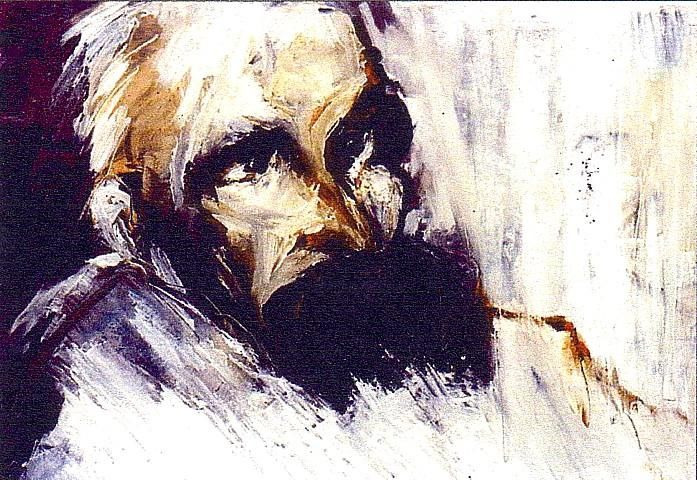
Friedrich Nietzsche, 2004, by Enrique Carceller Alcón
I do not speak of that greatness which is achieved by the fortunate politician or the successful soldier; that is a quality which belongs to the place he occupies rather than to the man; and a change of circumstance reduces it to very discreet proportions. The Prime Minister out of office is seen, too often, to have been but a pompous rhetorician, and the General without an army is but the tame hero of a market town.
–W. Somerset Maugham, The Moon and Sixpence, 1919
Stoic philosophy lately has seen a resurgence, though perhaps not the kind we’d want. While it’s been rising, enticing more and more to the joys of philosophy, it’s also been dumbed down to such an extent that it’s lost much of its meaning. However, it still has value, and ideally the desperate “alpha-males” brought to philosophy may actually gain an appreciation for it.
I write mostly about critical theory, but Stoic and existentialist literature interests me a lot. Aurelius and Camus provide magnificent guidance for modern life, despite both having died 2000 and 60 years ago, respectively. Their magnum opuses, Camus’ The Myth of Sisyphus and Aurelius’ Meditations, offer guidance on facing an absurd, meaningless, and frankly terrifying existence.
The most common advice? Express yourself–the same advice you’ve probably heard a million times.
I don’t mean to parrot the most basic possible advice given to just about every person on the planet. It’s certainly a bit irritating to hear over and over again, without any clarification, specificity, or, ironically, authenticity, that I should be authentic. It’s a nicety, a piece of advice given like party favors to each person, most of whom have heard it so often it’s been blunted and lost all meaning.
However, what Maugham wrote has a lot of meaning. It implies that authenticity comes in the social recognition of oneself, not one’s outermost layers.
Among my favorite thinkers, psychoanalyst Jacques Lacan, essentially dismantled the “be yourself” mantra. Each of us, deep down, has a version of ourselves we feel is our best, most authentic, most honest self. This ideal, what he called the Ideal-I, is socially constructed according to who we think others want us to be. To achieve it, we don’t work towards it. We project it, attempting to embody it and persuade other people through clothes, jewelry, new manners of speaking, and so on; paradoxically believing that, by projecting it, we are working towards it.
This Ideal-I, which structures desire itself, is fundamental to our identity.
The most discomforting implication of this is, of course, that we can’t be authentic. Our most honest identity, shed of each veneer and projection, is in fact a veneer and projection itself. We are, at all times, fake.
However, it’s not all miserable. Identity being socially constructed means identity is principally social, not individualistic. It comes from expressing oneself to a group, yes. But that means one must find a group they can express themselves to, i.e., they must find a group they fit best into. Through this, one can find true authenticity.
And in the end, the best way to hunt such genuine bonds is by expressing oneself to the world, outwardly and unveiled. Essentially, creatively.
It isn’t just through the ups and downs of love, platonic or romantic. Nor is it through Nietzsche, a 20th-century philosopher with an admiration for the powerful. His ideal is isolating and suppressive in itself. His diagnosis for nihilism (in part, the decline of higher meaning via a high power) is accurate; his solution for nihilism, achieving individual greatness, is deeply nihilistic.
It’s by finding solidarity among others, whether it’s joining an organization or a club, or involving oneself with family or groups of friends. It’s solidarity, belonging, and, ironically, bathing in what is essentially a gathering of ‘you’s’.
One’s ‘most authentic self’ is mostly nonexistent. Those who flee from society have a habit of losing their minds. Those who change society do so riding a wave made of many. Those who embrace society find themselves by finding others, so long as those ‘others’ are found without disguise and without pretense, while minimizing the inevitable but very human obsession with approval.
We become what we are immersed in. Thus, people among whom we can laugh freely, love deeply, and embody our most unobstructed selves are the most perfect mirrors. They are infinitely valuable.
 Aidan Vanhoof
Leave a comment