9 min read
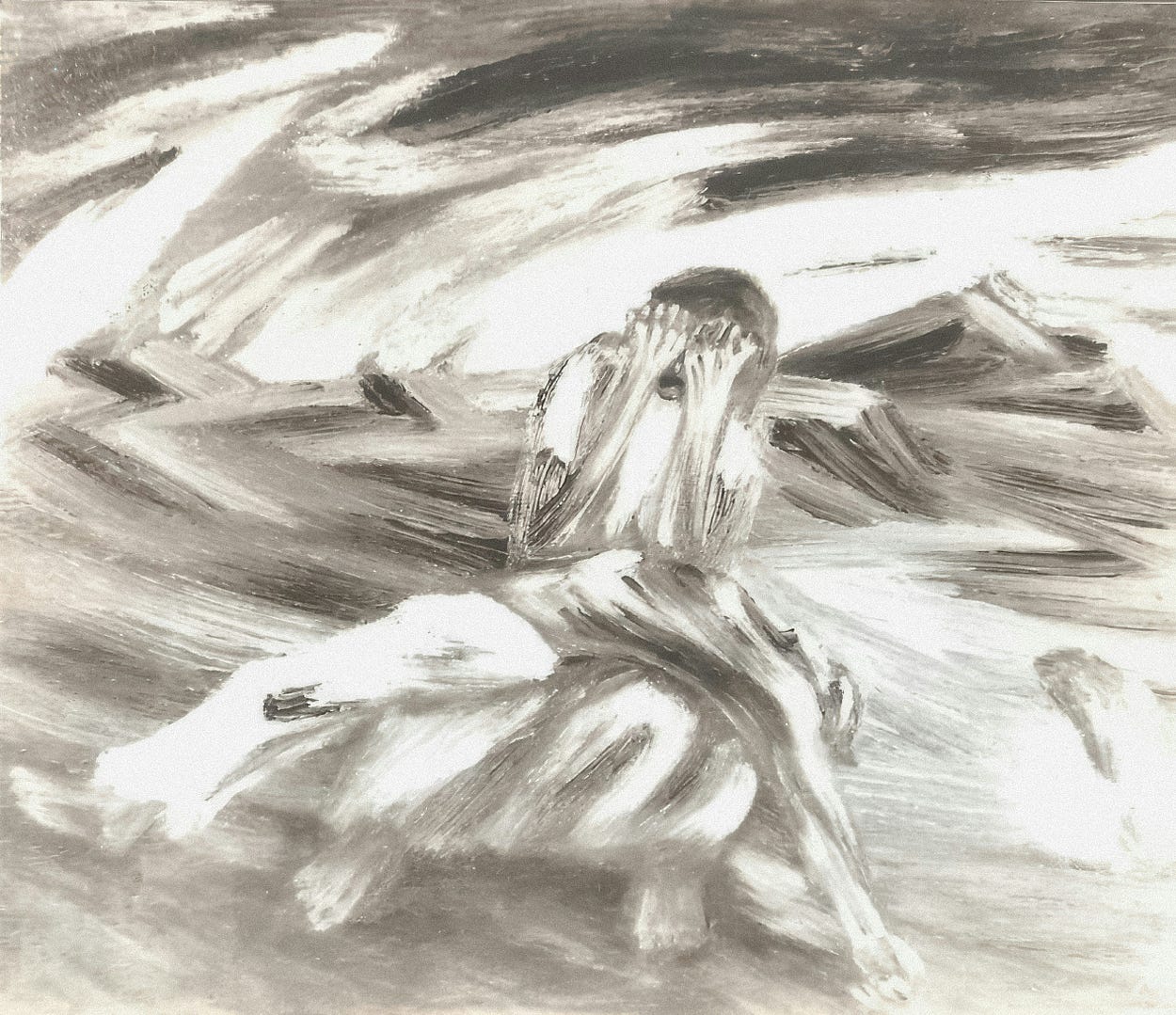
In Mary Shelley’s Frankenstein, the monster is defined as a ‘monster’ per its relation to its creator. It was created; therefore, it’s not ‘human’ like everyone else, despite being made of humans, having a conscious mind, desires, and so on. It is worthy of scorn, hatred, and complete societal rejection. In this process, it loses recognition — alienated, sidelined, and relegated to otherness as an outsider, a non-human. Thus, it is no longer a creature: it is a threat, a fetishized object symbolizing certain value judgments: ugly, menacing, violent, imposing, etc. It’s hunted down, leading to an implied suicide.
The otherness the monster is subjected to only promotes further antagonisms. But on a deeper level, the monster is a direct product of its master, yet vilified and blamed by the master for how it was created by him and for the actions taken because of conditions imposed upon it by greater society. This culminated in the monster declaring,
From you only could I hope for succour, although towards you I felt no sentiment but that of hatred. Unfeeling, heartless creator! You had endowed me with perceptions and passions and then cast me abroad, an object for the scorn and horror of mankind.
Frankenstein is a mirror for neoliberal logic: a snake eating its own tail. But such logic comes from a seemingly, though debatably, well-intentioned place. If I decide to pursue freedom, to create the freest, most perfect society from the bejeweled corpse of monarchy, what should I do? In this case, it would make sense to identify the main issue at hand: philosophers at the time of the American Revolution saw it as centralized authority, unjust taxation, and restrictions on what they perceived as innate human rights.
After identifying the problem, they acted, having made the complete antithesis to monarchy: liberalism. Decentralized authority, an unregulated market economy, and human rights for some, not for others. This, of course, would pave the way for further abuses of power. Human rights only apply to that which is ‘human.’ In that, if something is seen as subhuman, e.g., a racial minority, gay people, etc., human rights seemingly no longer apply. ‘Human’ as an ideological sign is nebulous, being as much defined by one’s belonging to a species as it is by their assimilation into a cultural zeitgeist: an ethical statement and description of conformity, class, and hegemony.
Those atop the hierarchy — the property owning classes, political elite, etc. — are more human than those beneath them. In that, by having greater access to rights in practice, fetishizing those beneath them (I’ve written about this before), and conforming perfectly to the system, they transcend any ‘subhuman’ properties they may otherwise have. This hegemonic control over what is human and what isn’t extends not just to hypocritically violating one’s own principles, but also to the broader symbolic structure of capitalist ideology.
Resignification
It is true, we shall be monsters, cut off from all the world; but on that account we shall be more attached to one another.
A given thing, by existing as its own thing, excludes the possibility of it being anything other than itself. So, every sign and event has meaning beyond its use and definitions, causes and effects. WW2 isn’t just influential for the wholesale annihilation of swaths of Europe, but for being a case study on the terrors of totalitarian ideology. It means something for its apparent good vs. evil binary, making it a perfect propaganda piece.
The Russians have a massive military parade each year to celebrate their victory over the Germans, despite Putin’s regime having nothing to do with it. Americans use it as an example of a world that could have been had their liberal democracy and freedom not stepped in to save the day. To the Russians, WW2 was a fight for nationalist supremacy. To the Americans, the preservation of Western liberal hegemony. In either case, the Nazis are more than a totalitarian, right-wing, nationalist fascist regime. They’re the embodiment of evil.
By identifying its antithesis, ideology implies its thesis: what it is, what it will be, and what it hopes to be. It defines itself by defining what it is not. In this process, a word is given surplus signification: a deeper, necessarily ideological definition. During the McCarthy era, communists were suspicious, untrustworthy, subversive, and traitorous. In other words, innately immoral. They were everywhere, penetrating deep into the heart of America.
Symbolically, communists were as Jews were to the Nazis: an invisible yet conceivably visible boogie-man, a monster hiding behind a deeply human disguise. Marxism wasn’t just a philosophy of liberation distorted and weaponized by authoritarian dictatorships, fundamentally shaped by Soviet hegemony and global influence paired with military overspending and competition with the West, but a necessarily terrible and cruel ideology of epic proportions, hellbent on world domination.
By reducing its opponents to dust, ideology made itself look like a skyscraper.
The Other
If such lovely creatures were miserable, it was less strange that I, an imperfect and solitary being, should be wretched.
By signifying liberty as inherently virtuous and its opposite evil, neoliberalism can justify itself to itself. What has liberty, regardless of how it manifests, is automatically permissible, even actively supported, under capitalism. The Chileans under Salvador Allende enjoyed a higher quality of life, literacy programs, and housing and food distributions. His administration introduced new technologies for central planning, making more efficient economic calculation a serious possibility.
After seeing this, despite him being democratically elected, because Allende restricted private property and the rights of property owners, the US deliberately devastated their economy, performed a coup, assassinated Allende, and then installed a tyrannical dictatorship, leading to the deaths of thousands and the repression of millions.
All for liberty.
By reframing overt poverty, slums, and inequality as seen in parts of America and all across the undeveloped world — which is a direct result of neoliberalism and imperialist capitalism as a whole — as a byproduct of freedom and a failure of a country or people to elevate itself out of poverty, squalor is made a ‘misuse of liberty,’ thus negligible. The poor are not downtrodden, but a vast array of individual failures. Neoliberal ideology and its countless predecessors take from terms like ‘poverty’ any serious meaning: they become non-words, ignorable, pointless, societal troughs worthy of neglect.
With the individualism inherent to neoliberalism, the working-class thus loses a cohesive sense of identity, as it’s tainted with a sense of ‘otherness.’ It’s no longer a ‘class’, as individualist ideology and economics mean each individual is seen as an isolated unit, not as a person with an identity contingent on the collective. The working class is a mass of neoliberalism’s disappointments; an aggregate of lost causes with a dormant potential for improvement, instead of a class whose poverty is a systemic symptom.
A focus on ‘opportunity’ as opposed to outcomes leads to a society in which the definition of ‘human’ is realized in relation to the economy. This definition only applies if opportunities are provided, ensuring the state fulfills its only real responsibility in protecting the right to private property. In that process, the working class loses coherence.
It’s misrecognized by a potent, traumatic Other, a Big Other, whose identity is made, not through solidarity, but by reference to the only recognized class, the group designated as the ‘most human’: that of the corporate, property-owning class.
Neoliberal otherness and Hegel
Listen to me, Frankenstein. You accuse me of murder; and yet you would, with a satisfied conscience, destroy your own creature. Oh, praise the eternal justice of man!
From the start, American private property justified genocide. Early drafts of the Declaration of Independence included condemnations of slavery. But the economic interests of Southern Planters ensured abolition would take millions of deaths to enact, using the perceived inferiority of the black population alongside passages from the Bible to disguise a naked obsession with profit. During Westward expansion, while Manifest Destiny motivated many, it acted solely as a religious justification for market imperialism, similar to Christian Nationalism or the early libertarian Christian organizations of the 1930s, 40s, 50s, and 60s. Settlers were given private property and free lots out West, but Native Americans weren’t given full citizenship, as they were recognized as their own nations. They were not American citizens worthy of the opportunity for property ownership, nor were they subject to human rights.
They were an Other. They were a foreign entity, an infestation to be resolved or exploited for land and labor. A people to be purged, expelled, and stripped of their native lands to facilitate American colonization, imperialism, and natural capitalist expansion. In Frantz Fanon’s Engagement with Hegel’s Master-Slave Dialectic, Brandon Hogan writes,
According to Fanon, while Hegel’s master seeks recognition from the slave, the colonial master seeks only work. Moreover, for Fanon, the Hegelian slave differs from the colonial slave because the former eventually gains self-consciousness and freedom through labor, while the latter seeks to be like his master — that is, he seeks to be white — and is thus unable to find liberation through labor alone.
Fanon’s critique of Hegel, while made in a European colonial context, is universal to class dialectics: Hegel’s theory of recognition doesn’t account for those who are unrecognized and unaccounted for, whose recognition is traumatic for either party. In this case, the foreign working class producing commodities the domestic working class consumes: the Indonesian textile worker, the Chinese Uyghur assembling plastic toys, and so on. These groups are beyond the gaze of the domestic working class and corporate class alike; they are exploited for labor, but society does not recognize them; they’re beyond our culture, our government, our beliefs, and way of life. They are commodities: values producing more values.
Yet, neoliberals defend this. Neoliberalism builds wealth, but typically domestically at the expense of foreign markets. However, the wealthy nation provides a beacon, a model to emulate, representing the potential neoliberal capitalism has for the impoverished foreign worker. Inequality is the soul of neoliberalism, as even that inequality elevates the corporate class to idols.
Here in America, South Americans, by acting as unrecognized laborers for jobs the middle class rarely occupied, took the role of the dehumanized human, the person without personhood. They are ‘illegals,’ and because they fail to assimilate into the American status quo, they lose their humanity, fetishized into a mass of invaders whose double nature permits them to be both docile, hard workers stealing American jobs, and an evil, crime-causing army of pseudo-terrorists. By distracting the population from the sins of the ruling class — which are blamed on the Mexicans — millions lose their humanity, thus their human rights. The victims are the American people; the enemies are illegals; freedom of opportunity is stolen from hardworking Americans. The thieves — illegals.
Neoliberal logic continues to invent a third party, a ‘third class’ sitting just outside the dialectic, whose absence of legal recognition and overt poverty deprives them of economic opportunities. A group to be neglected and exploited, then thrown out once it’s convenient. Class society remains the problem, but the property-owner/worker binary, alongside its subcategories— i.e., the labor aristocracy — is dated. As with the emergence of neoliberalism, we can see the simultaneous emergence of a new type of class, one visible solely on a global scale — the unrecognized subclass.
In each case, the concept of liberty, as realized in private property, was itself oppressive. The liberty of the American is the suffering of the exploited. In that, ‘liberty’ isn’t freedom. Economic freedom justifies itself by reframing liberty as a virtue, oppression as the failure of the oppressed, and history, not as the advancement of exploitation but of society, seen through the eyes of the property owner.
Neoliberalism thus only makes sense thanks to the mechanisms of neoliberal logic. Liberty only makes sense when understood and disseminated by the property-owning class. Humans are only ‘human’ given they exist to serve the capitalist world order (as proven by the Chilean people, Native Americans, Vietnamese, Russians, etc.), and ‘rights’ are wholly alienable. That is, if they are not human, as that which is unalienable is only unalienable for the select few.
The paradoxically inhuman obsession with distinguishing between different types of humans allows for an enjoyable contradiction: while one does not feel free, they feel free; they are not free, yet they think they’re free; thus, they grow complacent, tolerant, and through the promises passed down to them from prior generations, they venerate the technology, beauty, and power brought by the hegemony dehumanizing them.
This is neoliberalism’s totalitarian force: a leviathan isn’t needed to ossify ideology, as the ossification process is baked into the ideology itself, at its atomic level.
 Aidan Vanhoof
Leave a comment