7 min read
Jun 13, 2025

Recently, I’ve been spending some time thinking about my future, as any 19-year-old may. Not only college or my future career in journalism: what’s fascinated me has been my retirement. That point in life when working becomes undesirable, when to labor would bring me little meaning, and all I want is to settle down with a partner, perhaps a dog, and relax.
What fascinates me is how that retirement would go. I live in Southern New Jersey — known for its farmlands and seemingly endless suburbs and retirement communities, both of which have a habit of trapping me in a maze-like loop, with sparse landmarks and cloned houses and trees gifting me the now frequent opportunity to get lost. This endowed me with a deep and fundamental hatred for such communities, and I’ve decided that to live in one would be my personal hell.
Thus, in thinking about that, I’ve found that to live in its negation — an isolated, natural, beautiful environment that features actual life on earth — is far more desirable. One of my favorite TV shows is Twin Peaks. If you haven’t seen it, I’ll insert a picture below. That is the life that hypnotizes me — among the mountains, away from the world, in nature.
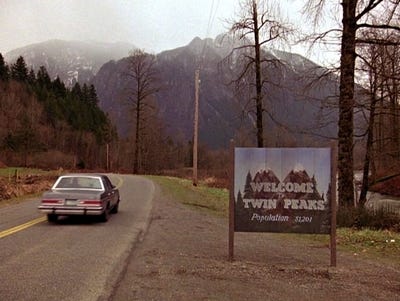
This has become a daunting task. Retiring and living a simple, content, quiet life — that’s seemingly an irrational want. This is my thesis to this essay: Being content is impossible in a world of wants. The modern world has ironically devolved with its simultaneous evolution: life is steeped in and utterly dysfunctional without consumption, without being bombarded with systems designed specially to play on human desire. To be content with little has become impossible; yet, to be content with lots remains impossible.
I’d like to preface my main argument with a statement on what leads a person to be content. In this case, I’d like to apply the theories of French psychoanalyst Jacques Lacan.
It is human nature to chase, but never to attain. To attain our desires would mean the creation of new desires for us to chase. What modern America is so good at doing is riding on our backs, holding the stick before our faces, letting us chase it in loops until we take the carrot (buy the product), then replacing it with another carrot — perhaps it’s bigger (advertisements, iPhones, and so on) — keeping planted on the saddle until we keel over and die. We only stop desiring once we die.
It is what mediates this desire that holds the most power over humanity: the state, the corporate world, our heroes, our villains, and so on. Desire is controlled by the world around us, by our culture, by language, by what we are taught and not taught. Desire, thus, is the desires of the Other — not our own. We desire what we want others to think we desire; i.e., we want to be seen a certain way, and we attempt to embody that ideal — the Ideal-I — and project it. This becomes our self-identity. As Lacan wrote,
The I is always in the field of the Other.
This is where I hope to elaborate on contentedness: the world of desire is not necessarily our own, as it is controlled by the world of symbolic systems — what Lacan called the symbolic order. It is with this that I come to my first conclusion: Authenticity is not primacy of the self, but primacy in the choice of selves.
The subject is incapable of the traditional, ‘existentialist’, libertarian type of authenticity: To use an example from Jean-Paul Sartre, the self one has when they think the mannequin is a real person, and the self they become when they realize it is fake, are one and the same; they are equal parts of the whole identity. One’s identity is formed by how they want to be perceived, and they become either happy if they are merely chasing it; or they become anxious if they feel they have already achieved it, but are not being recognized by the Other as such. Who a person is when they are watched is a version of their self, and who a person is when they are not is just as much a version of their self. But neither one is their ‘only’ self: they are each simply different selves. One projects internally in the pursuit and self-deception of the Ideal-I, and one projects externally in the projection of the Ideal-I.
Therefore, to become ‘authentic’, one must first acknowledge that such a thing is impossible. Authenticity is a myth, but a myth that remains important to human happiness. So, it is a myth that must be critiqued, but one that must also be supplanted with a non-myth: the idea that, instead of pursuing absolute ‘self-recognition’, one should achieve absolute ‘choice-recognition’. What this means is, I must choose how I am to be recognized, take steps to achieve that recognition, but avoid groups that recognize me differently to how I want to be recognized: in other words, authenticity manifests in choosing the groups you belong to, not necessarily in rejecting group identity. It comes in picking those who recognize you for who you are — who you want to be seen as — and not altering your sense of self to fit in with others, instead altering the others to fit your sense of self.
It is with this that I conclude that humans are fundamentally collectivist. Anti-social behavior thus often comes with a crisis of recognition: it comes when the Other fails to recognize the subject, alienating them from recognition as a basic precondition for happiness. Then, they reject recognition altogether, losing this communal edge to human nature. This would also be why altruism and ethical behavior is often important for individual happiness.
This is what capitalism does so well: it provides artificial means for recognition — watches, clothes, shoes, music, and other consumable products. Products that are sold to us as means to another identity, as pathways to a different self, as ways to fit in to the groups we choose. To build on a past metaphor, commodities are the carrot, corporations are the person holding the stick.
Contentedness comes in recognition without artificiality: e.g., a Buddhist monk may spend their time living a minimalist, basic existence, but they are purely content, as they are recognized within their group, and, whatever suffering they may endure pales in comparison to what they desire — true enlightenment. Desire overcomes pain, and with the meaning provided by recognition comes a warped happiness. This desire paired with pain emits a paradoxical attachment to the source for pain: the source for pain becomes a catalyst for the power of desire, as desire is amplified as the guiding light through times of suffering. Pain strengthens desire by bringing one closer to it emotionally.
Contentedness in the sense of the Buddhist monk is different from happiness as it is sold to us: the recipe for happiness has hardly changed for thousands of years, despite drastic changes in material conditions: it is predominantly social. Happiness is the satisfaction of recognition. Contentedness is the satisfaction of recognition wholly independent of material conditions. It is thus pure happiness.
Modern happiness is different: it is happiness mediated by commodification: it is the commodification of all that is social, happiness originates in the social, thus that which is commodified is also that which is social, therefore that which is happiness is also that which is commodified. Thus, in the modern schema, commodities equal happiness. This demands one desires what exists on the short term: what dies alongside the Buddhist monk, dies with the purchase of each new product for the American consumer. The Buddhist monk can be content through the whole of their life, despite enduring downright primitive material conditions. The commodified person is happy only as long as they are consuming. They cannot be content, they can only have false-joy and short-term pleasures. In other words, hedonism.
This is the source of my fear: I feel that I will not be content in retirement, for even to function in society requires I navigate the internet, own a cell phone, understand the media, and so on. While I hope I don’t end up a hermit, capitalist desire — consumerism — is utterly unavoidable. To be content in America, no matter how hard one may try, is becoming increasingly difficult, and it is a task that, while possible, is appearing more and more like a sheer, unclimbable cliff face towering before us. I fear for my retirement. I hope I won’t need to for much longer.
This is my desire.
I understand it must be ironic that I’m writing this and posting it on Medium and the internet at large. I must confess I enjoy these things — the commodities and infinite access to information. Capitalism is enjoyable on the short term. It is on the long term — contentedness — where the pains of American life as a commodity are discovered, yet it is also on the long term where desire is truly meaningful. Thus, the modern world is a factory for existential meaninglessness and shallow happiness; it is a world without character beyond the briefest of illusions and a life without true authenticity. For that authenticity, as much as it is touted by our individualist culture, is a commodity in-itself.
 Aidan Vanhoof
Leave a comment