6 min read
Sep 20, 2025
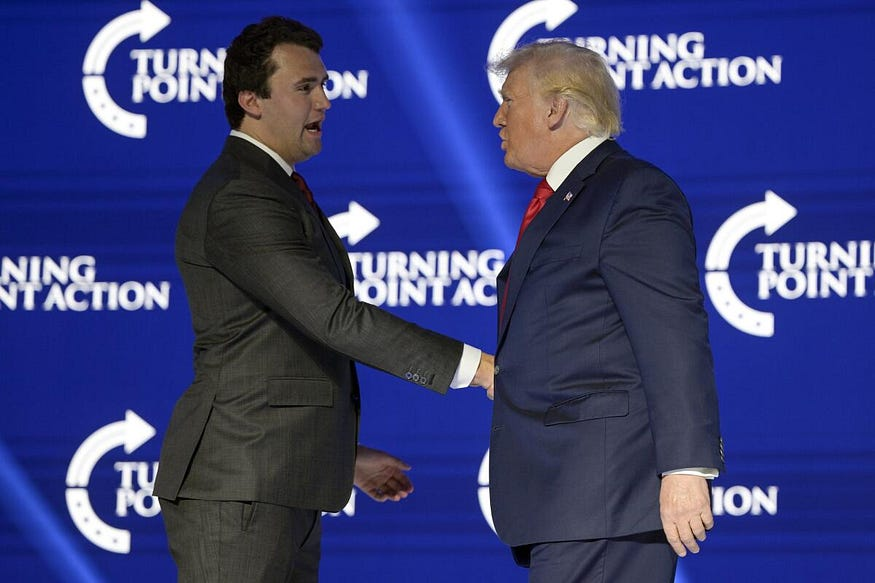
Charlie Kirk’s death has become among the most vicious battlegrounds in American politics. AOC delivered a speech condemning Kirk to a Congress ready to honor him as a true American hero; Trump’s pseudo-fascistic nature continues to reveal itself as he begins a campaign of repression against the left; and the right has taken a firm position against anyone speaking ill of him.
His death follows a worldwide pattern. Just two weeks ago, Nepal and Indonesia alike faced widespread anti-government protests, which for a time appeared to be decentralized, populist revolutions; each of which panned out like most: ending with just another, somewhat more liberal candidate — as we saw in Greece, for example.
Of course, Charlie Kirk’s death isn’t entirely the same. Charlie Kirk isn’t a government to be deposed, and his killer was a random college student. However, his death serves a similar symbolic purpose: His murder won’t end fascism, in fact it may make it worse; and his absence won’t spell the demise of Turning Point USA. But it absolutely means a paradigm shift in American politics, as we’re seeing in newfound, but deeply unsurprising, political repression.
In that same respect, the decentralized and generational nature of the aforementioned protests won’t end corruption or authoritarianism. But they symbolize an increasing disdain for a rotting status quo. His death marks, per the title of his organization, a ‘turning point’: an ugly and profoundly bloody martyrdom capable of enacting serious, albeit maybe undesirable, change.
To many, Trump and Kirk were the ideology. Their ideas were like supernatural properties engrained into their being, and Kirk’s death only ossifies this. The man who killed him, though this has since been disproven, was for a time assumed to be a leftist involved in anti-fascist circles (which Trump’s been using as a justification to classify Antifa (which isn’t an organization) as a terrorist organization). This assumption meant the man who killed a fetishized Kirk was his antithesis, his opposite, his absolute negation. And because Kirk was likely killed for his beliefs, Kirk’s fetishism only grew deeper with his death; martyring him, rendering him a man who died for his ideology wearing the emblem thereof.
The right’s rather immediate trauma was by no means subtle. Social media posts about how he was killed for speaking the truth, or how he was a good faith debater striving to spread traditional, Christian values across college campuses, would flood my and many other peoples’ feeds.
There wasn’t much to seriously warrant such a reaction. A common talking point from the left and liberals alike is that he continually ignored or embraced mass murders, school shootings, and gun violence as a necessary side effect of a free society; yet he himself was killed by gun violence (and his last words justified the Second Amendment), making his death seem somewhat self-inflicted.
He embodied a violent ideology, so Kirk’s fetishism extends to the left. He embodies the hypocrisy inherent to right wing ideology, instead of the violence inherent to leftism. To each side, his death means something greater than what it is — an ignorant, bigoted fascist shot and killed in front of a crowd by an angry college student. He’s just another gun death in America — one of thousands — yet to each side he’s something far deeper.
The death of a fetish is always traumatic for both sides. One side loses an object, an idealized fetish representing a society that has yet to come; the other, rationalized racism taking a human form, the enemy to be destroyed and the figure restraining a better world. The right lost their God figure, the left lost their rival.
Both mostly enjoyed this dynamic. Kirk’s dominance over political discourse was infuriating and enjoyable. Thus, his loss is disturbing, alarming, and frightening, far more so than the school shooting happening at roughly the same time as his death.
But to understand this deeper, it may help to look in literature.
In The Wall by Marlen Haushofer, the main protagonist’s stuck in a forest when an invisible wall, which descends as far into the ground as she can dig and as high as she can see, spawns into the world, alongside the deaths of everyone she knows. She eventually begins the arduous process of survival in a novel that explores the powers of patriarchy, social conservatism, and animal companionship. (Warning, spoilers) At the end, the only other person she sees, she kills, as he seeks to kill her and her animals for food and resources. Now, she is truly alone.
The wall, to the protagonist, is restriction. It’s a barrier confining her to one half of the world while keeping the rest out of reach — a world that’s visible to her yet riddled with the petrified corpses of the past. The man she kills was at one point the man she’d been searching for: he was the only hope, the object of desire whom she thought would fill a gap in her being; who kept her going, searching, and gifted her meaning and purpose in life. Once he died, that collapsed; thus his death was not only traumatic because she murdered someone, but because she lost something libidinally satisfying.
Kirk filled one of these roles to each side: to the leftist, he was the wall; to the conservative, he was the man. In the novel, the protagonist, despite having been put in such an awful position by the wall, simultaneously finds it liberating: the wall distances her from the confines of state, patriarchy, and so on; her newfound purpose derives from the wall in searching for another person, in establishing what the wall is; thus she finds it has a personified role in her identity: it’s not a wall, but a mirror for identity formation, as her life is centered around it.
The leftist response to Charlie Kirk’s death — in large part attacking him but condemning his assassination — is a symptom of this trauma. His death, not him, was the focus. The barrier he represented has fallen, so it makes some level of sense that his death wasn’t traumatic: it’s what his death means for greater society that matters (democratic backsliding, leftist persecution, etc.). For the rightist, the relationship is inverted: the ruthless condemnation of the left for Kirk’s assassination, given the right neglects gun violence otherwise, was an afterthought compared to Kirk himself.
Violence is thus acceptable depending on who died. Violence only matters to the right wing if a leftist perpetrates it or if a rightist dies; violence only matters to the left if a rightist perpetrates it or a leftist dies.
For this reason, Kirk’s death is overinflated in the attention directed towards it, almost obsessively. It’s ugly, somewhat irrational, but strictly ideological: the right mourns the loss of an ideological idol, the left either mourns or celebrates the rise of political violence in America.
This contradiction extends to every function of government; to the existence of the state itself. Why is it that those who condemn political violence don’t condemn the police, authority, the military, etc.? Why is it that anarchy isn’t their first and only choice if violence is so cruel, so unnecessary and vile?
The state is contingent on violence. It can’t exist without it. Yet if a citizen does what police do every day, it’s a crime.
Political violence is thus acceptable to most Americans, but once again it depends on the party under attack, and Charlie Kirk’s death mirrors this perfectly. The countless condemnations of political violence and degrading discourse; the horrified gasps as we watched democracy undermine itself in such a bloody way. The same people flying thin-blue-line flags, who claim to support the police and law and order, condemn such a senseless act. Yet few, except the students who painted a BLM symbol over Charlie Kirk’s name at a memorial, realized this contradiction.
 Aidan Vanhoof
Leave a comment