13 min read
Jul 8, 2025
Since this essay is rather long, I think it’s important that I state my thesis early on: Marxist materialism, while on paper quite practical, fails to bring about the most effective solution to capitalism by reducing both human consciousness and class-struggle to material conditions; thus, our understanding of capitalism and the solutions thereof become oversimplified. Hegelian theory paints a more accurate picture of modern capitalism and class-struggle, and should be used as a replacement or at least an accompaniment to Marxism in the modern world.
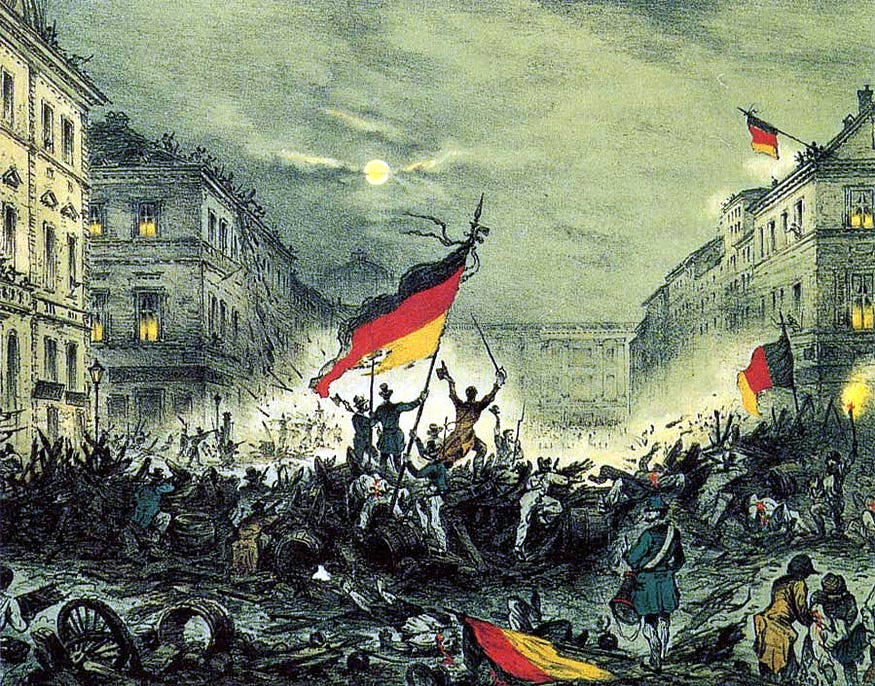
Karl Marx is widely cited as, not necessarily the first, but the most important anti-capitalist in philosophy. He refined anti-capitalism into a masterfully constructed theory of economics, politics, psychology, and even existence. One which, since Marx’s time, has grown into arguably the most influential philosophy in history.
We can spend as much time as we like attacking Marx. The Marxists of the 20th century are an easy example, given the atrocities they committed in the name of a communist utopia that would never come. But Marx himself was never involved in such things, nor were many of his ideas. Lenin, I would say, is the one to blame — though he wasn’t the devil on his own, either.
So, I feel it is necessary that, when critiquing Marx, we don’t look at the USSR or Maoist China or any other major communist experiment. I consider them, given they were bolstered heavily by the USSR during and following Stalin, more so Leninist and Stalinist than Marxist.
A great example is religion: The Catholic Church’s official position on Marxism and socialism as a whole is disapproval, due to the anti-religiosity of the USSR and subsequent socialist regimes. But Marx himself was not expressly anti-religious — Lenin was. The quote misappropriated as being ‘anti-religious’ — the one in which he refers to it as “the opiate of the masses” — is both a mistranslation and taken out of context. By and large, when taken within context, the quote holds quite a positive view of religion. Only that one should focus on abolishing the material conditions that lead to religious belief, as opposed to resorting to religious belief to cope.¹
So, it’s become more important to look at his philosophy in relation to other philosophers, in the abstract as much as in a pragmatic sense. The ‘pragmatic Marx’ is the pragmatism of his followers and not so much himself.
Part I: There is no Marx without Hegel
When we consider Marx, we have to consider Hegel. Even Lenin thought so. From his Collected Works,
It is impossible completely to understand Marx’s Capital, and especially its first chapter, without having thoroughly studied and understood the whole of Hegel’s Logic.
Hegel’s dialectical logic, while abstract, is the foundation for Marx’s dialectical materialism, thus, his historical materialism — i.e., his material analysis of class and economics and his material analysis of history.
But if we are to look at Hegel on his own, perhaps also considering his heavy influence from Kant (Hegelian theory could be considered an extension of Kantian theory), we reach our first contradiction. Hegel was an idealist — in that, he considered consciousness to have primacy over material. The idea being, we process reality through consciousness, so, consciousness is the foundation for our understanding of reality. This also means we can’t ever truly grasp reality as it is always translated into a conscious form. It is thus changed from its material form into a non-material form: we are altering it to fit our own limitations. And, that this conscious experience of reality is altered and made more sophisticated with time and knowledge — our increasing ‘understanding’ of the world, moving towards an eventual Absolute: an ‘ultimate understanding’.
This doesn’t imply that material reality doesn’t exist. But it does imply that immaterial conditions are more important than material conditions. This is where Marx diverges from Hegel. From A Contribution to the Critique of Hegel’s Philosophy of Right,
For revolutions require a passive element, a material basis. Theory is fulfilled in a people only insofar as it is the fulfilment of the needs of that people. But will the monstrous discrepancy between the demands of German thought and the answers of German reality find a corresponding discrepancy between civil society and the state, and between civil society and itself? Will the theoretical needs be immediate practical needs? It is not enough for thought to strive for realization, reality must itself strive towards thought.
This is a complete inversion of Hegelian thought. In that, while Marx is not making a statement on the philosophy of consciousness in the same way Hegel or Kant did, he is arguing for the impracticality of such a theory. For Marx, theories of consciousness don’t necessarily translate into political theory. Thus, a new political theoretical position is necessary.
If political economy is necessarily material and it is made specially to alter material conditions, and if that which is pragmatic is that which is materially useful, then this new ‘political dialectic’ would need to be material: dialectical materialism. Thus, Marx was able to apply Hegelian logic to a material base.
Part II: What Marxism gets right
With this essay I’d like to reverse that process. But, I’d first like to clarify that Marx was right in arguing that most otherwise immaterial aspects of political economy are stuck in a funnel — they all strive toward a material ends.
Let’s take the family. From A Contribution to the Critique of Hegel’s Philosophy of Right,
The family, as person, has its real external existence in property.
And, from the preface for A Contribution to the Critique of Political Economy,
The mode of production in material life determines the general character of the social, political, and spiritual processes of life. It is not the consciousness of men that determines their existence, but on the contrary their social existence determines their consciousness.
The family, at the time of Marx (and even now), was considered by many to be the main economic unit. For the wealthy, families of power and influence intermarry to link one-another together, conjoining the greater powers of society, thus making them stronger. But this power only manifests in a material form: in power over people, power over politics, and power over economics. All of which either concern labor processes, the enforcement or creation of laws, or the exchanging of money. Why do they want these things? So their material conditions can improve and grow increasingly stable, able to endure for generations.
For the working class, the family unit allows for a stable system of interconnectedness and for increased labor, thus income, for the household (at least at Marx’s time). All of these things contribute to better material conditions for the household. This doesn’t discount the importance of family, but it absolutely alters how we ought to understand family: as something necessarily due to material conditions and not something that holds primacy over them.
Part III: What Marx got wrong
But, striving towards something doesn’t necessarily imply the supremacy of that which we strive towards. If I’m hungry and I want food, does that hunger define who I am? Am I not more complex than my desire for food, even if it’s a fundamental driving force for humanity? When we look at it from this perspective, it would imply that what I strive for at this given moment is who I am. And this simply is not the case. When expanded to a political perspective, we can understand that the ends do not define the means. After all, do we regard the Holodomor or the Great Chinese Famine as something acceptable for their desired ends — that being a ‘perfect communist utopia’? For the majority of people, I would say, no. ²
Yes — material conditions are the ultimate ends. But those material conditions are defined also by immaterial conditions. Money, for example, holds no value beyond the value we put on it. The numbers printed on the corner are only recognized as ‘value’ because of a symbolic system we all mutually agree upon. This number is only worth anything because an abstract mathematical system defines it as such, and so on.
Also, the problem remains that the means by which we reach a ‘material’ ends can be either material or immaterial, depending on what and how we intend to reach that point. It isn’t necessarily material. And, why do we want to reach the material ends? Why do we want to have our hunger satisfied, our house to be bigger, our income more stable? I would say, for emotional satisfaction: the avoidance of anguish. As the negative aspects of poor material conditions, except for death of course, are experienced via our senses (pain, pleasure, etc.), positively or negatively.
This is where an effective theory of consciousness is in fact pragmatic. It allows us to understand ‘why’ we strive toward material. And if that ‘why’ is the foundation to material, then it is most pragmatic to consider that ‘why’. Thus, the material at the very least is not dominant over the immaterial, especially in consciousness and even in politics — and this isn’t just a theoretical claim: it is a practical claim.
Part IV: Applying the Hegelian dialectic to egalitarianism and socialism
Now that I’ve established this, how can we apply an idealist dialectic to material reality? (In the following part, I will draw heavily from the theories outlined in Hegel’s The Phenomenology of Spirit.)
When we consider Marxist theory, what’s the end goal? Is it not to enhance working class power through the complete overhaul of prior economic and political conditions?
From Marx’s Correspondence of 1843,
Man must recognize his own forces as social forces, organize them and thus no longer separate social forces from himself in the form of political forces. Only when this has been achieved will human emancipation be completed.
While this may seem like the most material of material goals, I would not consider it as such. I want to dispute the idea that social forces are inherently political and that to emancipate the social we must first emancipate the political. To me, they are one and the same and the balance between material and immaterial in social and political life is in a state of equilibrium: one is not dominant over the other. They are codependent.
If the goal is for the working class to be autonomous, then it seeks to be independent of its opposite, its negation, the ‘Other’ that controls it while contradicting it: the ruling classes, who give them their identity as a ‘working class’ by providing their opposite. After all, for something to have a positive property there must also be a negative property for that ‘thing’ to be anything other than neutral.
If the working class wants to emancipate itself from the ruling class, it is therefore attempting to stop the dialectic, its interaction with its opposite: it wants to become its own entity: it wants to become ‘self-conscious’, to use Hegelian terminology. It wants to be recognized as the entity with power, while the Other is to be submissive to it, or even eliminated altogether. It wants ‘self-recognition’ without a traumatic antithesis to give it identity. It wants to garner an identity as absolutely equal — as without exception — so, it cannot have class: i.e., socialism.
But this problem of recognition is not one of material but one of a collective desire for emancipation. They feel unrecognized by the ruling class; or, if they are recognized, as a mere servant to the ruling class. But, this position is of course undesirable. After all, if the main goal is to be recognized, it is easiest to be recognized when you are the dominant class, the Other to which all other classes strive. Therefore, the desire is one of power. Yes, economic power, but economic power as a means to recognition, as a means to authentic self-determination: as a means to the same self-consciousness that the ruling class has without becoming a new ruling-class.
Part V: Where do we go from here?
This is neither material nor immaterial. It is both a desire born from an immaterial conception of class, of culture and community — one born from a mutual suffering at the hands of a higher power, and a desire both for it to end and to be recognized as a valid community; and a desire for material emancipation from that higher class. It is born from a desire for a better emotional state, a stronger community, and a more comfortable and vastly more fair material state.
This struggle, therefore, can be understood in two ways:
- As a desire for self-consciousness (in this case, autonomy, communal strength, and a less alienating and competitive system — alienation being an emotional byproduct of poor labor systems, and competition dismantling community: an immaterial state and something often considered by idealists), and not necessarily food or nicer houses. A person a thousand years ago may even be happier than a person now even if we live like kings compared to them. For example, wealthy celebrities are notoriously mentally unwell (Kurt Cobain, Chris Cornell, Layne Staley, etc., all of whom are dead either due to suicide or drugs and all of whom belonged to the same musical movement). Material conditions play a role in happiness, but they are by no means dominant.
- As a desire for dominance over a class that once oppressed them, a deeply Nietzschean move: moral and political condemnation based upon resentment. But, this would imply that communism is not the solution to their problems. Instead, a new form of capitalism which simply ‘swaps’ wealth.
The first option is more likely. However, the second option is not dead, in fact, it is thriving.
Hustle culture is a great example. When people complain about debt, poverty, and so on, they are not told that they are in debt and impoverished because they’re being exploited for everything they’re worth as a human being, but because they need to work harder. They need to serve the ruling class better. If they do so, they’ll be allowed an opportunity to join the ruling class and exploit others instead of being the exploited.
They’re told there exists certain secrets, certain things rich people have that poor people don’t. That there is a fundamental difference in nature between the two classes, but by attaining these properties, the poor can become rich too. Thus, absolving the rich of any ethical issues (as the difference in wealth isn’t a difference of exploitation, but of ‘mindset’) and turning resentment into paradoxical desire.
This attitude can be summarized by the following phrase:
“Why do they get to be rich? I want to be rich too! It’s unfair!”
It’s not a recognition of a systemic problem, but an infantile fetishism of both class and wealth (the application of non-material and often arbitrary yet extreme value onto an object or concept; another term may be ‘idolization’). One resents the ruling class, so they seek to destroy them. They seek to take from them their wealth, but it doesn’t necessarily have to be a collective redistribution. It could also be a more egoistic concentration of wealth, thus, the desire to replace the ruling class, not equalize all class.
This can be seen in right-wing populism: the idea that the world is unequal, but that’s not the problem — it’s those who are in the lower classes who are failing, not the ruling classes. Thus, the state and the economy is to provide gateways to wealth, not wealth itself.
Part VI: Marxism contradicts itself
Thus, option one is the only option that would consistently lead to a socialist system: it is thus the only truly Marxist position, despite being idealist in nature. Marxist materialism thus logically and pragmatically contradicts itself.
If we are to recognize the power of the working class, it is by recognizing both why a new society is valuable and how it is to be achieved. And it is not necessarily through immediate revolution and solely material changes, as we saw with the 20th century communists, who attempted a solely material revolution without a consideration for anything else. This led, inevitably, toward a totalitarian ends, as the only means to changing the immaterial (culture) through a specifically materialist framework (Marxism), is by changing it materially: via authoritarian measures.
Repression doesn’t destroy that which is repressed, it merely sends it ‘underground’, which can be understood through Hegel. When a given group lacks recognition, or is actively stripped of it, it labors for that recognition. It does not die out. It often becomes stronger, fighting for what it feels is necessary for its sustained existence. We can see this in protests, wherein riots are often incited through a police presence meant ironically to deter riots. Or how the USSR failed entirely to eliminate religion despite oppressing religious organizations.
A democratic socialism, one in which reactionaries and religious folk alike can exist freely, is wholly necessary. As by repressing these groups, they will not die — they will only grow stronger. We can imagine a given group as a body: straining and pushing and fighting only makes the human body stronger. We tear our own muscles to bring more back, we break our souls to rebuild them bigger, and we strain our minds to garner more knowledge. It’s the embodiment of the Nietzschean ideal: when that which kills you only makes you stronger.
¹Here is the full passage from A Contribution to the Critique of Hegel’s Philosophy of Right:
Religious suffering is, at one and the same time, the expression of real suffering and a protest against real suffering. Religion is the sigh of the oppressed creature, the heart of a heartless world, and the soul of soulless conditions. It is the opium of the people.
The abolition of religion as the illusory happiness of the people is the demand for their real happiness. To call on them to give up their illusions about their condition is to call on them to give up a condition that requires illusions. The criticism of religion is, therefore, in embryo, the criticism of that vale of tears of which religion is the halo.
Criticism has plucked the imaginary flowers on the chain not in order that man shall continue to bear that chain without fantasy or consolation, but so that he shall throw off the chain and pluck the living flower. The criticism of religion disillusions man, so that he will think, act, and fashion his reality like a man who has discarded his illusions and regained his senses, so that he will move around himself as his own true Sun. Religion is only the illusory Sun which revolves around man as long as he does not revolve around himself.
It is, therefore, the task of history, once the other-world of truth has vanished, to establish the truth of this world. It is the immediate task of philosophy, which is in the service of history, to unmask self-estrangement in its unholy forms once the holy form of human self-estrangement has been unmasked. Thus, the criticism of Heaven turns into the criticism of Earth, the criticism of religion into the criticism of law, and the criticism of theology into the criticism of politics.
²While from a psychoanalytic perspective we can dispute this, what psychoanalyst Jacques Lacan theorizes pertaining to desire relates to ever-changing goals defined most of all by something immaterial: the gaze of the Other.
 Aidan Vanhoof
Leave a comment