In Philadelphia, Pennsylvania, Wooden Shoe Books is the state’s only leftist bookstore. Selling anarchist, Marxist, and generally anti-fascist leftist literature, they serve an important role: to preserve radical ideology in a world in desperate need of it. Their anarchic ideology isn’t just posing: they’re fully volunteer-led and non-profit; in fact, they describe themselves on their website as “anti-profit,” writing,
We seek to be an example of the society we envision and what we are working towards as radicals… We are a non-hierarchical collective that hopes to empower members through worker self-management and a consensus decision-making process.
Walking in, this mentality is clear. Anarchist and Marxist literature sits in full display on shelves and tables; posters and stickers decrying the state and capitalism cover every surface without a book.
But is their ideology, anarchism, a genuinely anti-hegemonic ideology like they claim it is? Does it seriously challenge the status quo? In this essay, I’d like to explore the idea of hegemony, how to prevent it, and whether prevention is even possible.
Rebellion feeds into itself
… Power is exercised rather than possessed; it is not the ‘privilege’, acquired or preserved, of the dominant class, but the overall effect of its strategic positions — an effect that is manifested and sometimes extended by the position of those who are dominated. Furthermore, this power is not exercised simply as an obligation or a prohibition on those who ‘do not have it’; it invests them, is transmitted by them and through them; it exerts pressure upon them, just as they themselves, in their struggle against it, resist the grip it has on them.
— Michel Foucault, Discipline & Punish (1975)
Foucault’s idea that power is self-reinforcing applies well here. Rebellion can’t be formalized. By formalizing rebellion, it’s made another form of conformity, a doctrine to be followed. Revolution — rebellion to enact something new — embodies this: to rebel for a new world implies the creation of new conditions to rebel against.
Let’s take art. To create, one expresses oneself, as even when art expresses a collective act, like a mural or a band, it’s either a subjective interpretation of a collective thing, or a series of such interpretations. For example, when a band writes a song together, the lyrics and melodies they create, while they feed off of one another, are only as strong as the individuals who created them. Each lyric comes from the mind of a single person, another edits it, another moves a line around, and so on. Each movement, each action, is the action of an individual, which eventually results in a greater ‘collective action.’
Either way, the creative act is defiant. It abandons society and distills this abandonment into a product, expressing the independent self, or at least as independent as they can be. However, each individual, given that they absorb external influences, unloads these external biases onto the page, canvas, mic, and so on. So, while art still mirrors the individual (as the individual remains the filter through which external factors travel), the individual also mirrors greater society. In this process, hegemonic systems gain territory over art.
Such systems are discovered easily in the bourgeois influence over the arts. Yet, they’re also found in artistic movements on their own. The ‘movement’ is hegemonic, similar to ideology. By being a separate movement, it’s severing itself from a previous status quo, rebelling, creating a new status quo, and morphing into a revolution. By gaining independence, it produces new conditions to be defied, perpetuating the cycle of artistic rebellion and originality.
Let’s take modernism, once revolutionary. Now it’s a well-established style taught to art students. Rock music was once outrageous. Now it’s stereotypical, not solely among baby boomers. Each revolution becomes tradition — what was once new grows old, what was once thrilling turns boring.
Trotsky’s permanent revolution
Trotskyism echoes here: A revolution cannot stop in one country. It has to continue, spreading itself across the globe, engulfing the world in socialism and rendering the working class a unified whole; a new hegemony. At this point, the revolution will have been complete.
Leon Trotsky writes in Theory of Permanent Revolution (1931),
The dictatorship of the proletariat which has risen to power as the leader of the democratic revolution is inevitably and very quickly confronted with tasks, the fulfillment of which is bound up with deep inroads into the rights of bourgeois property. The democratic revolution grows over directly into the socialist revolution and thereby becomes a permanent revolution.
By continually rebelling against previous systems and establishing new systems, hegemony doesn’t disappear. It repeats itself. And, internationally and domestically, Trotsky’s theory faced further challenges. Stalin, due to Western pressure and the frequent failure of foreign revolutions (e.g., the German revolution), decided against world communism. He dissolved the Soviet Comintern and concocted a theory of ‘socialism in one country’ as an alternative to Trotsky’s — his political and theoretical rival at the time.
Trotsky mistakenly assumed foreign proletarian movements could dissolve domestic hegemony. But hegemonic systems, e.g., capitalism, naturally become worldwide as they develop; meaning Western support, alongside basic military superiority, crushed working-class movements as quickly as they emerged.
The Soviets certainly could provide support, and they tried in some cases, such as Cuba, Vietnam, China, and North Korea. But by ignorantly attempting to rival Western powers militarily and economically, they dedicated swaths of their economy to military and foreign projects instead of domestic human wellbeing. They were a developing nation, one still escaping a brutal monarchical feudal system — they were not a capitalist power with centuries of development.
So while Trotsky’s theory was a tad unrealistic, so was Stalin’s. Stalin’s nationalistic obsession led to external pressure and an inevitable authoritarian backslide; Trotsky’s theory could only work in a developed nation with resources to spend on foreign aid and combating rival hegemony.
In either case, it’s a contradiction: hegemony requires either obedience or a clone. It’s a virus that kills or spreads depending on the host’s response.
The state’s role in combating hegemony
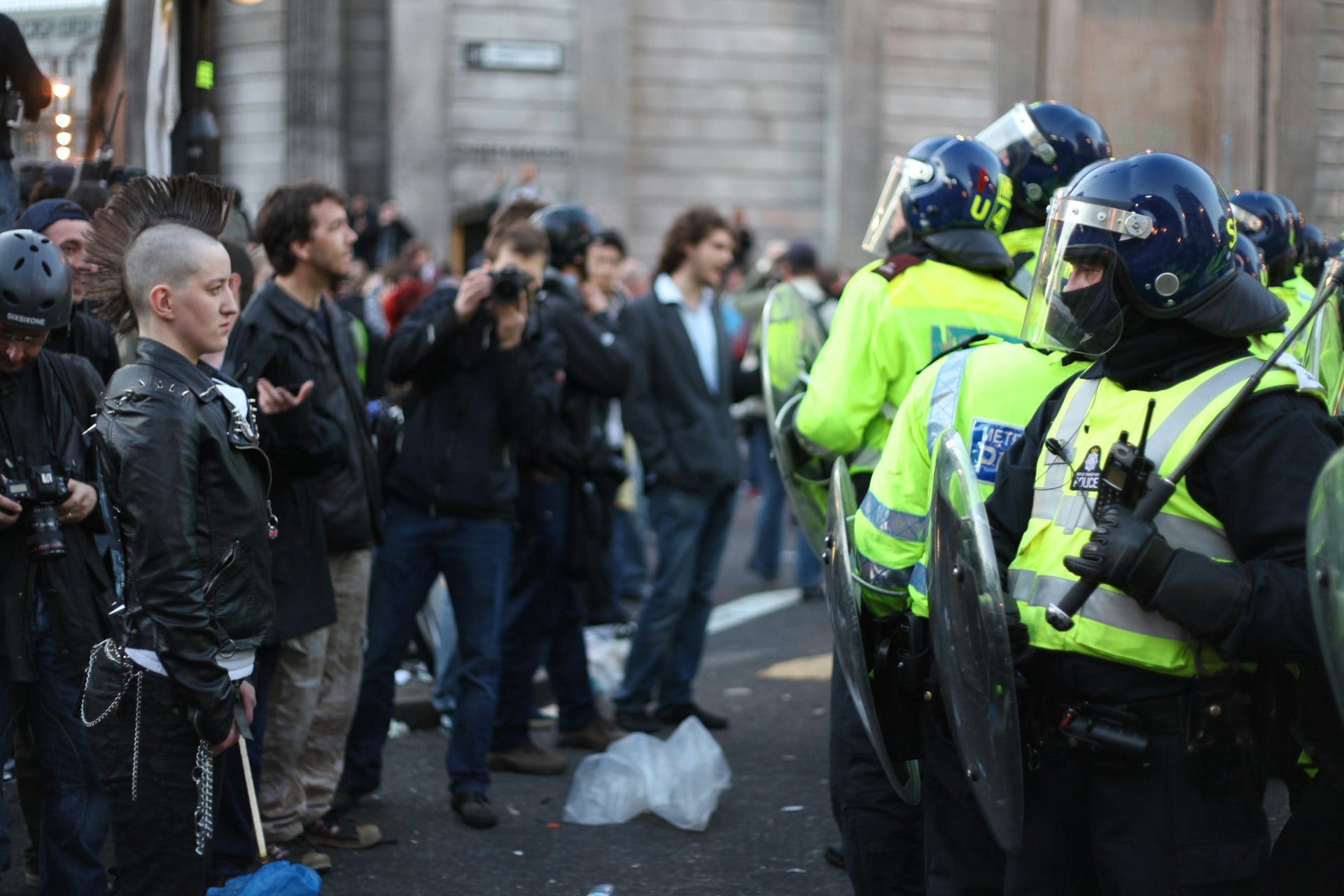
Considering this, we land right back where we started: with the rebel’s paradox. To rebel requires perpetual rebellion, which means submission to a sort of ‘doctrine of rebellion.’
Let’s take punk music: the punk community, spawning from early skinhead movements, ska music, and various alt-rock bands of the 1960s (e.g., the Velvet Underground) served as music’s voice for defiant, polemical, politically charged youth anger. However, by focusing mostly on defiance, those deemed ‘not defiant enough’ were kicked out, creating an in-group; a new status quo, i.e., hegemony. The punk movement would die out over time, its corpse fertilizing various new subcultures.
The anti-gatekeeping gatekeepers killed themselves off.
Similarly, the Soviet Union, early on, ended workers councils (soviets), taking away worker control over the means of production. This is why Trotskyists criticize central planning, calling it state capitalism instead of socialism.
Ironically, Trotsky initially supported these measures, grifting his way through the Bolsheviks’ ranks despite his previously extensive criticism of Bolshevism’s right-leaning tendencies.
In part, the Russian proletariat was nonexistent at the time, meaning socialism couldn’t exist in a fully developed form. Workers councils wouldn’t have made sense, as there weren’t any workers to council. But as the Soviet Union rapidly developed into an industrialized power, workers’ rights only shrank. Stalin initially stripped back any workplace democracy or scientific planning previously implemented under Lenin, and future reforms failed to render the Soviet Union genuinely socialist.
Working-class state hegemony destroyed working-class power.
Is anarchy the solution?
To liberate the working class, and by extension, to liberate oppressed classes everywhere, hegemony itself must be identified as the problem. Material needs may be satisfied. Comforts, like stability, once afforded only by the ruling classes, may be distributed universally and without cost. But it doesn’t matter. The exploitation inherent to class society arises, this time between the state and the worker, the ruler and the ruled. Avoiding this implies not only ending private property, but ending hierarchies of coercive authority.
Chris Harman writes in A People’s History of the World (1999),
Humanity increased its degree of control over nature, but at the price of most people becoming subject to control and exploitation by privileged minority groups.
Such groups could only keep the surplus [resources] in their own hands at times when the whole of society was suffering great hardship if they found ways of imposing their will on the rest of society by establishing coercive structures — states. Control over the surplus provided them with the means to do so, by hiring armed men and investing in expensive techniques such as metal working which could give them a monopoly of the most efficient means of killing.
Armed force is most effective when backed by legal codes and ideologies which sanctify ruling class power by making it seem like the source of people’s livelihoods.
When agriculture emerges, a surplus of resources comes with it. Thus, control and distribution systems for that surplus, with this, the state and a class of police, soldiers, and those who manage them. Class is the immediate consequence of statism. In other words, socialism demands a horizontal — never vertical — distribution of authority. In essence, anarchy. What anarchy looks like depends on who you ask, on historical progression, and on material conditions.
Emma Goldman writes in her essay Anarchism: What It Really Stands for (1911),
It is a living force in the affairs of our life, constantly creating new conditions. The methods of Anarchism therefore do not comprise an iron-clad program to be carried out under all circumstances. Methods must grow out of the economic needs of each place and time, and of the intellectual and temperamental requirements of the individual.
Anarchy isn’t the absence of organization. It’s a new form of organization, based entirely on free association between people whose lives don’t depend on the state, but on each other and themselves. Each person, by freely associating with groups, ideas, and societal roles, without coercion or command, guides society, alongside their groups, in a sort of ‘market of roles.’ What doesn’t need to get done, or what people don’t want to do, doesn’t get done. Groups dedicated to it die out, and vice versa.
This interaction between organizations, which clash in a separate yet necessarily intertwined way, drives the anarchist economy. It’s not democracy, nor is it authority. It’s absolute liberty, not to do as one wishes — like rob, rape, and murder — but to associate as one sees fit.
Goldman writes,
That being the ideal of Anarchism, its economic arrangements must consist of voluntary productive and distributive associations, gradually developing into free communism, as the best means of producing with the least waste of human energy. Anarchism, however, also recognizes the right of the individual, or numbers of individuals, to arrange at all times for other forms of work, in harmony with their tastes and desires.
Trotsky, Stalin, punks, and artistic revolution all have one thing in common: they assume authority isn’t the problem. The punks religiously opposed authority. Yet by doing so, they enforced an anti-authoritarian doctrine. Stalin cultivated a profoundly oppressive political class, and Trotsky assumed a universal socialist hegemony would somehow end hegemony, domination, and exploitation. Each is a case study against replacing domination with domination to destroy domination. History repeats itself over and over again, dialectically. Materialist analysis leads us to one culprit: class. But the state is the mother of class.
Of course, anarchy doesn’t mean all authority disappears. It’s reframed as refusal, but it’s authoritative nonetheless. But the authority anarchy thwarts isn’t hierarchies themselves, but coercion. It’s the absence of commands. The only rule one’s held to is the lack thereof. Respect, community, protection, and so on — they remain. Social norms bind the anarchic commune; people may even pick someone they admire and treat them as a guiding force. But they won’t have a gun to their head, they won’t have a police officer shouting at them to obey.
The structure is hegemonic, but the hierarchy is not — exploitation ceases.
Anarchism destroys itself
Yet, is any of this actually practical? We’ve all heard the criticisms of anarchy: chaos, mayhem, selfishness, and aimless nihilism. But this misunderstands anarchy and the supposed ‘human nature.’ Anarchy can be organized, such as through anarcho-syndicalism’s federalist model. And humans are naturally collaborative, as proven through ancient primitive communism, as well as primitive societies today.
The end goal of any communist ideology is, in that sense, essentially anarchy. The critical aspect of anarchy, dividing it from something like Trotskyism, is the absence of a transitional state. Anarchists topple the state, society is free; socialists topple capitalism, society is free. One goes for everything, the other only eats half.
The Marxist approach risks perpetuating hegemony, but doesn’t anarchy do, too? If society is kept together socially, what if that social element itself grows oppressive? What if conformity to the culture keeping anarchy alive becomes the rule, and a new authority emerges? People, psychologically, cite and rely on authority. The big Other, symbolic order, alongside libidinal obsession, dominate our lives. The state only asks that people truly believe in it. The population must have faith; otherwise, the symbolic systems preventing the state from collapsing in on itself die out.
The state, fundamentally, is the symbolic order formalized: it’s the subjective understanding of symbolic, communal systems, manifested materially.
In other words, a new state structure can emerge without material causes. All it requires is someone manipulative enough to centralize power. So how can anarchy be protected without a regulatory structure? To rephrase, how can anarchy survive without a state? Anarchism demands a rational population, but psychologically, we’re equally irrational and rational. We have a whole subconscious and deeply unreasonable world framing massive portions of who we are and who we will become.
And how can anarchy restructure society and end capitalism while foreign hegemonic systems remain? The anarchic militia can’t defend itself against the United States’ military or the economic force of Western Europe. How can the federalist structure of anarcho-syndicalism keep itself together without a centralized authority? Mutual trust and self-interest, as I’ve established, are cheap compared to the state’s binding power.
How can the working class direct its political interests meaningfully without a vanguard party? Donald Trump’s populism used socialist tendencies and turned them fascistic. How can we prevent such a thing without a vanguard to direct class consciousness?
Anarchy is synonymous with statism, as each breeds its opposite. A socialist worker’s state, one without the hellish totalitarianism of Maoism and Stalinism, may be the only path to genuine liberation: whether from class division, the environmental devastation of climate change, or the emergence of new technologies and conflicts bent on humanity’s destruction.
Capitalism only continues to spread one class from the other, while a vile cabal of oligarchs exploits every resource, including people, they can. The question, however, remains: Where to now?
Climate change is impossible to end with grassroots action — state intervention is necessary. The material causes for climate change are strictly capitalist production; thus, capitalist production must end for climate change to end.
Material inequality, following the state’s death, will likely remain, and a socialist state assigned the task of resolving inequity seems to me like the only path forward.
Anarchy is an ideal, anti-authoritarianism is a necessity, but it’s as much an ideal as it is a tragic fantasy: anarchy is unachievable by anarchist means. Yet, with the virtues of anarchism, we are left with yet another irony: like anarchism, socialism is unachievable by socialist means. The only certainty is that power regurgitates itself.
Politics is a game of contradictions. The key is deciding which side is less wrong than the other.
 Aidan Vanhoof
Leave a comment